

568
M. Saini et al.
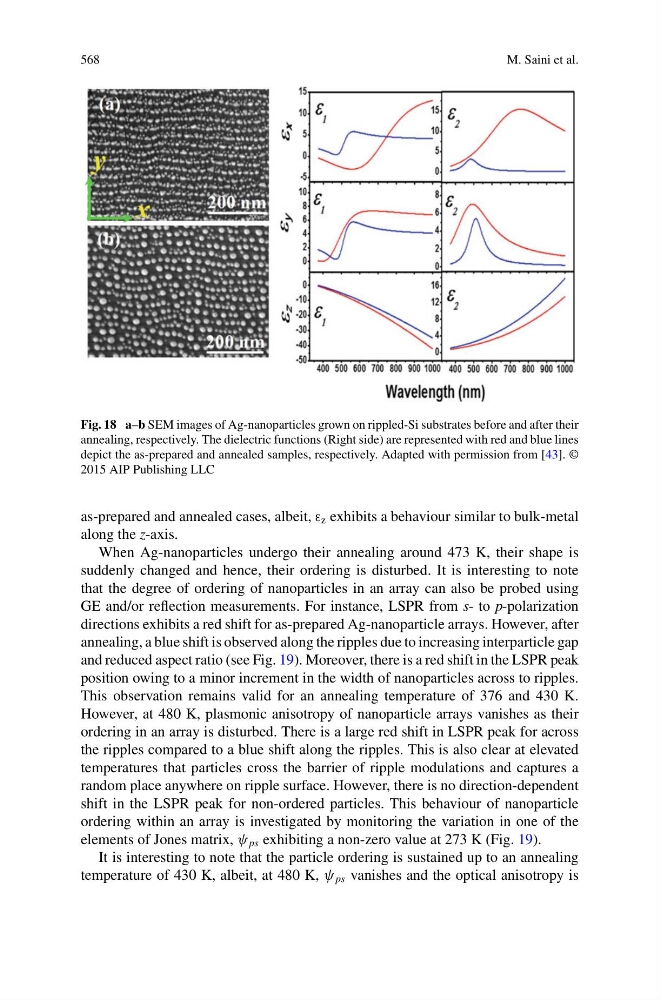
Fig. 18 a–b SEM images of Ag-nanoparticles grown on rippled-Si substrates before and after their
annealing, respectively. The dielectric functions (Right side) are represented with red and blue lines
depict the as-prepared and annealed samples, respectively. Adapted with permission from [43]. ©
2015 AIP Publishing LLC
as-prepared and annealed cases, albeit, ε z exhibits a behaviour similar to bulk-metal
along the z-axis.
When Ag-nanoparticles undergo their annealing around 473 K, their shape is
suddenly changed and hence, their ordering is disturbed. It is interesting to note
that the degree of ordering of nanoparticles in an array can also be probed using
GE and/or reflection measurements. For instance, LSPR from s- to p-polarization
directions exhibits a red shift for as-prepared Ag-nanoparticle arrays. However, after
annealing, a blue shift is observed along the ripples due to increasing interparticle gap
and reduced aspect ratio (see Fig. 19). Moreover, there is a red shift in the LSPR peak
position owing to a minor increment in the width of nanoparticles across to ripples.
This observation remains valid for an annealing temperature of 376 and 430 K.
However, at 480 K, plasmonic anisotropy of nanoparticle arrays vanishes as their
ordering in an array is disturbed. There is a large red shift in LSPR peak for across
the ripples compared to a blue shift along the ripples. This is also clear at elevated
temperatures that particles cross the barrier of ripple modulations and captures a
random place anywhere on ripple surface. However, there is no direction-dependent
shift in the LSPR peak for non-ordered particles. This behaviour of nanoparticle
ordering within an array is investigated by monitoring the variation in one of the
elements of Jones matrix, ψ ps exhibiting a non-zero value at 273 K (Fig. 19).
It is interesting to note that the particle ordering is sustained up to an annealing
temperature of 430 K, albeit, at 480 K, ψ ps vanishes and the optical anisotropy is
M. Saini et al.
Fig. 18 a–b SEM images of Ag-nanoparticles grown on rippled-Si substrates before and after their
annealing, respectively. The dielectric functions (Right side) are represented with red and blue lines
depict the as-prepared and annealed samples, respectively. Adapted with permission from [43]. ©
2015 AIP Publishing LLC
as-prepared and annealed cases, albeit, ε z exhibits a behaviour similar to bulk-metal
along the z-axis.
When Ag-nanoparticles undergo their annealing around 473 K, their shape is
suddenly changed and hence, their ordering is disturbed. It is interesting to note
that the degree of ordering of nanoparticles in an array can also be probed using
GE and/or reflection measurements. For instance, LSPR from s- to p-polarization
directions exhibits a red shift for as-prepared Ag-nanoparticle arrays. However, after
annealing, a blue shift is observed along the ripples due to increasing interparticle gap
and reduced aspect ratio (see Fig. 19). Moreover, there is a red shift in the LSPR peak
position owing to a minor increment in the width of nanoparticles across to ripples.
This observation remains valid for an annealing temperature of 376 and 430 K.
However, at 480 K, plasmonic anisotropy of nanoparticle arrays vanishes as their
ordering in an array is disturbed. There is a large red shift in LSPR peak for across
the ripples compared to a blue shift along the ripples. This is also clear at elevated
temperatures that particles cross the barrier of ripple modulations and captures a
random place anywhere on ripple surface. However, there is no direction-dependent
shift in the LSPR peak for non-ordered particles. This behaviour of nanoparticle
ordering within an array is investigated by monitoring the variation in one of the
elements of Jones matrix, ψ ps exhibiting a non-zero value at 273 K (Fig. 19).
It is interesting to note that the particle ordering is sustained up to an annealing
temperature of 430 K, albeit, at 480 K, ψ ps vanishes and the optical anisotropy is