

Ellipsometry Techniques and Its Advanced Applications …
567
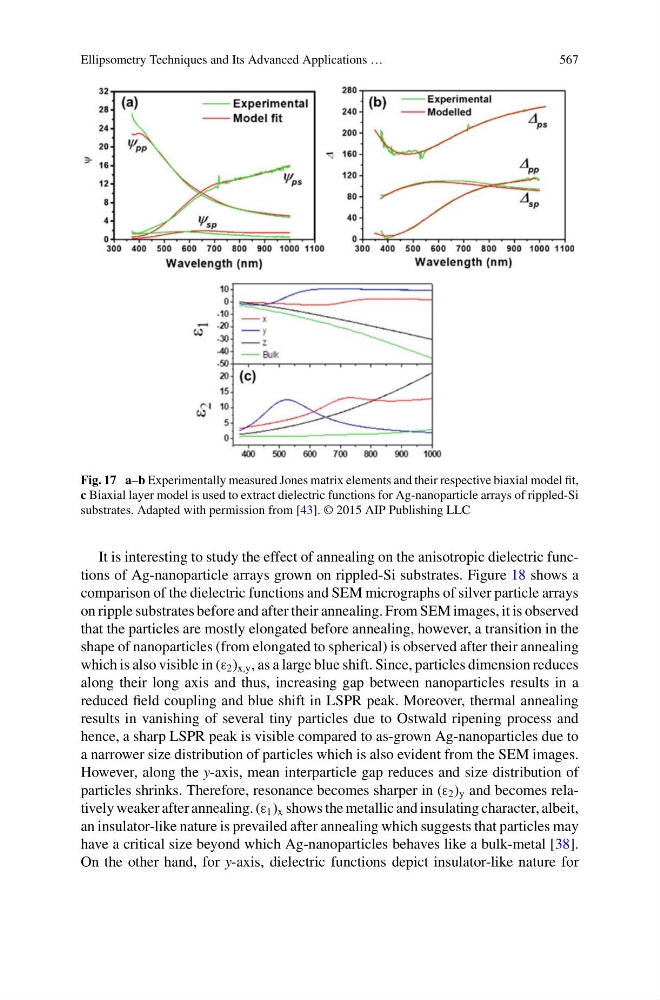
Fig. 17 a–b Experimentally measured Jones matrix elements and their respective biaxial model fit,
c Biaxial layer model is used to extract dielectric functions for Ag-nanoparticle arrays of rippled-Si
substrates. Adapted with permission from [43]. © 2015 AIP Publishing LLC
It is interesting to study the effect of annealing on the anisotropic dielectric functions of Ag-nanoparticle arrays grown on rippled-Si substrates. Figure 18 shows a
comparison of the dielectric functions and SEM micrographs of silver particle arrays
on ripple substrates before and after their annealing. From SEM images, it is observed
that the particles are mostly elongated before annealing, however, a transition in the
shape of nanoparticles (from elongated to spherical) is observed after their annealing
which is also visible in (ε 2 ) x,y , as a large blue shift. Since, particles dimension reduces
along their long axis and thus, increasing gap between nanoparticles results in a
reduced field coupling and blue shift in LSPR peak. Moreover, thermal annealing
results in vanishing of several tiny particles due to Ostwald ripening process and
hence, a sharp LSPR peak is visible compared to as-grown Ag-nanoparticles due to
a narrower size distribution of particles which is also evident from the SEM images.
However, along the y-axis, mean interparticle gap reduces and size distribution of
particles shrinks. Therefore, resonance becomes sharper in (ε 2 ) y and becomes relatively weaker after annealing. (ε 1 ) x shows the metallic and insulating character, albeit,
an insulator-like nature is prevailed after annealing which suggests that particles may
have a critical size beyond which Ag-nanoparticles behaves like a bulk-metal [38].
On the other hand, for y-axis, dielectric functions depict insulator-like nature for
567
Fig. 17 a–b Experimentally measured Jones matrix elements and their respective biaxial model fit,
c Biaxial layer model is used to extract dielectric functions for Ag-nanoparticle arrays of rippled-Si
substrates. Adapted with permission from [43]. © 2015 AIP Publishing LLC
It is interesting to study the effect of annealing on the anisotropic dielectric functions of Ag-nanoparticle arrays grown on rippled-Si substrates. Figure 18 shows a
comparison of the dielectric functions and SEM micrographs of silver particle arrays
on ripple substrates before and after their annealing. From SEM images, it is observed
that the particles are mostly elongated before annealing, however, a transition in the
shape of nanoparticles (from elongated to spherical) is observed after their annealing
which is also visible in (ε 2 ) x,y , as a large blue shift. Since, particles dimension reduces
along their long axis and thus, increasing gap between nanoparticles results in a
reduced field coupling and blue shift in LSPR peak. Moreover, thermal annealing
results in vanishing of several tiny particles due to Ostwald ripening process and
hence, a sharp LSPR peak is visible compared to as-grown Ag-nanoparticles due to
a narrower size distribution of particles which is also evident from the SEM images.
However, along the y-axis, mean interparticle gap reduces and size distribution of
particles shrinks. Therefore, resonance becomes sharper in (ε 2 ) y and becomes relatively weaker after annealing. (ε 1 ) x shows the metallic and insulating character, albeit,
an insulator-like nature is prevailed after annealing which suggests that particles may
have a critical size beyond which Ag-nanoparticles behaves like a bulk-metal [38].
On the other hand, for y-axis, dielectric functions depict insulator-like nature for