

566
M. Saini et al.
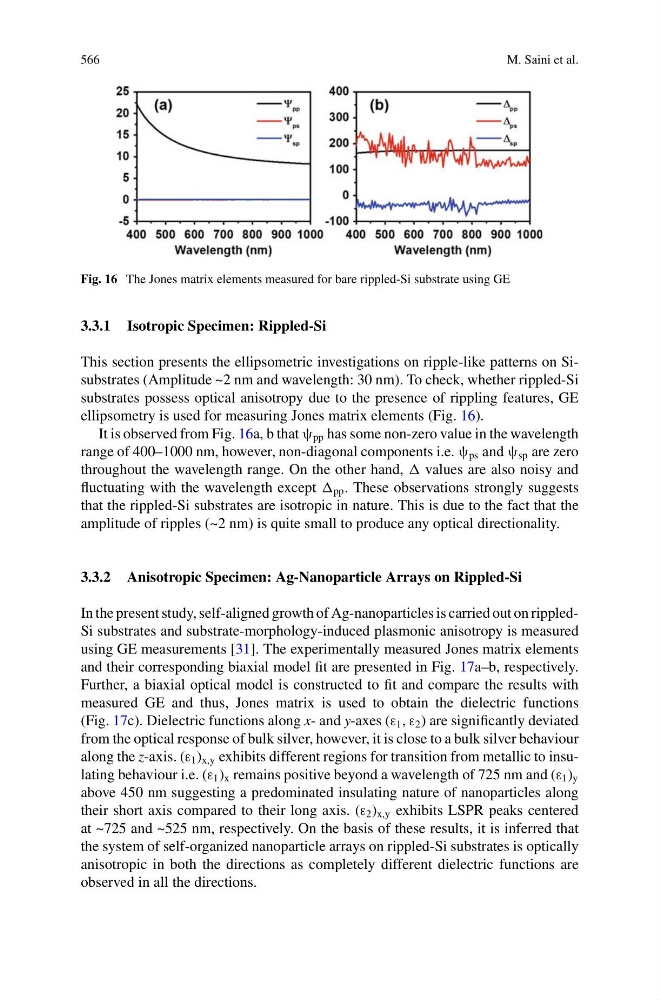
Fig. 16 The Jones matrix elements measured for bare rippled-Si substrate using GE
3.3.1 Isotropic Specimen: Rippled-Si
This section presents the ellipsometric investigations on ripple-like patterns on Sisubstrates (Amplitude ~2 nm and wavelength: 30 nm). To check, whether rippled-Si
substrates possess optical anisotropy due to the presence of rippling features, GE
ellipsometry is used for measuring Jones matrix elements (Fig. 16).
It is observed from Fig. 16a, b that ψ pp has some non-zero value in the wavelength
range of 400–1000 nm, however, non-diagonal components i.e. ψ ps and ψ sp are zero
throughout the wavelength range. On the other hand, values are also noisy and
fluctuating with the wavelength except pp . These observations strongly suggests
that the rippled-Si substrates are isotropic in nature. This is due to the fact that the
amplitude of ripples (~2 nm) is quite small to produce any optical directionality.
3.3.2 Anisotropic Specimen: Ag-Nanoparticle Arrays on Rippled-Si
In the present study, self-aligned growth of Ag-nanoparticles is carried out on rippledSi substrates and substrate-morphology-induced plasmonic anisotropy is measured
using GE measurements [31]. The experimentally measured Jones matrix elements
and their corresponding biaxial model fit are presented in Fig. 17a–b, respectively.
Further, a biaxial optical model is constructed to fit and compare the results with
measured GE and thus, Jones matrix is used to obtain the dielectric functions
(Fig. 17c). Dielectric functions along x- and y-axes (ε 1 , ε 2 ) are significantly deviated
from the optical response of bulk silver, however, it is close to a bulk silver behaviour
along the z-axis. (ε 1 ) x,y exhibits different regions for transition from metallic to insulating behaviour i.e. (ε 1 ) x remains positive beyond a wavelength of 725 nm and (ε 1 ) y
above 450 nm suggesting a predominated insulating nature of nanoparticles along
their short axis compared to their long axis. (ε 2 ) x,y exhibits LSPR peaks centered
at ~725 and ~525 nm, respectively. On the basis of these results, it is inferred that
the system of self-organized nanoparticle arrays on rippled-Si substrates is optically
anisotropic in both the directions as completely different dielectric functions are
observed in all the directions.
M. Saini et al.
Fig. 16 The Jones matrix elements measured for bare rippled-Si substrate using GE
3.3.1 Isotropic Specimen: Rippled-Si
This section presents the ellipsometric investigations on ripple-like patterns on Sisubstrates (Amplitude ~2 nm and wavelength: 30 nm). To check, whether rippled-Si
substrates possess optical anisotropy due to the presence of rippling features, GE
ellipsometry is used for measuring Jones matrix elements (Fig. 16).
It is observed from Fig. 16a, b that ψ pp has some non-zero value in the wavelength
range of 400–1000 nm, however, non-diagonal components i.e. ψ ps and ψ sp are zero
throughout the wavelength range. On the other hand, values are also noisy and
fluctuating with the wavelength except pp . These observations strongly suggests
that the rippled-Si substrates are isotropic in nature. This is due to the fact that the
amplitude of ripples (~2 nm) is quite small to produce any optical directionality.
3.3.2 Anisotropic Specimen: Ag-Nanoparticle Arrays on Rippled-Si
In the present study, self-aligned growth of Ag-nanoparticles is carried out on rippledSi substrates and substrate-morphology-induced plasmonic anisotropy is measured
using GE measurements [31]. The experimentally measured Jones matrix elements
and their corresponding biaxial model fit are presented in Fig. 17a–b, respectively.
Further, a biaxial optical model is constructed to fit and compare the results with
measured GE and thus, Jones matrix is used to obtain the dielectric functions
(Fig. 17c). Dielectric functions along x- and y-axes (ε 1 , ε 2 ) are significantly deviated
from the optical response of bulk silver, however, it is close to a bulk silver behaviour
along the z-axis. (ε 1 ) x,y exhibits different regions for transition from metallic to insulating behaviour i.e. (ε 1 ) x remains positive beyond a wavelength of 725 nm and (ε 1 ) y
above 450 nm suggesting a predominated insulating nature of nanoparticles along
their short axis compared to their long axis. (ε 2 ) x,y exhibits LSPR peaks centered
at ~725 and ~525 nm, respectively. On the basis of these results, it is inferred that
the system of self-organized nanoparticle arrays on rippled-Si substrates is optically
anisotropic in both the directions as completely different dielectric functions are
observed in all the directions.