

Ellipsometry Techniques and Its Advanced Applications …
561
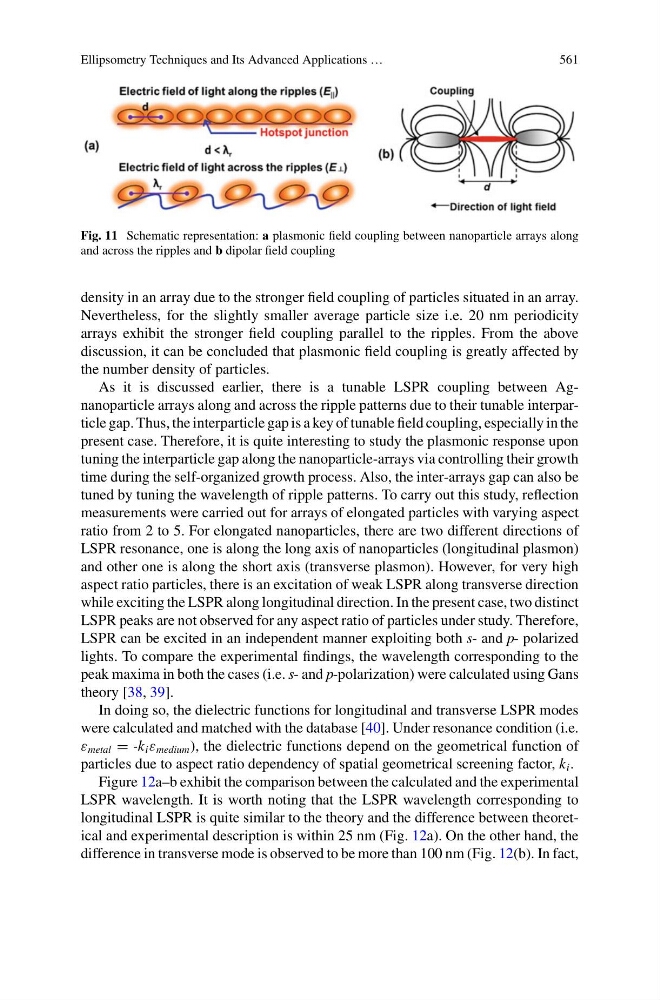
Fig. 11 Schematic representation: a plasmonic field coupling between nanoparticle arrays along
and across the ripples and b dipolar field coupling
density in an array due to the stronger field coupling of particles situated in an array.
Nevertheless, for the slightly smaller average particle size i.e. 20 nm periodicity
arrays exhibit the stronger field coupling parallel to the ripples. From the above
discussion, it can be concluded that plasmonic field coupling is greatly affected by
the number density of particles.
As it is discussed earlier, there is a tunable LSPR coupling between Agnanoparticle arrays along and across the ripple patterns due to their tunable interparticle gap. Thus, the interparticle gap is a key of tunable field coupling, especially in the
present case. Therefore, it is quite interesting to study the plasmonic response upon
tuning the interparticle gap along the nanoparticle-arrays via controlling their growth
time during the self-organized growth process. Also, the inter-arrays gap can also be
tuned by tuning the wavelength of ripple patterns. To carry out this study, reflection
measurements were carried out for arrays of elongated particles with varying aspect
ratio from 2 to 5. For elongated nanoparticles, there are two different directions of
LSPR resonance, one is along the long axis of nanoparticles (longitudinal plasmon)
and other one is along the short axis (transverse plasmon). However, for very high
aspect ratio particles, there is an excitation of weak LSPR along transverse direction
while exciting the LSPR along longitudinal direction. In the present case, two distinct
LSPR peaks are not observed for any aspect ratio of particles under study. Therefore,
LSPR can be excited in an independent manner exploiting both s- and p- polarized
lights. To compare the experimental findings, the wavelength corresponding to the
peak maxima in both the cases (i.e. s- and p-polarization) were calculated using Gans
theory [38, 39].
In doing so, the dielectric functions for longitudinal and transverse LSPR modes
were calculated and matched with the database [40]. Under resonance condition (i.e.
ε metal = -k i ε medium ), the dielectric functions depend on the geometrical function of
particles due to aspect ratio dependency of spatial geometrical screening factor, k i .
Figure 12a–b exhibit the comparison between the calculated and the experimental
LSPR wavelength. It is worth noting that the LSPR wavelength corresponding to
longitudinal LSPR is quite similar to the theory and the difference between theoretical and experimental description is within 25 nm (Fig. 12a). On the other hand, the
difference in transverse mode is observed to be more than 100 nm (Fig. 12(b). In fact,
561
Fig. 11 Schematic representation: a plasmonic field coupling between nanoparticle arrays along
and across the ripples and b dipolar field coupling
density in an array due to the stronger field coupling of particles situated in an array.
Nevertheless, for the slightly smaller average particle size i.e. 20 nm periodicity
arrays exhibit the stronger field coupling parallel to the ripples. From the above
discussion, it can be concluded that plasmonic field coupling is greatly affected by
the number density of particles.
As it is discussed earlier, there is a tunable LSPR coupling between Agnanoparticle arrays along and across the ripple patterns due to their tunable interparticle gap. Thus, the interparticle gap is a key of tunable field coupling, especially in the
present case. Therefore, it is quite interesting to study the plasmonic response upon
tuning the interparticle gap along the nanoparticle-arrays via controlling their growth
time during the self-organized growth process. Also, the inter-arrays gap can also be
tuned by tuning the wavelength of ripple patterns. To carry out this study, reflection
measurements were carried out for arrays of elongated particles with varying aspect
ratio from 2 to 5. For elongated nanoparticles, there are two different directions of
LSPR resonance, one is along the long axis of nanoparticles (longitudinal plasmon)
and other one is along the short axis (transverse plasmon). However, for very high
aspect ratio particles, there is an excitation of weak LSPR along transverse direction
while exciting the LSPR along longitudinal direction. In the present case, two distinct
LSPR peaks are not observed for any aspect ratio of particles under study. Therefore,
LSPR can be excited in an independent manner exploiting both s- and p- polarized
lights. To compare the experimental findings, the wavelength corresponding to the
peak maxima in both the cases (i.e. s- and p-polarization) were calculated using Gans
theory [38, 39].
In doing so, the dielectric functions for longitudinal and transverse LSPR modes
were calculated and matched with the database [40]. Under resonance condition (i.e.
ε metal = -k i ε medium ), the dielectric functions depend on the geometrical function of
particles due to aspect ratio dependency of spatial geometrical screening factor, k i .
Figure 12a–b exhibit the comparison between the calculated and the experimental
LSPR wavelength. It is worth noting that the LSPR wavelength corresponding to
longitudinal LSPR is quite similar to the theory and the difference between theoretical and experimental description is within 25 nm (Fig. 12a). On the other hand, the
difference in transverse mode is observed to be more than 100 nm (Fig. 12(b). In fact,