

562
M. Saini et al.
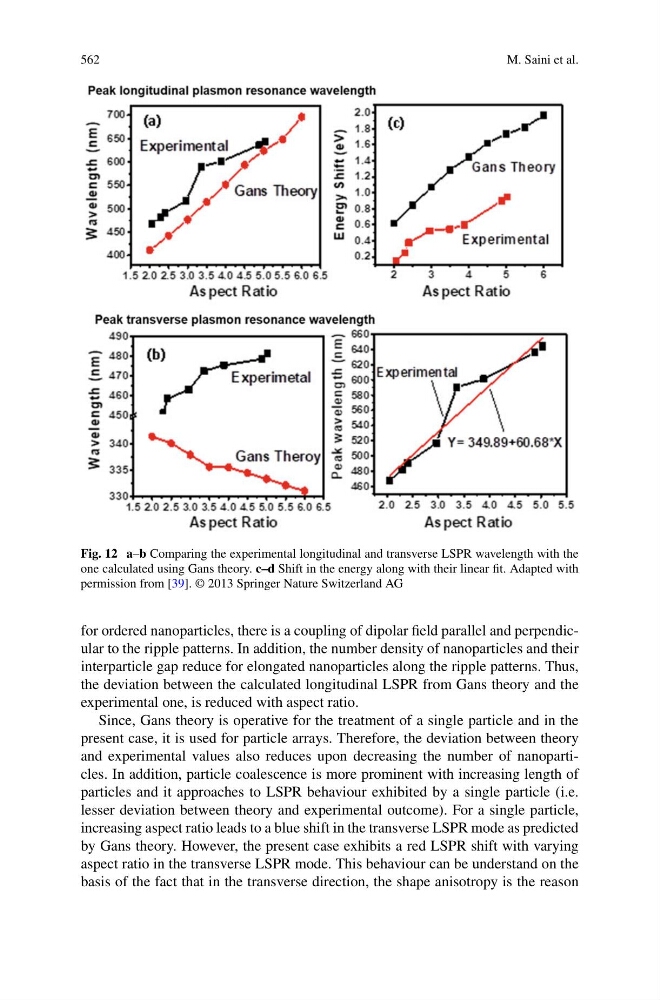
Fig. 12 a–b Comparing the experimental longitudinal and transverse LSPR wavelength with the
one calculated using Gans theory. c–d Shift in the energy along with their linear fit. Adapted with
permission from [39]. © 2013 Springer Nature Switzerland AG
for ordered nanoparticles, there is a coupling of dipolar field parallel and perpendicular to the ripple patterns. In addition, the number density of nanoparticles and their
interparticle gap reduce for elongated nanoparticles along the ripple patterns. Thus,
the deviation between the calculated longitudinal LSPR from Gans theory and the
experimental one, is reduced with aspect ratio.
Since, Gans theory is operative for the treatment of a single particle and in the
present case, it is used for particle arrays. Therefore, the deviation between theory
and experimental values also reduces upon decreasing the number of nanoparticles. In addition, particle coalescence is more prominent with increasing length of
particles and it approaches to LSPR behaviour exhibited by a single particle (i.e.
lesser deviation between theory and experimental outcome). For a single particle,
increasing aspect ratio leads to a blue shift in the transverse LSPR mode as predicted
by Gans theory. However, the present case exhibits a red LSPR shift with varying
aspect ratio in the transverse LSPR mode. This behaviour can be understand on the
basis of the fact that in the transverse direction, the shape anisotropy is the reason
M. Saini et al.
Fig. 12 a–b Comparing the experimental longitudinal and transverse LSPR wavelength with the
one calculated using Gans theory. c–d Shift in the energy along with their linear fit. Adapted with
permission from [39]. © 2013 Springer Nature Switzerland AG
for ordered nanoparticles, there is a coupling of dipolar field parallel and perpendicular to the ripple patterns. In addition, the number density of nanoparticles and their
interparticle gap reduce for elongated nanoparticles along the ripple patterns. Thus,
the deviation between the calculated longitudinal LSPR from Gans theory and the
experimental one, is reduced with aspect ratio.
Since, Gans theory is operative for the treatment of a single particle and in the
present case, it is used for particle arrays. Therefore, the deviation between theory
and experimental values also reduces upon decreasing the number of nanoparticles. In addition, particle coalescence is more prominent with increasing length of
particles and it approaches to LSPR behaviour exhibited by a single particle (i.e.
lesser deviation between theory and experimental outcome). For a single particle,
increasing aspect ratio leads to a blue shift in the transverse LSPR mode as predicted
by Gans theory. However, the present case exhibits a red LSPR shift with varying
aspect ratio in the transverse LSPR mode. This behaviour can be understand on the
basis of the fact that in the transverse direction, the shape anisotropy is the reason