

560
M. Saini et al.
particles exponentially vanishes by increasing the gap between particles [35, 36]. It
can also be observed from Fig. 9c that the field-coupling strength is relatively weaker
for across the ripples case than the one for along the ripples. At the same time, there
is higher number density of particles aligned along the ripples in comparison to the
ones in across the ripples.
Chern et al. have derived a light scattering theory [37], according to which, a
LSPR shift is observed by increasing number density of arranged particles in an array
due to stronger field coupling with increasing number of particles and consequently
making a larger red-shift. Therefore, it is concluded that the strong optical anisotropy
is observed for aligned Ag-nanoparticles due to their tunable particle number density
and/or inter-particle gap along and across the ripple direction. It is worth noting that
the tunable resonance peak shift can also be achieved by tuning the wavelength
of rippled substrates to be used for the growth of metallic nanoparticle arrays. For
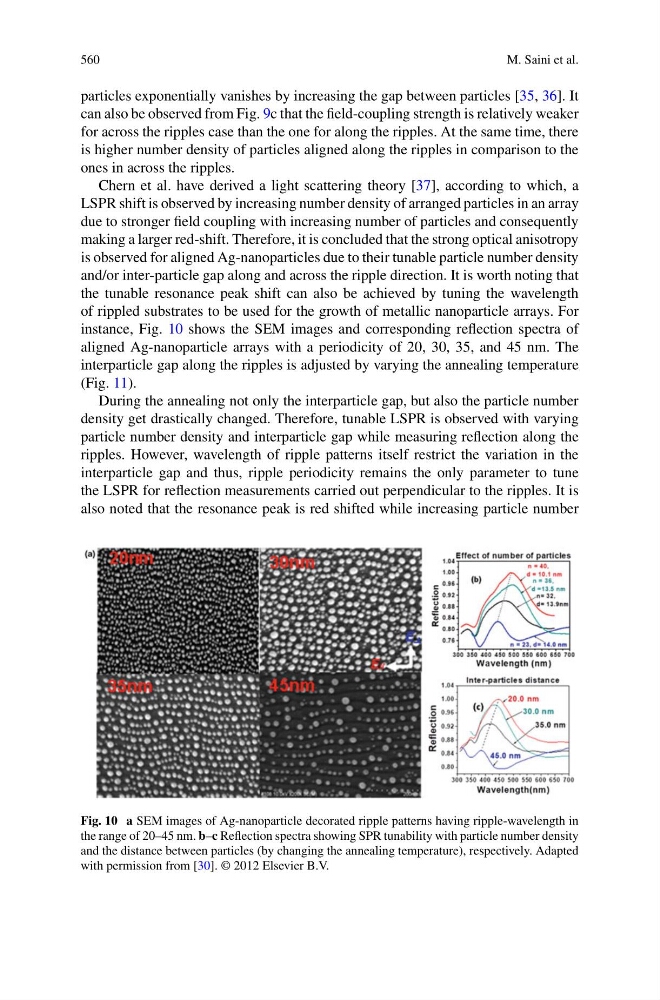
instance, Fig. 10 shows the SEM images and corresponding reflection spectra of
aligned Ag-nanoparticle arrays with a periodicity of 20, 30, 35, and 45 nm. The
interparticle gap along the ripples is adjusted by varying the annealing temperature
(Fig. 11).
During the annealing not only the interparticle gap, but also the particle number
density get drastically changed. Therefore, tunable LSPR is observed with varying
particle number density and interparticle gap while measuring reflection along the
ripples. However, wavelength of ripple patterns itself restrict the variation in the
interparticle gap and thus, ripple periodicity remains the only parameter to tune
the LSPR for reflection measurements carried out perpendicular to the ripples. It is
also noted that the resonance peak is red shifted while increasing particle number
Fig. 10 a SEM images of Ag-nanoparticle decorated ripple patterns having ripple-wavelength in
the range of 20–45 nm. b–c Reflection spectra showing SPR tunability with particle number density
and the distance between particles (by changing the annealing temperature), respectively. Adapted
with permission from [30]. © 2012 Elsevier B.V.
M. Saini et al.
particles exponentially vanishes by increasing the gap between particles [35, 36]. It
can also be observed from Fig. 9c that the field-coupling strength is relatively weaker
for across the ripples case than the one for along the ripples. At the same time, there
is higher number density of particles aligned along the ripples in comparison to the
ones in across the ripples.
Chern et al. have derived a light scattering theory [37], according to which, a
LSPR shift is observed by increasing number density of arranged particles in an array
due to stronger field coupling with increasing number of particles and consequently
making a larger red-shift. Therefore, it is concluded that the strong optical anisotropy
is observed for aligned Ag-nanoparticles due to their tunable particle number density
and/or inter-particle gap along and across the ripple direction. It is worth noting that
the tunable resonance peak shift can also be achieved by tuning the wavelength
of rippled substrates to be used for the growth of metallic nanoparticle arrays. For
instance, Fig. 10 shows the SEM images and corresponding reflection spectra of
aligned Ag-nanoparticle arrays with a periodicity of 20, 30, 35, and 45 nm. The
interparticle gap along the ripples is adjusted by varying the annealing temperature
(Fig. 11).
During the annealing not only the interparticle gap, but also the particle number
density get drastically changed. Therefore, tunable LSPR is observed with varying
particle number density and interparticle gap while measuring reflection along the
ripples. However, wavelength of ripple patterns itself restrict the variation in the
interparticle gap and thus, ripple periodicity remains the only parameter to tune
the LSPR for reflection measurements carried out perpendicular to the ripples. It is
also noted that the resonance peak is red shifted while increasing particle number
Fig. 10 a SEM images of Ag-nanoparticle decorated ripple patterns having ripple-wavelength in
the range of 20–45 nm. b–c Reflection spectra showing SPR tunability with particle number density
and the distance between particles (by changing the annealing temperature), respectively. Adapted
with permission from [30]. © 2012 Elsevier B.V.