

Ellipsometry Techniques and Its Advanced Applications …
559
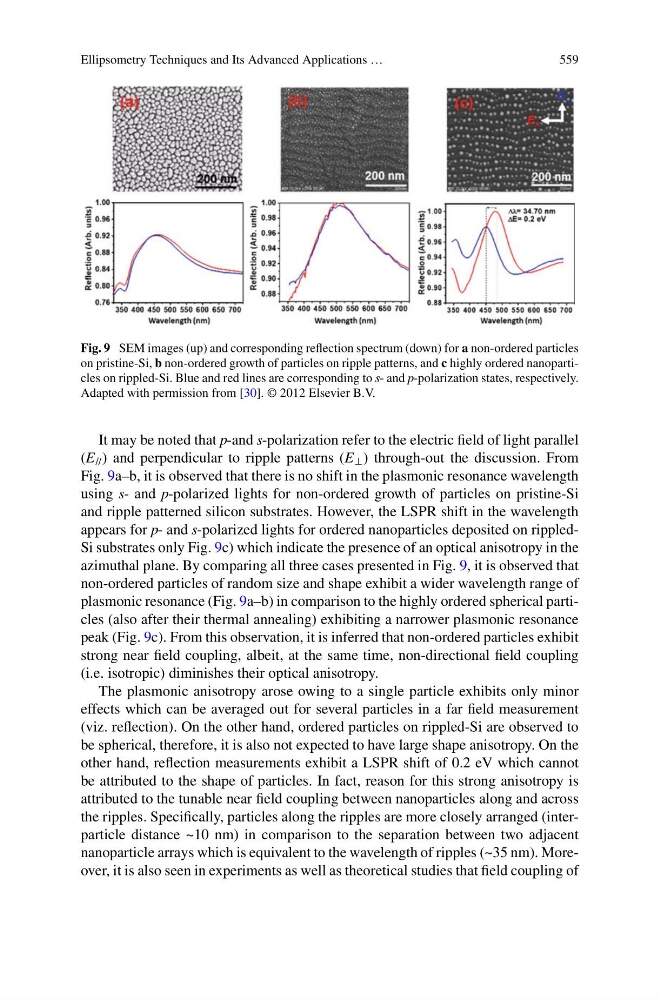
Fig. 9 SEM images (up) and corresponding reflection spectrum (down) for a non-ordered particles
on pristine-Si, b non-ordered growth of particles on ripple patterns, and c highly ordered nanoparticles on rippled-Si. Blue and red lines are corresponding to s- and p-polarization states, respectively.
Adapted with permission from [30]. © 2012 Elsevier B.V.
It may be noted that p-and s-polarization refer to the electric field of light parallel
(E // ) and perpendicular to ripple patterns (E ⊥ ) through-out the discussion. From
Fig. 9a–b, it is observed that there is no shift in the plasmonic resonance wavelength
using s- and p-polarized lights for non-ordered growth of particles on pristine-Si
and ripple patterned silicon substrates. However, the LSPR shift in the wavelength
appears for p- and s-polarized lights for ordered nanoparticles deposited on rippledSi substrates only Fig. 9c) which indicate the presence of an optical anisotropy in the
azimuthal plane. By comparing all three cases presented in Fig. 9, it is observed that
non-ordered particles of random size and shape exhibit a wider wavelength range of
plasmonic resonance (Fig. 9a–b) in comparison to the highly ordered spherical particles (also after their thermal annealing) exhibiting a narrower plasmonic resonance
peak (Fig. 9c). From this observation, it is inferred that non-ordered particles exhibit
strong near field coupling, albeit, at the same time, non-directional field coupling
(i.e. isotropic) diminishes their optical anisotropy.
The plasmonic anisotropy arose owing to a single particle exhibits only minor
effects which can be averaged out for several particles in a far field measurement
(viz. reflection). On the other hand, ordered particles on rippled-Si are observed to
be spherical, therefore, it is also not expected to have large shape anisotropy. On the
other hand, reflection measurements exhibit a LSPR shift of 0.2 eV which cannot
be attributed to the shape of particles. In fact, reason for this strong anisotropy is
attributed to the tunable near field coupling between nanoparticles along and across
the ripples. Specifically, particles along the ripples are more closely arranged (interparticle distance ~10 nm) in comparison to the separation between two adjacent
nanoparticle arrays which is equivalent to the wavelength of ripples (~35 nm). Moreover, it is also seen in experiments as well as theoretical studies that field coupling of
559
Fig. 9 SEM images (up) and corresponding reflection spectrum (down) for a non-ordered particles
on pristine-Si, b non-ordered growth of particles on ripple patterns, and c highly ordered nanoparticles on rippled-Si. Blue and red lines are corresponding to s- and p-polarization states, respectively.
Adapted with permission from [30]. © 2012 Elsevier B.V.
It may be noted that p-and s-polarization refer to the electric field of light parallel
(E // ) and perpendicular to ripple patterns (E ⊥ ) through-out the discussion. From
Fig. 9a–b, it is observed that there is no shift in the plasmonic resonance wavelength
using s- and p-polarized lights for non-ordered growth of particles on pristine-Si
and ripple patterned silicon substrates. However, the LSPR shift in the wavelength
appears for p- and s-polarized lights for ordered nanoparticles deposited on rippledSi substrates only Fig. 9c) which indicate the presence of an optical anisotropy in the
azimuthal plane. By comparing all three cases presented in Fig. 9, it is observed that
non-ordered particles of random size and shape exhibit a wider wavelength range of
plasmonic resonance (Fig. 9a–b) in comparison to the highly ordered spherical particles (also after their thermal annealing) exhibiting a narrower plasmonic resonance
peak (Fig. 9c). From this observation, it is inferred that non-ordered particles exhibit
strong near field coupling, albeit, at the same time, non-directional field coupling
(i.e. isotropic) diminishes their optical anisotropy.
The plasmonic anisotropy arose owing to a single particle exhibits only minor
effects which can be averaged out for several particles in a far field measurement
(viz. reflection). On the other hand, ordered particles on rippled-Si are observed to
be spherical, therefore, it is also not expected to have large shape anisotropy. On the
other hand, reflection measurements exhibit a LSPR shift of 0.2 eV which cannot
be attributed to the shape of particles. In fact, reason for this strong anisotropy is
attributed to the tunable near field coupling between nanoparticles along and across
the ripples. Specifically, particles along the ripples are more closely arranged (interparticle distance ~10 nm) in comparison to the separation between two adjacent
nanoparticle arrays which is equivalent to the wavelength of ripples (~35 nm). Moreover, it is also seen in experiments as well as theoretical studies that field coupling of