

558
M. Saini et al.
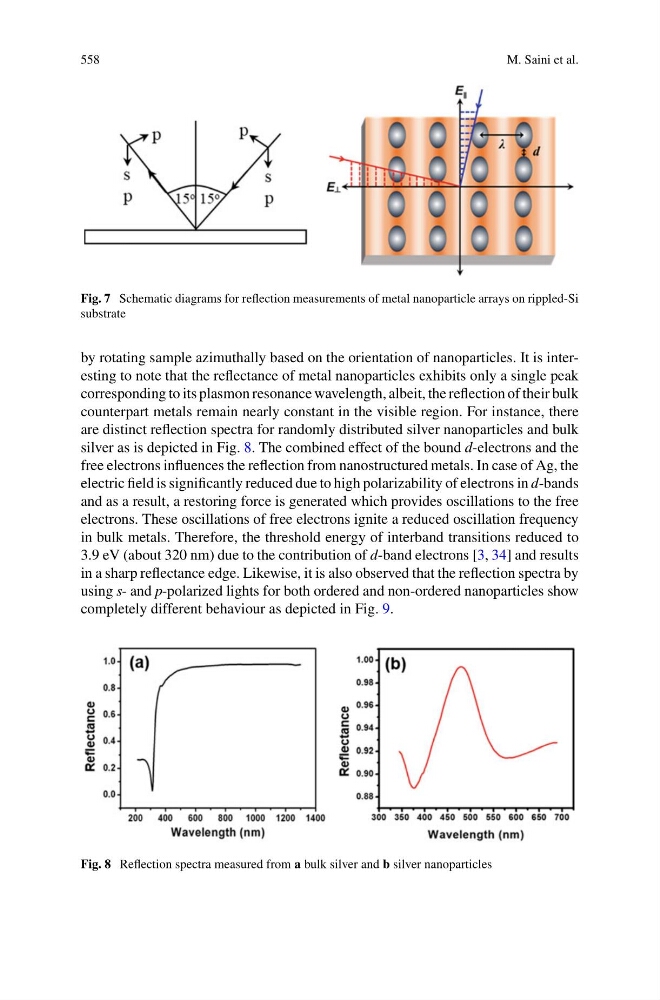
Fig. 7 Schematic diagrams for reflection measurements of metal nanoparticle arrays on rippled-Si
substrate
by rotating sample azimuthally based on the orientation of nanoparticles. It is interesting to note that the reflectance of metal nanoparticles exhibits only a single peak
corresponding to its plasmon resonance wavelength, albeit, the reflection of their bulk
counterpart metals remain nearly constant in the visible region. For instance, there
are distinct reflection spectra for randomly distributed silver nanoparticles and bulk
silver as is depicted in Fig. 8. The combined effect of the bound d-electrons and the
free electrons influences the reflection from nanostructured metals. In case of Ag, the
electric field is significantly reduced due to high polarizability of electrons in d-bands
and as a result, a restoring force is generated which provides oscillations to the free
electrons. These oscillations of free electrons ignite a reduced oscillation frequency
in bulk metals. Therefore, the threshold energy of interband transitions reduced to
3.9 eV (about 320 nm) due to the contribution of d-band electrons [3, 34] and results
in a sharp reflectance edge. Likewise, it is also observed that the reflection spectra by
using s- and p-polarized lights for both ordered and non-ordered nanoparticles show
completely different behaviour as depicted in Fig. 9.
Fig. 8 Reflection spectra measured from a bulk silver and b silver nanoparticles
M. Saini et al.
Fig. 7 Schematic diagrams for reflection measurements of metal nanoparticle arrays on rippled-Si
substrate
by rotating sample azimuthally based on the orientation of nanoparticles. It is interesting to note that the reflectance of metal nanoparticles exhibits only a single peak
corresponding to its plasmon resonance wavelength, albeit, the reflection of their bulk
counterpart metals remain nearly constant in the visible region. For instance, there
are distinct reflection spectra for randomly distributed silver nanoparticles and bulk
silver as is depicted in Fig. 8. The combined effect of the bound d-electrons and the
free electrons influences the reflection from nanostructured metals. In case of Ag, the
electric field is significantly reduced due to high polarizability of electrons in d-bands
and as a result, a restoring force is generated which provides oscillations to the free
electrons. These oscillations of free electrons ignite a reduced oscillation frequency
in bulk metals. Therefore, the threshold energy of interband transitions reduced to
3.9 eV (about 320 nm) due to the contribution of d-band electrons [3, 34] and results
in a sharp reflectance edge. Likewise, it is also observed that the reflection spectra by
using s- and p-polarized lights for both ordered and non-ordered nanoparticles show
completely different behaviour as depicted in Fig. 9.
Fig. 8 Reflection spectra measured from a bulk silver and b silver nanoparticles