

Ellipsometry Techniques and Its Advanced Applications …
555
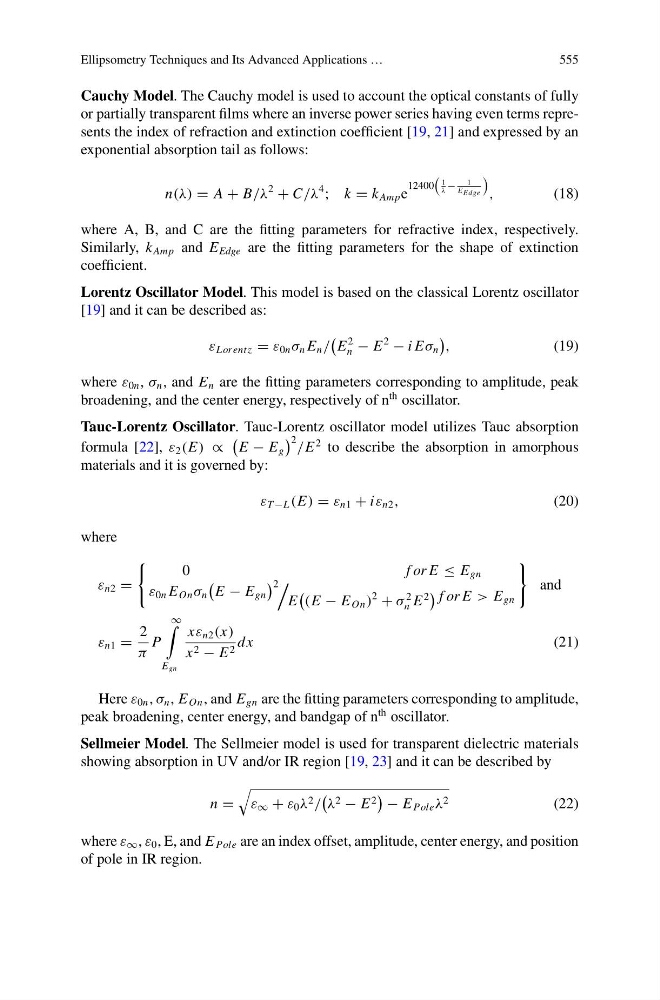
Cauchy Model. The Cauchy model is used to account the optical constants of fully
or partially transparent films where an inverse power series having even terms represents the index of refraction and extinction coefficient [19, 21] and expressed by an
exponential absorption tail as follows:
n(λ) = A + B/λ
2
+ C/λ
4
; k = k Amp e
12400
1
λ −
1
E Edge
,
(18)
where A, B, and C are the fitting parameters for refractive index, respectively.
Similarly, k Amp and E Edge are the fitting parameters for the shape of extinction
coefficient.
Lorentz Oscillator Model. This model is based on the classical Lorentz oscillator
[19] and it can be described as:
ε Lorentz = ε 0n σ n E n /
E
2
n − E
2
− i Eσ n
,
(19)
where ε 0n , σ n , and E n are the fitting parameters corresponding to amplitude, peak
broadening, and the center energy, respectively of n
th oscillator.
Tauc-Lorentz Oscillator. Tauc-Lorentz oscillator model utilizes Tauc absorption
formula [22], ε 2 (E) ∝
E − E g
2 /E
2 to describe the absorption in amorphous
materials and it is governed by:
ε T −L (E) = ε n1 + iε n2 ,
(20)
where
ε n2 =
0
f or E ≤ E gn
ε 0n E On σ n
E − E gn
2
E
(E − E On )
2
+ σ
2
n E
2
f or E > E gn
and
ε n1 =
2
π
P
∞
E gn
xε n2 (x)
x 2 − E 2 dx
(21)
Here ε 0n , σ n , E On , and E gn are the fitting parameters corresponding to amplitude,
peak broadening, center energy, and bandgap of n
th oscillator.
Sellmeier Model. The Sellmeier model is used for transparent dielectric materials
showing absorption in UV and/or IR region [19, 23] and it can be described by
n =
ε ∞ + ε 0 λ 2 /
λ 2 − E 2
− E Pole λ 2
(22)
where ε ∞ , ε 0 , E, and E Pole are an index offset, amplitude, center energy, and position
of pole in IR region.
555
Cauchy Model. The Cauchy model is used to account the optical constants of fully
or partially transparent films where an inverse power series having even terms represents the index of refraction and extinction coefficient [19, 21] and expressed by an
exponential absorption tail as follows:
n(λ) = A + B/λ
2
+ C/λ
4
; k = k Amp e
12400
1
λ −
1
E Edge
,
(18)
where A, B, and C are the fitting parameters for refractive index, respectively.
Similarly, k Amp and E Edge are the fitting parameters for the shape of extinction
coefficient.
Lorentz Oscillator Model. This model is based on the classical Lorentz oscillator
[19] and it can be described as:
ε Lorentz = ε 0n σ n E n /
E
2
n − E
2
− i Eσ n
,
(19)
where ε 0n , σ n , and E n are the fitting parameters corresponding to amplitude, peak
broadening, and the center energy, respectively of n
th oscillator.
Tauc-Lorentz Oscillator. Tauc-Lorentz oscillator model utilizes Tauc absorption
formula [22], ε 2 (E) ∝
E − E g
2 /E
2 to describe the absorption in amorphous
materials and it is governed by:
ε T −L (E) = ε n1 + iε n2 ,
(20)
where
ε n2 =
0
f or E ≤ E gn
ε 0n E On σ n
E − E gn
2
E
(E − E On )
2
+ σ
2
n E
2
f or E > E gn
and
ε n1 =
2
π
P
∞
E gn
xε n2 (x)
x 2 − E 2 dx
(21)
Here ε 0n , σ n , E On , and E gn are the fitting parameters corresponding to amplitude,
peak broadening, center energy, and bandgap of n
th oscillator.
Sellmeier Model. The Sellmeier model is used for transparent dielectric materials
showing absorption in UV and/or IR region [19, 23] and it can be described by
n =
ε ∞ + ε 0 λ 2 /
λ 2 − E 2
− E Pole λ 2
(22)
where ε ∞ , ε 0 , E, and E Pole are an index offset, amplitude, center energy, and position
of pole in IR region.