

556
M. Saini et al.
2.3.2 Effective Medium Theories
Since ellipsometry is quite sensitive to surface or interface roughness, it is quite
important to incorporate the surface and interface structures while constructing an
optical model. Therefore, it is exigent to introduce theories based on effective medium
approximation. According to effective medium theory (EMT) [24, 25], a dielectric
material composed of various phases can be expressed by their effective dielectric
coefficient, ε as:
ε − ε h
ε + γ ε h
=
j
f j
ε j − ε h
ε j + γ ε h
(23)
where γ ~ 2 is the depolarization factor, f j is the volume fraction of j
th material in
the composite and ε h is the dielectric coefficient of host material. The choice of host
material leads to different EMT [25] which are written as:
Lorentz-Lorentz EMT ε h = 1
Maxwell–Garnett EMT ε h = ε 1
Bruggeman EMT
ε h = ε.
3 Applications of Ellipsometry in Plasmonics
3.1 Introduction to Plasmonics
Plasmonics is a branch of optics which deals with the unique optical properties of
materials, specifically, noble metal nanoparticles owing to the excitation of local
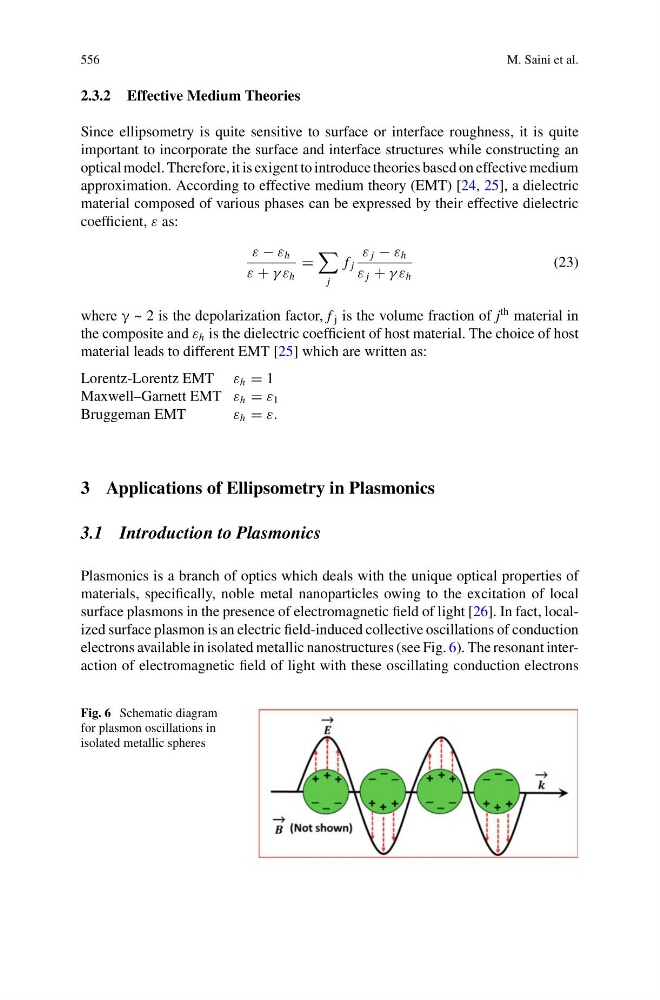
surface plasmons in the presence of electromagnetic field of light [26]. In fact, localized surface plasmon is an electric field-induced collective oscillations of conduction
electrons available in isolated metallic nanostructures (see Fig. 6). The resonant interaction of electromagnetic field of light with these oscillating conduction electrons
Fig. 6 Schematic diagram
for plasmon oscillations in
isolated metallic spheres
M. Saini et al.
2.3.2 Effective Medium Theories
Since ellipsometry is quite sensitive to surface or interface roughness, it is quite
important to incorporate the surface and interface structures while constructing an
optical model. Therefore, it is exigent to introduce theories based on effective medium
approximation. According to effective medium theory (EMT) [24, 25], a dielectric
material composed of various phases can be expressed by their effective dielectric
coefficient, ε as:
ε − ε h
ε + γ ε h
=
j
f j
ε j − ε h
ε j + γ ε h
(23)
where γ ~ 2 is the depolarization factor, f j is the volume fraction of j
th material in
the composite and ε h is the dielectric coefficient of host material. The choice of host
material leads to different EMT [25] which are written as:
Lorentz-Lorentz EMT ε h = 1
Maxwell–Garnett EMT ε h = ε 1
Bruggeman EMT
ε h = ε.
3 Applications of Ellipsometry in Plasmonics
3.1 Introduction to Plasmonics
Plasmonics is a branch of optics which deals with the unique optical properties of
materials, specifically, noble metal nanoparticles owing to the excitation of local
surface plasmons in the presence of electromagnetic field of light [26]. In fact, localized surface plasmon is an electric field-induced collective oscillations of conduction
electrons available in isolated metallic nanostructures (see Fig. 6). The resonant interaction of electromagnetic field of light with these oscillating conduction electrons
Fig. 6 Schematic diagram
for plasmon oscillations in
isolated metallic spheres