

554
M. Saini et al.
directly [3, 7, 9, 10]. The mathematical description of Mueller matrix is provided in
Sect. 1.2.5. For instance, optically isotropic specimen have only three independent
components present in the Mueller matrix which are essentially the Stokes vectors
and thus, single RCE measurement is sufficient to measure all of them. On the other
hand, there are six independent components present in the Mueller matrix for an
optically anisotropic specimen. However, there is a need of seven components of
Mueller matrix for an anisotropic specimen having depolarization effect also. Thus,
Mueller matrix ellipsometry instrument is essential for complete analysis of an optically anisotropic specimen. In addition, imaging of Mueller matrix components can
also be carried out against light wavelength or angle of incidence by measuring
reflection intensity in two-dimensional plane using a CCD camera.
2.3 Dielectric Function Models and Effective Medium
Theories
Optical model is an essential part of ellipsometry to correctly interpret the data
directly obtained from an ellipsometer into known physical parameters. The optical
model fit needs sufficient information of the specimen and also time consuming.
There are various well-defined dielectric function models and effective medium
theories which are the building-blocks of a proposed optical model. In fact, dielectric
function models are chosen on the basis of the conductivity nature (i.e. metal, semiconductor, or insulator) and transparency of the specimen. In addition, the composition of specimen including diffusion, intermixing, and alloy formation are taken
care by the effective medium theories.
2.3.1 Dielectric Function Models
There are various well-defined dielectric function models [3, 15, 18] viz. Drude
model, Cauchy model, Lorentz oscillator, Tauc-Lorentz oscillator etc. which needs
to be chosen in an optical model on the basis of the conductivity behaviour and the
transparency of the specimen. Some of the popular dielectric function models are
briefly explained in the following sections.
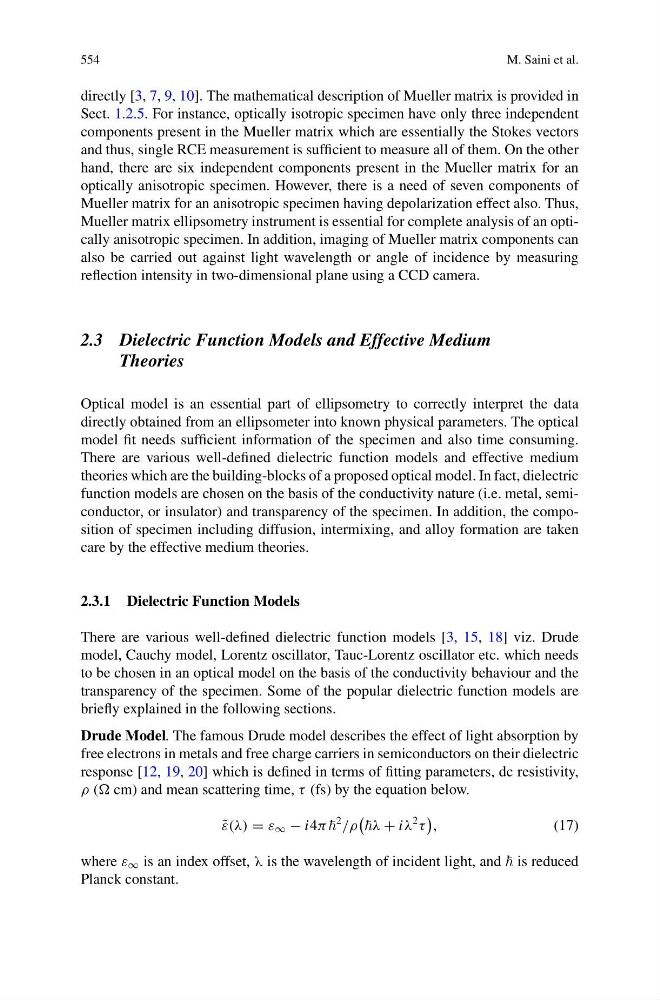
Drude Model. The famous Drude model describes the effect of light absorption by
free electrons in metals and free charge carriers in semiconductors on their dielectric
response [12, 19, 20] which is defined in terms of fitting parameters, dc resistivity,
ρ ( cm) and mean scattering time, τ (fs) by the equation below.
˜
ε(λ) = ε ∞ − i4π
2
/ρ
λ + iλ
2
τ
,
(17)
where ε ∞ is an index offset, λ is the wavelength of incident light, and is reduced
Planck constant.
M. Saini et al.
directly [3, 7, 9, 10]. The mathematical description of Mueller matrix is provided in
Sect. 1.2.5. For instance, optically isotropic specimen have only three independent
components present in the Mueller matrix which are essentially the Stokes vectors
and thus, single RCE measurement is sufficient to measure all of them. On the other
hand, there are six independent components present in the Mueller matrix for an
optically anisotropic specimen. However, there is a need of seven components of
Mueller matrix for an anisotropic specimen having depolarization effect also. Thus,
Mueller matrix ellipsometry instrument is essential for complete analysis of an optically anisotropic specimen. In addition, imaging of Mueller matrix components can
also be carried out against light wavelength or angle of incidence by measuring
reflection intensity in two-dimensional plane using a CCD camera.
2.3 Dielectric Function Models and Effective Medium
Theories
Optical model is an essential part of ellipsometry to correctly interpret the data
directly obtained from an ellipsometer into known physical parameters. The optical
model fit needs sufficient information of the specimen and also time consuming.
There are various well-defined dielectric function models and effective medium
theories which are the building-blocks of a proposed optical model. In fact, dielectric
function models are chosen on the basis of the conductivity nature (i.e. metal, semiconductor, or insulator) and transparency of the specimen. In addition, the composition of specimen including diffusion, intermixing, and alloy formation are taken
care by the effective medium theories.
2.3.1 Dielectric Function Models
There are various well-defined dielectric function models [3, 15, 18] viz. Drude
model, Cauchy model, Lorentz oscillator, Tauc-Lorentz oscillator etc. which needs
to be chosen in an optical model on the basis of the conductivity behaviour and the
transparency of the specimen. Some of the popular dielectric function models are
briefly explained in the following sections.
Drude Model. The famous Drude model describes the effect of light absorption by
free electrons in metals and free charge carriers in semiconductors on their dielectric
response [12, 19, 20] which is defined in terms of fitting parameters, dc resistivity,
ρ ( cm) and mean scattering time, τ (fs) by the equation below.
˜
ε(λ) = ε ∞ − i4π
2
/ρ
λ + iλ
2
τ
,
(17)
where ε ∞ is an index offset, λ is the wavelength of incident light, and is reduced
Planck constant.