

Ellipsometry Techniques and Its Advanced Applications …
543
and redistribute their energy in such a way that some distinct points in the medium
get minimum intensity and other distinct points have maximum intensity of light
then this phenomenon is called interference of light.
1.2 Polarization of Light
Polarization of light is a phenomenon caused due to the wave nature of light that
specifies the geometrical orientation of the oscillations taking place perpendicular
to the direction of the wave propagation [2]. Electromagnetic waves are transverse
in nature i.e. it has oscillating electric field
E and magnetic field
B in the planes
perpendicular to each other as well as mutually perpendicular to the direction of
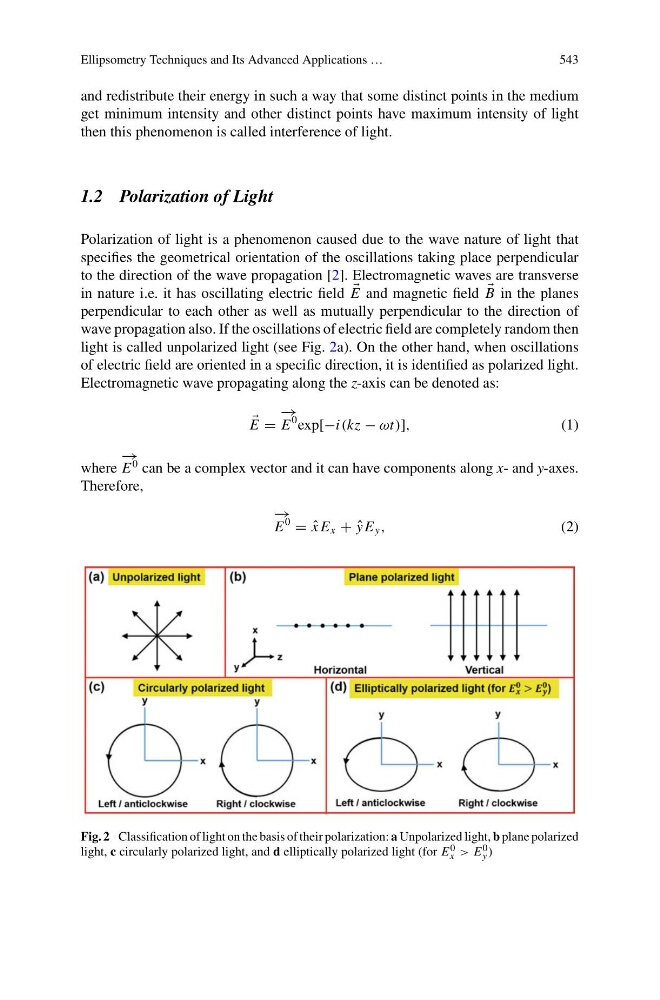
wave propagation also. If the oscillations of electric field are completely random then
light is called unpolarized light (see Fig. 2a). On the other hand, when oscillations
of electric field are oriented in a specific direction, it is identified as polarized light.
Electromagnetic wave propagating along the z-axis can be denoted as:
E =
− →
E
0 exp[−i(kz − ωt)],
(1)
where
− →
E
0 can be a complex vector and it can have components along x- and y-axes.
Therefore,
− →
E
0
= ˆ
x E x + ˆ
y E y ,
(2)
Fig. 2 Classification of light on the basis of their polarization: a Unpolarized light, b plane polarized
light, c circularly polarized light, and d elliptically polarized light (for E 0
x > E 0
y )
543
and redistribute their energy in such a way that some distinct points in the medium
get minimum intensity and other distinct points have maximum intensity of light
then this phenomenon is called interference of light.
1.2 Polarization of Light
Polarization of light is a phenomenon caused due to the wave nature of light that
specifies the geometrical orientation of the oscillations taking place perpendicular
to the direction of the wave propagation [2]. Electromagnetic waves are transverse
in nature i.e. it has oscillating electric field
E and magnetic field
B in the planes
perpendicular to each other as well as mutually perpendicular to the direction of
wave propagation also. If the oscillations of electric field are completely random then
light is called unpolarized light (see Fig. 2a). On the other hand, when oscillations
of electric field are oriented in a specific direction, it is identified as polarized light.
Electromagnetic wave propagating along the z-axis can be denoted as:
E =
− →
E
0 exp[−i(kz − ωt)],
(1)
where
− →
E
0 can be a complex vector and it can have components along x- and y-axes.
Therefore,
− →
E
0
= ˆ
x E x + ˆ
y E y ,
(2)
Fig. 2 Classification of light on the basis of their polarization: a Unpolarized light, b plane polarized
light, c circularly polarized light, and d elliptically polarized light (for E 0
x > E 0
y )