

542
M. Saini et al.
[1]. The word “optic” is originated from a Greek word “Optik´ os”, which refers to
the word “seen”. Light is not only a medium to uncover the objects to our eyes,
but also an electromagnetic wave covering the ultraviolet (UV), visible, and near
infrared (NIR) region of the electromagnetic spectrum. However, the particle nature
of light is also well accepted and photon is considered as the quanta of light. Thus,
the dual nature of light can be explained from various phenomenon of light such
as reflection, refraction, interference, diffraction, photoelectric effect etc. which are
briefly discussed in upcoming sections.
Now-a-days, the growing knowledge and understanding in the field of optics
led to new horizons in developing versatile instrumentation (viz. UV–Visible-NIR
spectroscopy, fluorescence spectroscopy, spectroscopic ellipsometry, Raman spectroscopy, Fourier-transform infrared spectroscopy etc.) for probing various physical properties and thus, advancing the development of intriguing applications. This
chapter deals with spectroscopic ellipsometry and its applications in characterizing
isotropic and anisotropic specimen for plasmonics-based advanced applications.
1.1 Propagation of Light
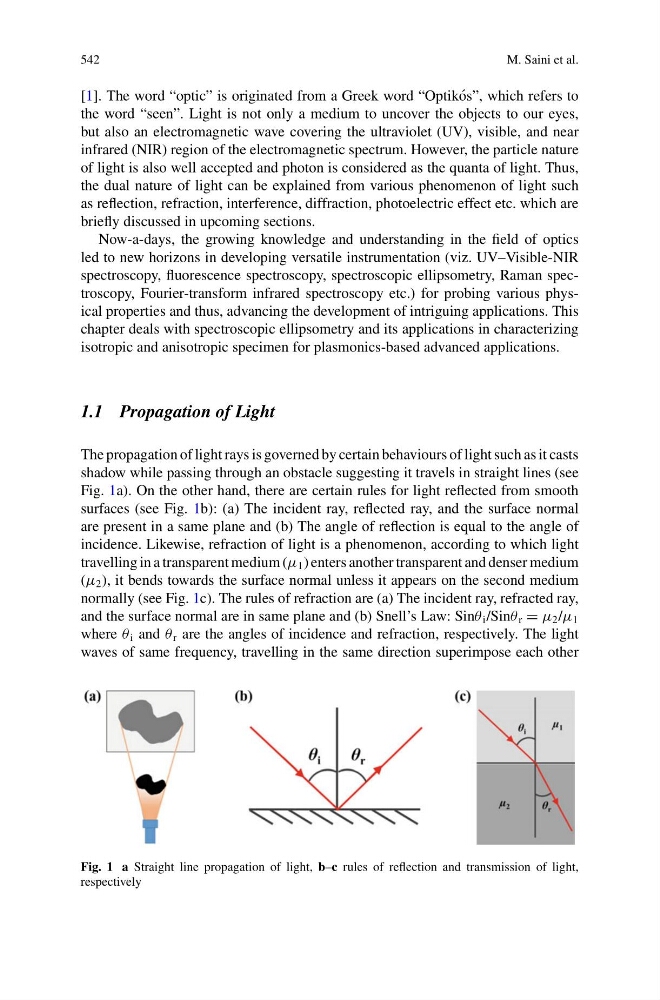
The propagation of light rays is governed by certain behaviours of light such as it casts
shadow while passing through an obstacle suggesting it travels in straight lines (see
Fig. 1a). On the other hand, there are certain rules for light reflected from smooth
surfaces (see Fig. 1b): (a) The incident ray, reflected ray, and the surface normal
are present in a same plane and (b) The angle of reflection is equal to the angle of
incidence. Likewise, refraction of light is a phenomenon, according to which light
travelling in a transparent medium (μ 1 ) enters another transparent and denser medium
(μ 2 ), it bends towards the surface normal unless it appears on the second medium
normally (see Fig. 1c). The rules of refraction are (a) The incident ray, refracted ray,
and the surface normal are in same plane and (b) Snell’s Law: Sinθ i /Sinθ r = μ 2 /μ 1
where θ i and θ r are the angles of incidence and refraction, respectively. The light
waves of same frequency, travelling in the same direction superimpose each other
Fig. 1 a Straight line propagation of light, b–c rules of reflection and transmission of light,
respectively
M. Saini et al.
[1]. The word “optic” is originated from a Greek word “Optik´ os”, which refers to
the word “seen”. Light is not only a medium to uncover the objects to our eyes,
but also an electromagnetic wave covering the ultraviolet (UV), visible, and near
infrared (NIR) region of the electromagnetic spectrum. However, the particle nature
of light is also well accepted and photon is considered as the quanta of light. Thus,
the dual nature of light can be explained from various phenomenon of light such
as reflection, refraction, interference, diffraction, photoelectric effect etc. which are
briefly discussed in upcoming sections.
Now-a-days, the growing knowledge and understanding in the field of optics
led to new horizons in developing versatile instrumentation (viz. UV–Visible-NIR
spectroscopy, fluorescence spectroscopy, spectroscopic ellipsometry, Raman spectroscopy, Fourier-transform infrared spectroscopy etc.) for probing various physical properties and thus, advancing the development of intriguing applications. This
chapter deals with spectroscopic ellipsometry and its applications in characterizing
isotropic and anisotropic specimen for plasmonics-based advanced applications.
1.1 Propagation of Light
The propagation of light rays is governed by certain behaviours of light such as it casts
shadow while passing through an obstacle suggesting it travels in straight lines (see
Fig. 1a). On the other hand, there are certain rules for light reflected from smooth
surfaces (see Fig. 1b): (a) The incident ray, reflected ray, and the surface normal
are present in a same plane and (b) The angle of reflection is equal to the angle of
incidence. Likewise, refraction of light is a phenomenon, according to which light
travelling in a transparent medium (μ 1 ) enters another transparent and denser medium
(μ 2 ), it bends towards the surface normal unless it appears on the second medium
normally (see Fig. 1c). The rules of refraction are (a) The incident ray, refracted ray,
and the surface normal are in same plane and (b) Snell’s Law: Sinθ i /Sinθ r = μ 2 /μ 1
where θ i and θ r are the angles of incidence and refraction, respectively. The light
waves of same frequency, travelling in the same direction superimpose each other
Fig. 1 a Straight line propagation of light, b–c rules of reflection and transmission of light,
respectively