

544
M. Saini et al.
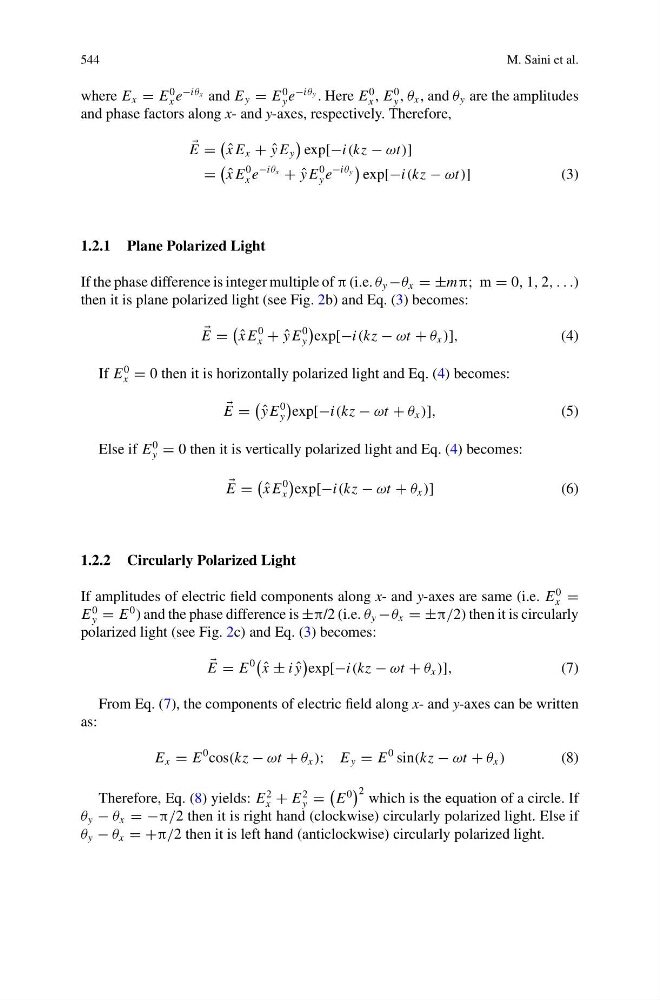
where E x = E
0
x e
−iθ x and E y = E
0
y e
−iθ y . Here E
0
x , E
0
y , θ x , and θ y are the amplitudes
and phase factors along x- and y-axes, respectively. Therefore,
E =
ˆ
x E x + ˆ
y E y
exp[−i(kz − ωt)]
=
ˆ
x E
0
x e
−iθ x + ˆ
y E
0
y e
−iθ y
exp[−i(kz − ωt)]
(3)
1.2.1 Plane Polarized Light
If the phase difference is integer multiple of π (i.e. θ y −θ x = ±mπ; m = 0, 1, 2, . . .)
then it is plane polarized light (see Fig. 2b) and Eq. (3) becomes:
E =
ˆ
x E
0
x + ˆ
y E
0
y
exp[−i(kz − ωt + θ x )],
(4)
If E
0
x = 0 then it is horizontally polarized light and Eq. (4) becomes:
E =
ˆ
y E
0
y
exp[−i(kz − ωt + θ x )],
(5)
Else if E
0
y = 0 then it is vertically polarized light and Eq. (4) becomes:
E =
ˆ
x E
0
x
exp[−i(kz − ωt + θ x )]
(6)
1.2.2 Circularly Polarized Light
If amplitudes of electric field components along x- and y-axes are same (i.e. E
0
x =
E
0
y = E
0 ) and the phase difference is ±π/2 (i.e. θ y −θ x = ±π/2) then it is circularly
polarized light (see Fig. 2c) and Eq. (3) becomes:
E = E
0
ˆ
x ± i ˆ
y
exp[−i(kz − ωt + θ x )],
(7)
From Eq. (7), the components of electric field along x- and y-axes can be written
as:
E x = E
0 cos(kz − ωt + θ x ); E y = E
0 sin(kz − ωt + θ x )
(8)
Therefore, Eq. (8) yields: E
2
x + E
2
y =
E
0
2 which is the equation of a circle. If
θ y − θ x = −π/2 then it is right hand (clockwise) circularly polarized light. Else if
θ y − θ x = +π/2 then it is left hand (anticlockwise) circularly polarized light.
M. Saini et al.
where E x = E
0
x e
−iθ x and E y = E
0
y e
−iθ y . Here E
0
x , E
0
y , θ x , and θ y are the amplitudes
and phase factors along x- and y-axes, respectively. Therefore,
E =
ˆ
x E x + ˆ
y E y
exp[−i(kz − ωt)]
=
ˆ
x E
0
x e
−iθ x + ˆ
y E
0
y e
−iθ y
exp[−i(kz − ωt)]
(3)
1.2.1 Plane Polarized Light
If the phase difference is integer multiple of π (i.e. θ y −θ x = ±mπ; m = 0, 1, 2, . . .)
then it is plane polarized light (see Fig. 2b) and Eq. (3) becomes:
E =
ˆ
x E
0
x + ˆ
y E
0
y
exp[−i(kz − ωt + θ x )],
(4)
If E
0
x = 0 then it is horizontally polarized light and Eq. (4) becomes:
E =
ˆ
y E
0
y
exp[−i(kz − ωt + θ x )],
(5)
Else if E
0
y = 0 then it is vertically polarized light and Eq. (4) becomes:
E =
ˆ
x E
0
x
exp[−i(kz − ωt + θ x )]
(6)
1.2.2 Circularly Polarized Light
If amplitudes of electric field components along x- and y-axes are same (i.e. E
0
x =
E
0
y = E
0 ) and the phase difference is ±π/2 (i.e. θ y −θ x = ±π/2) then it is circularly
polarized light (see Fig. 2c) and Eq. (3) becomes:
E = E
0
ˆ
x ± i ˆ
y
exp[−i(kz − ωt + θ x )],
(7)
From Eq. (7), the components of electric field along x- and y-axes can be written
as:
E x = E
0 cos(kz − ωt + θ x ); E y = E
0 sin(kz − ωt + θ x )
(8)
Therefore, Eq. (8) yields: E
2
x + E
2
y =
E
0
2 which is the equation of a circle. If
θ y − θ x = −π/2 then it is right hand (clockwise) circularly polarized light. Else if
θ y − θ x = +π/2 then it is left hand (anticlockwise) circularly polarized light.