

Impedance Spectroscopy
535
4.3 Characterization of Anisotropic Materials
IS is applied for characterization of anisotropic molecules such as liquid crystals
(LCs) which are dual in nature. LCs display rheological behaviour similar to liquids
as well as they have quasi long-range order that can be either orientational or positional or both, resembling crystalline solids. IS can easily deduce the anisotropic
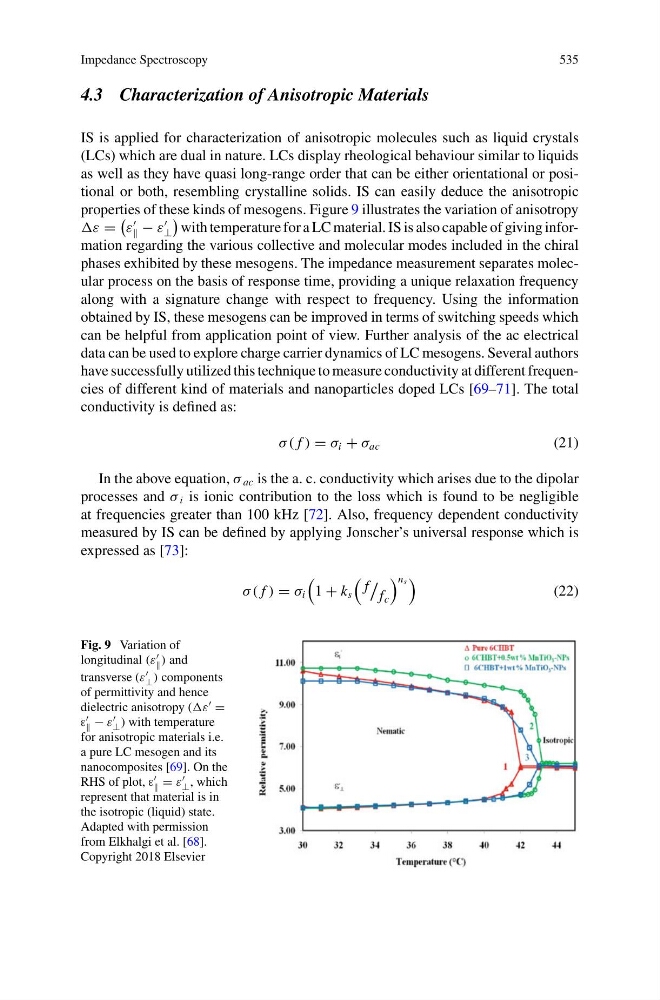
properties of these kinds of mesogens. Figure 9 illustrates the variation of anisotropy
ε =
ε
− ε
⊥
with temperature for a LC material. IS is also capable of giving information regarding the various collective and molecular modes included in the chiral
phases exhibited by these mesogens. The impedance measurement separates molecular process on the basis of response time, providing a unique relaxation frequency
along with a signature change with respect to frequency. Using the information
obtained by IS, these mesogens can be improved in terms of switching speeds which
can be helpful from application point of view. Further analysis of the ac electrical
data can be used to explore charge carrier dynamics of LC mesogens. Several authors
have successfully utilized this technique to measure conductivity at different frequencies of different kind of materials and nanoparticles doped LCs [69–71]. The total
conductivity is defined as:
σ ( f ) = σ i + σ ac
(21)
In the above equation, σ ac is the a. c. conductivity which arises due to the dipolar
processes and σ i is ionic contribution to the loss which is found to be negligible
at frequencies greater than 100 kHz [72]. Also, frequency dependent conductivity
measured by IS can be defined by applying Jonscher’s universal response which is
expressed as [73]:
σ ( f ) = σ i
1 + k s
f
f c
n s
(22)
Fig. 9 Variation of
longitudinal (ε
) and
transverse (ε
⊥ ) components
of permittivity and hence
dielectric anisotropy (ε =
ε
− ε
⊥ ) with temperature
for anisotropic materials i.e.
a pure LC mesogen and its
nanocomposites [69]. On the
RHS of plot, ε
= ε
⊥ , which
represent that material is in
the isotropic (liquid) state.
Adapted with permission
from Elkhalgi et al. [68].
Copyright 2018 Elsevier
535
4.3 Characterization of Anisotropic Materials
IS is applied for characterization of anisotropic molecules such as liquid crystals
(LCs) which are dual in nature. LCs display rheological behaviour similar to liquids
as well as they have quasi long-range order that can be either orientational or positional or both, resembling crystalline solids. IS can easily deduce the anisotropic
properties of these kinds of mesogens. Figure 9 illustrates the variation of anisotropy
ε =
ε
− ε
⊥
with temperature for a LC material. IS is also capable of giving information regarding the various collective and molecular modes included in the chiral
phases exhibited by these mesogens. The impedance measurement separates molecular process on the basis of response time, providing a unique relaxation frequency
along with a signature change with respect to frequency. Using the information
obtained by IS, these mesogens can be improved in terms of switching speeds which
can be helpful from application point of view. Further analysis of the ac electrical
data can be used to explore charge carrier dynamics of LC mesogens. Several authors
have successfully utilized this technique to measure conductivity at different frequencies of different kind of materials and nanoparticles doped LCs [69–71]. The total
conductivity is defined as:
σ ( f ) = σ i + σ ac
(21)
In the above equation, σ ac is the a. c. conductivity which arises due to the dipolar
processes and σ i is ionic contribution to the loss which is found to be negligible
at frequencies greater than 100 kHz [72]. Also, frequency dependent conductivity
measured by IS can be defined by applying Jonscher’s universal response which is
expressed as [73]:
σ ( f ) = σ i
1 + k s
f
f c
n s
(22)
Fig. 9 Variation of
longitudinal (ε
) and
transverse (ε
⊥ ) components
of permittivity and hence
dielectric anisotropy (ε =
ε
− ε
⊥ ) with temperature
for anisotropic materials i.e.
a pure LC mesogen and its
nanocomposites [69]. On the
RHS of plot, ε
= ε
⊥ , which
represent that material is in
the isotropic (liquid) state.
Adapted with permission
from Elkhalgi et al. [68].
Copyright 2018 Elsevier