

536
N. Yadav and R. Dhar
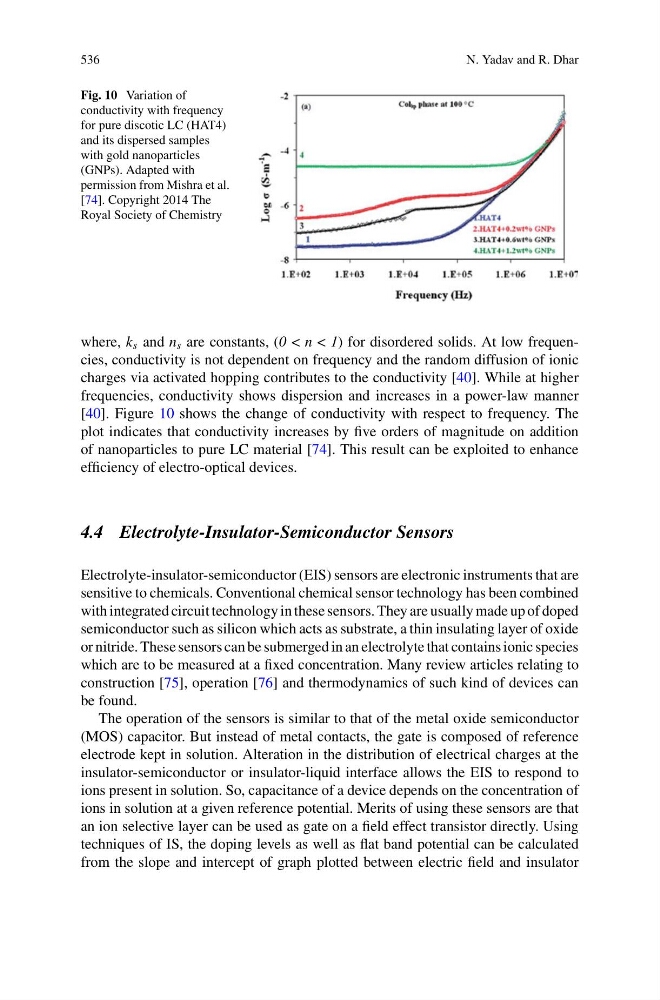
Fig. 10 Variation of
conductivity with frequency
for pure discotic LC (HAT4)
and its dispersed samples
with gold nanoparticles
(GNPs). Adapted with
permission from Mishra et al.
[74]. Copyright 2014 The
Royal Society of Chemistry
where, k s and n s are constants, (0 < n < 1) for disordered solids. At low frequencies, conductivity is not dependent on frequency and the random diffusion of ionic
charges via activated hopping contributes to the conductivity [40]. While at higher
frequencies, conductivity shows dispersion and increases in a power-law manner
[40]. Figure 10 shows the change of conductivity with respect to frequency. The
plot indicates that conductivity increases by five orders of magnitude on addition
of nanoparticles to pure LC material [74]. This result can be exploited to enhance
efficiency of electro-optical devices.
4.4 Electrolyte-Insulator-Semiconductor Sensors
Electrolyte-insulator-semiconductor (EIS) sensors are electronic instruments that are
sensitive to chemicals. Conventional chemical sensor technology has been combined
with integrated circuit technology in these sensors. They are usually made up of doped
semiconductor such as silicon which acts as substrate, a thin insulating layer of oxide
or nitride. These sensors can be submerged in an electrolyte that contains ionic species
which are to be measured at a fixed concentration. Many review articles relating to
construction [75], operation [76] and thermodynamics of such kind of devices can
be found.
The operation of the sensors is similar to that of the metal oxide semiconductor
(MOS) capacitor. But instead of metal contacts, the gate is composed of reference
electrode kept in solution. Alteration in the distribution of electrical charges at the
insulator-semiconductor or insulator-liquid interface allows the EIS to respond to
ions present in solution. So, capacitance of a device depends on the concentration of
ions in solution at a given reference potential. Merits of using these sensors are that
an ion selective layer can be used as gate on a field effect transistor directly. Using
techniques of IS, the doping levels as well as flat band potential can be calculated
from the slope and intercept of graph plotted between electric field and insulator
N. Yadav and R. Dhar
Fig. 10 Variation of
conductivity with frequency
for pure discotic LC (HAT4)
and its dispersed samples
with gold nanoparticles
(GNPs). Adapted with
permission from Mishra et al.
[74]. Copyright 2014 The
Royal Society of Chemistry
where, k s and n s are constants, (0 < n < 1) for disordered solids. At low frequencies, conductivity is not dependent on frequency and the random diffusion of ionic
charges via activated hopping contributes to the conductivity [40]. While at higher
frequencies, conductivity shows dispersion and increases in a power-law manner
[40]. Figure 10 shows the change of conductivity with respect to frequency. The
plot indicates that conductivity increases by five orders of magnitude on addition
of nanoparticles to pure LC material [74]. This result can be exploited to enhance
efficiency of electro-optical devices.
4.4 Electrolyte-Insulator-Semiconductor Sensors
Electrolyte-insulator-semiconductor (EIS) sensors are electronic instruments that are
sensitive to chemicals. Conventional chemical sensor technology has been combined
with integrated circuit technology in these sensors. They are usually made up of doped
semiconductor such as silicon which acts as substrate, a thin insulating layer of oxide
or nitride. These sensors can be submerged in an electrolyte that contains ionic species
which are to be measured at a fixed concentration. Many review articles relating to
construction [75], operation [76] and thermodynamics of such kind of devices can
be found.
The operation of the sensors is similar to that of the metal oxide semiconductor
(MOS) capacitor. But instead of metal contacts, the gate is composed of reference
electrode kept in solution. Alteration in the distribution of electrical charges at the
insulator-semiconductor or insulator-liquid interface allows the EIS to respond to
ions present in solution. So, capacitance of a device depends on the concentration of
ions in solution at a given reference potential. Merits of using these sensors are that
an ion selective layer can be used as gate on a field effect transistor directly. Using
techniques of IS, the doping levels as well as flat band potential can be calculated
from the slope and intercept of graph plotted between electric field and insulator