

Nuclear Magnetic Resonance Spectroscopy: Theory and Applications
499
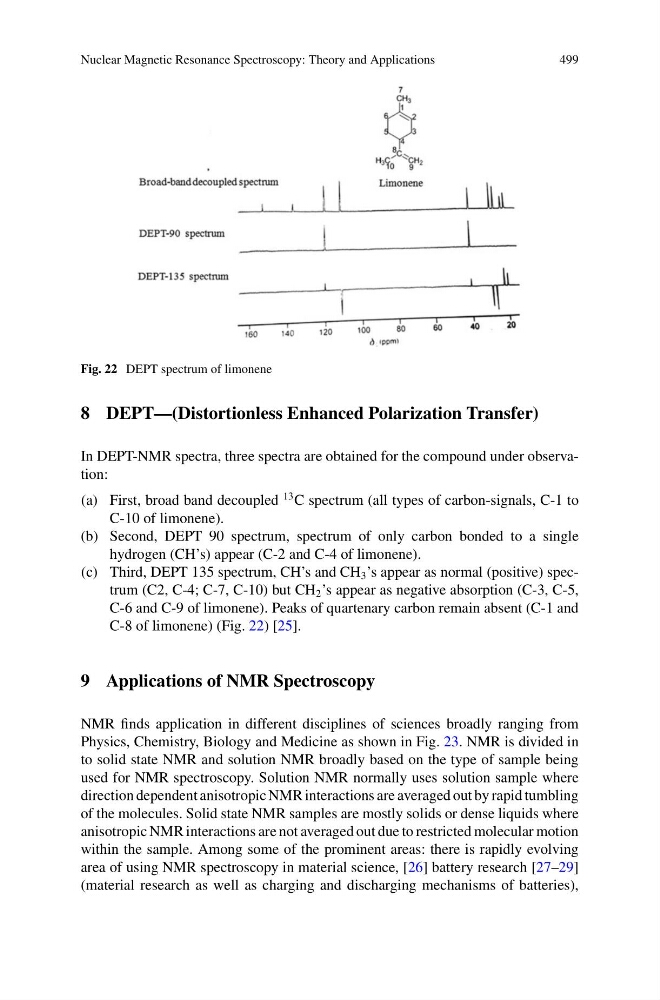
Fig. 22 DEPT spectrum of limonene
8 DEPT—(Distortionless Enhanced Polarization Transfer)
In DEPT-NMR spectra, three spectra are obtained for the compound under observation:
(a) First, broad band decoupled
13 C spectrum (all types of carbon-signals, C-1 to
C-10 of limonene).
(b) Second, DEPT 90 spectrum, spectrum of only carbon bonded to a single
hydrogen (CH’s) appear (C-2 and C-4 of limonene).
(c) Third, DEPT 135 spectrum, CH’s and CH 3 ’s appear as normal (positive) spectrum (C2, C-4; C-7, C-10) but CH 2 ’s appear as negative absorption (C-3, C-5,
C-6 and C-9 of limonene). Peaks of quartenary carbon remain absent (C-1 and
C-8 of limonene) (Fig. 22) [25].
9 Applications of NMR Spectroscopy
NMR finds application in different disciplines of sciences broadly ranging from
Physics, Chemistry, Biology and Medicine as shown in Fig. 23. NMR is divided in
to solid state NMR and solution NMR broadly based on the type of sample being
used for NMR spectroscopy. Solution NMR normally uses solution sample where
direction dependent anisotropic NMR interactions are averaged out by rapid tumbling
of the molecules. Solid state NMR samples are mostly solids or dense liquids where
anisotropic NMR interactions are not averaged out due to restricted molecular motion
within the sample. Among some of the prominent areas: there is rapidly evolving
area of using NMR spectroscopy in material science, [26] battery research [27–29]
(material research as well as charging and discharging mechanisms of batteries),
499
Fig. 22 DEPT spectrum of limonene
8 DEPT—(Distortionless Enhanced Polarization Transfer)
In DEPT-NMR spectra, three spectra are obtained for the compound under observation:
(a) First, broad band decoupled
13 C spectrum (all types of carbon-signals, C-1 to
C-10 of limonene).
(b) Second, DEPT 90 spectrum, spectrum of only carbon bonded to a single
hydrogen (CH’s) appear (C-2 and C-4 of limonene).
(c) Third, DEPT 135 spectrum, CH’s and CH 3 ’s appear as normal (positive) spectrum (C2, C-4; C-7, C-10) but CH 2 ’s appear as negative absorption (C-3, C-5,
C-6 and C-9 of limonene). Peaks of quartenary carbon remain absent (C-1 and
C-8 of limonene) (Fig. 22) [25].
9 Applications of NMR Spectroscopy
NMR finds application in different disciplines of sciences broadly ranging from
Physics, Chemistry, Biology and Medicine as shown in Fig. 23. NMR is divided in
to solid state NMR and solution NMR broadly based on the type of sample being
used for NMR spectroscopy. Solution NMR normally uses solution sample where
direction dependent anisotropic NMR interactions are averaged out by rapid tumbling
of the molecules. Solid state NMR samples are mostly solids or dense liquids where
anisotropic NMR interactions are not averaged out due to restricted molecular motion
within the sample. Among some of the prominent areas: there is rapidly evolving
area of using NMR spectroscopy in material science, [26] battery research [27–29]
(material research as well as charging and discharging mechanisms of batteries),