

498
M. Rashid et al.
Simplification of such complex spectra is achieved by following
1 H nucleus
decoupling techniques.
7.4.1 Broad-Band Hydrogen (or Protons) Decoupling
Carbon-Hydrogen (C–H) coupling is removed by this technique by irradiating the
sample with the band of radiofrequency radiation that can excite all the proton-nuclei.
It leads to rapid flipping of protons between two spin-states (α to β state) having net
magnetic field orientation ‘zero’. As a result no coupling occurs with the
13 C-carbon
and each-peak appears as a singlet. For e.g. in a magnetic field of 58,750G, carbon13 resonate at 62.8 MHz while hydrogen at 250 MHz. To generate off-resonance
proton decoupled spectrum, the first radiofrequency signal (62.8 MHz) is used to
produce
13 C nuclei in resonance, while exposure of second-signal of radiofrequency
250 MHz at the same time causes all the proton nuclei to rapid flip of their α ↔ β
state transition state to average their magnetic-field contribution. Overall result is the
absence of coupling.
7.4.2 Off-resonance Coupling
Broad-band decoupling involves complete removal of coupling between
13 C–
1 H
nuclei and hence observation of
13 C-simplified spectra with information of nonequivalent
13 C nucleus. One of the drawbacks of broad-band decoupling is less of
information which may arise due to
13 C–
1 H coupling.
Off-resonance decoupling technique produces simplified
13 C-spectrum with
coupling of
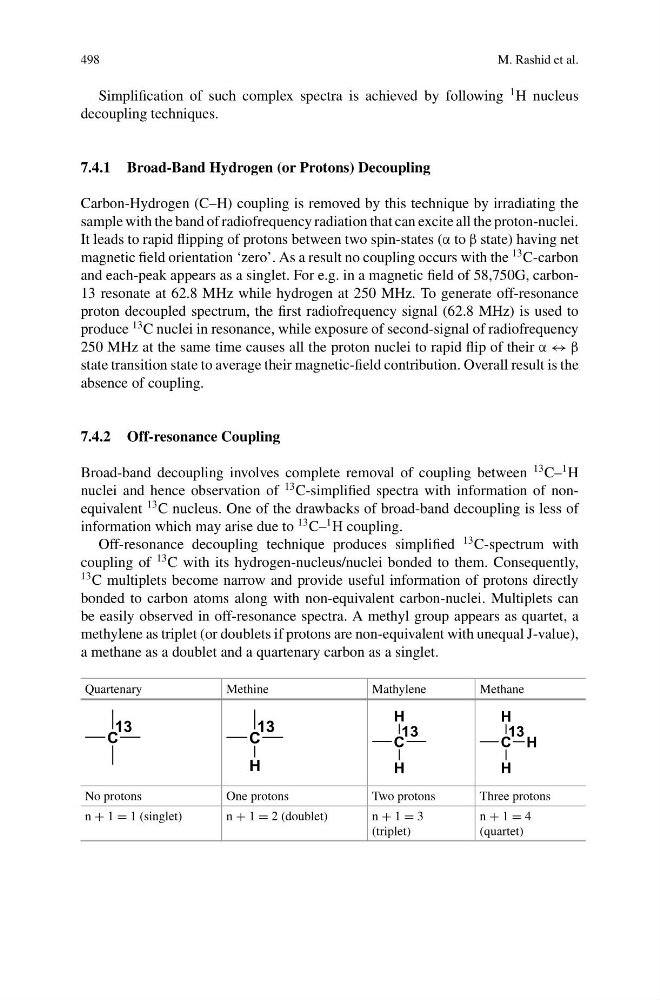
13 C with its hydrogen-nucleus/nuclei bonded to them. Consequently,
13 C multiplets become narrow and provide useful information of protons directly
bonded to carbon atoms along with non-equivalent carbon-nuclei. Multiplets can
be easily observed in off-resonance spectra. A methyl group appears as quartet, a
methylene as triplet (or doublets if protons are non-equivalent with unequal J-value),
a methane as a doublet and a quartenary carbon as a singlet.
Quartenary
Methine
Mathylene
Methane
C
13
C
H
13
C
H
H
13
C
H
H
H
13
No protons
One protons
Two protons
Three protons
n + 1 = 1 (singlet)
n + 1 = 2 (doublet)
n + 1 = 3
(triplet)
n + 1 = 4
(quartet)
M. Rashid et al.
Simplification of such complex spectra is achieved by following
1 H nucleus
decoupling techniques.
7.4.1 Broad-Band Hydrogen (or Protons) Decoupling
Carbon-Hydrogen (C–H) coupling is removed by this technique by irradiating the
sample with the band of radiofrequency radiation that can excite all the proton-nuclei.
It leads to rapid flipping of protons between two spin-states (α to β state) having net
magnetic field orientation ‘zero’. As a result no coupling occurs with the
13 C-carbon
and each-peak appears as a singlet. For e.g. in a magnetic field of 58,750G, carbon13 resonate at 62.8 MHz while hydrogen at 250 MHz. To generate off-resonance
proton decoupled spectrum, the first radiofrequency signal (62.8 MHz) is used to
produce
13 C nuclei in resonance, while exposure of second-signal of radiofrequency
250 MHz at the same time causes all the proton nuclei to rapid flip of their α ↔ β
state transition state to average their magnetic-field contribution. Overall result is the
absence of coupling.
7.4.2 Off-resonance Coupling
Broad-band decoupling involves complete removal of coupling between
13 C–
1 H
nuclei and hence observation of
13 C-simplified spectra with information of nonequivalent
13 C nucleus. One of the drawbacks of broad-band decoupling is less of
information which may arise due to
13 C–
1 H coupling.
Off-resonance decoupling technique produces simplified
13 C-spectrum with
coupling of
13 C with its hydrogen-nucleus/nuclei bonded to them. Consequently,
13 C multiplets become narrow and provide useful information of protons directly
bonded to carbon atoms along with non-equivalent carbon-nuclei. Multiplets can
be easily observed in off-resonance spectra. A methyl group appears as quartet, a
methylene as triplet (or doublets if protons are non-equivalent with unequal J-value),
a methane as a doublet and a quartenary carbon as a singlet.
Quartenary
Methine
Mathylene
Methane
C
13
C
H
13
C
H
H
13
C
H
H
H
13
No protons
One protons
Two protons
Three protons
n + 1 = 1 (singlet)
n + 1 = 2 (doublet)
n + 1 = 3
(triplet)
n + 1 = 4
(quartet)