

484
M. Rashid et al.
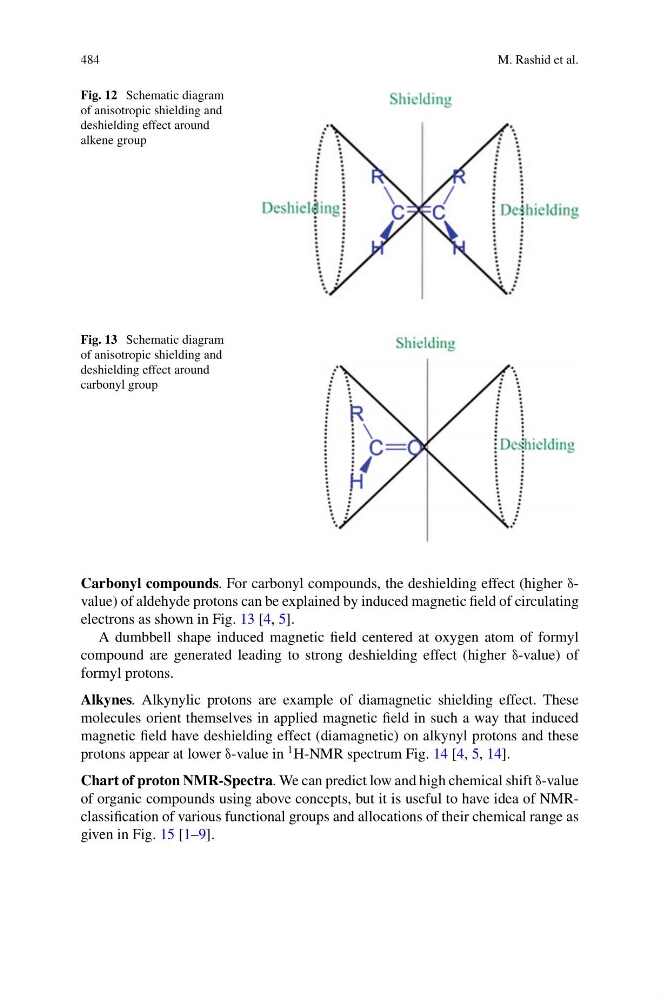
Fig. 12 Schematic diagram
of anisotropic shielding and
deshielding effect around
alkene group
Fig. 13 Schematic diagram
of anisotropic shielding and
deshielding effect around
carbonyl group
Carbonyl compounds. For carbonyl compounds, the deshielding effect (higher δvalue) of aldehyde protons can be explained by induced magnetic field of circulating
electrons as shown in Fig. 13 [4, 5].
A dumbbell shape induced magnetic field centered at oxygen atom of formyl
compound are generated leading to strong deshielding effect (higher δ-value) of
formyl protons.
Alkynes. Alkynylic protons are example of diamagnetic shielding effect. These
molecules orient themselves in applied magnetic field in such a way that induced
magnetic field have deshielding effect (diamagnetic) on alkynyl protons and these
protons appear at lower δ-value in
1 H-NMR spectrum Fig. 14 [4, 5, 14].
Chart of proton NMR-Spectra. We can predict low and high chemical shift δ-value
of organic compounds using above concepts, but it is useful to have idea of NMRclassification of various functional groups and allocations of their chemical range as
given in Fig. 15 [1–9].
M. Rashid et al.
Fig. 12 Schematic diagram
of anisotropic shielding and
deshielding effect around
alkene group
Fig. 13 Schematic diagram
of anisotropic shielding and
deshielding effect around
carbonyl group
Carbonyl compounds. For carbonyl compounds, the deshielding effect (higher δvalue) of aldehyde protons can be explained by induced magnetic field of circulating
electrons as shown in Fig. 13 [4, 5].
A dumbbell shape induced magnetic field centered at oxygen atom of formyl
compound are generated leading to strong deshielding effect (higher δ-value) of
formyl protons.
Alkynes. Alkynylic protons are example of diamagnetic shielding effect. These
molecules orient themselves in applied magnetic field in such a way that induced
magnetic field have deshielding effect (diamagnetic) on alkynyl protons and these
protons appear at lower δ-value in
1 H-NMR spectrum Fig. 14 [4, 5, 14].
Chart of proton NMR-Spectra. We can predict low and high chemical shift δ-value
of organic compounds using above concepts, but it is useful to have idea of NMRclassification of various functional groups and allocations of their chemical range as
given in Fig. 15 [1–9].