

Nuclear Magnetic Resonance Spectroscopy: Theory and Applications
485
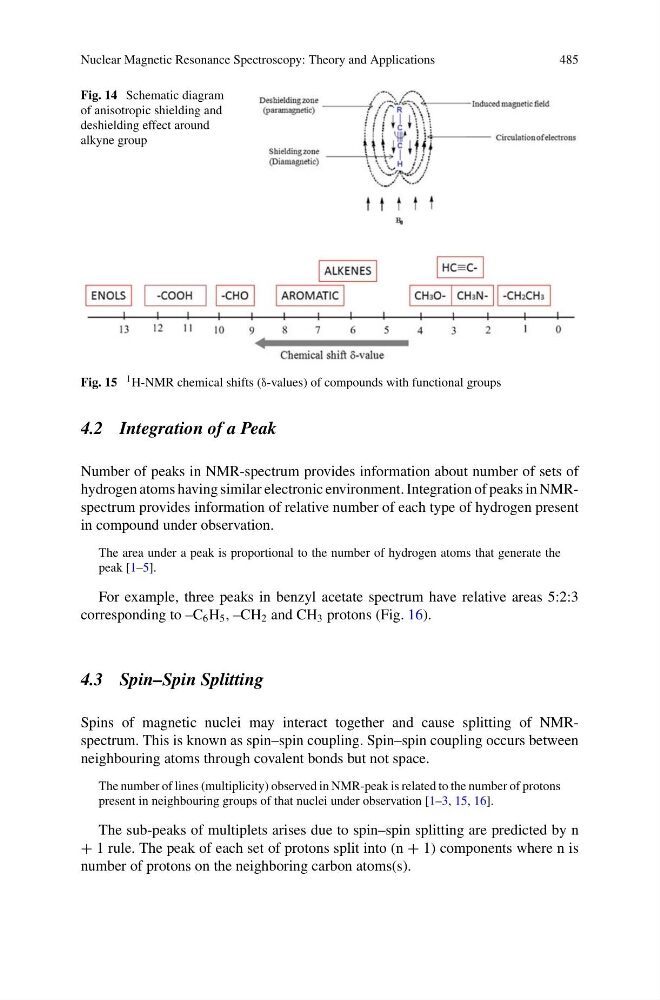
Fig. 14 Schematic diagram
of anisotropic shielding and
deshielding effect around
alkyne group
Fig. 15 1 H-NMR chemical shifts (δ-values) of compounds with functional groups
4.2 Integration of a Peak
Number of peaks in NMR-spectrum provides information about number of sets of
hydrogen atoms having similar electronic environment. Integration of peaks in NMRspectrum provides information of relative number of each type of hydrogen present
in compound under observation.
The area under a peak is proportional to the number of hydrogen atoms that generate the
peak [1–5].
For example, three peaks in benzyl acetate spectrum have relative areas 5:2:3
corresponding to –C 6 H 5 , –CH 2 and CH 3 protons (Fig. 16).
4.3 Spin–Spin Splitting
Spins of magnetic nuclei may interact together and cause splitting of NMRspectrum. This is known as spin–spin coupling. Spin–spin coupling occurs between
neighbouring atoms through covalent bonds but not space.
The number of lines (multiplicity) observed in NMR-peak is related to the number of protons
present in neighbouring groups of that nuclei under observation [1–3, 15, 16].
The sub-peaks of multiplets arises due to spin–spin splitting are predicted by n
+ 1 rule. The peak of each set of protons split into (n + 1) components where n is
number of protons on the neighboring carbon atoms(s).
485
Fig. 14 Schematic diagram
of anisotropic shielding and
deshielding effect around
alkyne group
Fig. 15 1 H-NMR chemical shifts (δ-values) of compounds with functional groups
4.2 Integration of a Peak
Number of peaks in NMR-spectrum provides information about number of sets of
hydrogen atoms having similar electronic environment. Integration of peaks in NMRspectrum provides information of relative number of each type of hydrogen present
in compound under observation.
The area under a peak is proportional to the number of hydrogen atoms that generate the
peak [1–5].
For example, three peaks in benzyl acetate spectrum have relative areas 5:2:3
corresponding to –C 6 H 5 , –CH 2 and CH 3 protons (Fig. 16).
4.3 Spin–Spin Splitting
Spins of magnetic nuclei may interact together and cause splitting of NMRspectrum. This is known as spin–spin coupling. Spin–spin coupling occurs between
neighbouring atoms through covalent bonds but not space.
The number of lines (multiplicity) observed in NMR-peak is related to the number of protons
present in neighbouring groups of that nuclei under observation [1–3, 15, 16].
The sub-peaks of multiplets arises due to spin–spin splitting are predicted by n
+ 1 rule. The peak of each set of protons split into (n + 1) components where n is
number of protons on the neighboring carbon atoms(s).