

Nuclear Magnetic Resonance Spectroscopy: Theory and Applications
483
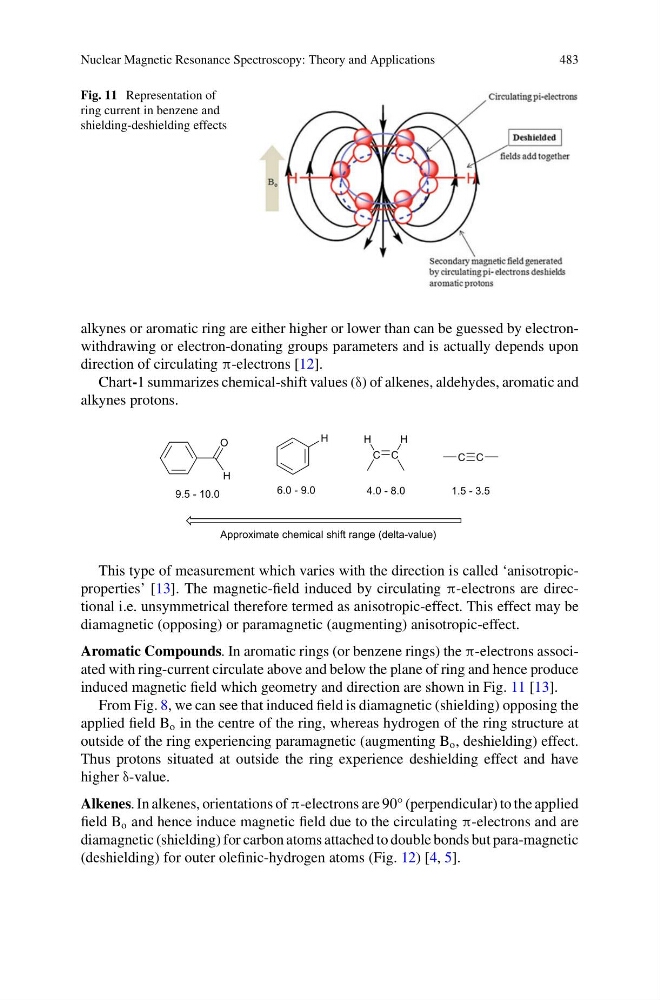
Fig. 11 Representation of
ring current in benzene and
shielding-deshielding effects
alkynes or aromatic ring are either higher or lower than can be guessed by electronwithdrawing or electron-donating groups parameters and is actually depends upon
direction of circulating π-electrons [12].
Chart-1 summarizes chemical-shift values (δ) of alkenes, aldehydes, aromatic and
alkynes protons.
O
H
H
C C
C C
H
H
9.5 - 10.0
6.0 - 9.0
4.0 - 8.0
1.5 - 3.5
Approximate chemical shift range (delta-value)
This type of measurement which varies with the direction is called ‘anisotropicproperties’ [13]. The magnetic-field induced by circulating π-electrons are directional i.e. unsymmetrical therefore termed as anisotropic-effect. This effect may be
diamagnetic (opposing) or paramagnetic (augmenting) anisotropic-effect.
Aromatic Compounds. In aromatic rings (or benzene rings) the π-electrons associated with ring-current circulate above and below the plane of ring and hence produce
induced magnetic field which geometry and direction are shown in Fig. 11 [13].
From Fig. 8, we can see that induced field is diamagnetic (shielding) opposing the
applied field B o in the centre of the ring, whereas hydrogen of the ring structure at
outside of the ring experiencing paramagnetic (augmenting B o , deshielding) effect.
Thus protons situated at outside the ring experience deshielding effect and have
higher δ-value.
Alkenes. In alkenes, orientations of π-electrons are 90° (perpendicular) to the applied
field B o and hence induce magnetic field due to the circulating π-electrons and are
diamagnetic (shielding) for carbon atoms attached to double bonds but para-magnetic
(deshielding) for outer olefinic-hydrogen atoms (Fig. 12) [4, 5].
483
Fig. 11 Representation of
ring current in benzene and
shielding-deshielding effects
alkynes or aromatic ring are either higher or lower than can be guessed by electronwithdrawing or electron-donating groups parameters and is actually depends upon
direction of circulating π-electrons [12].
Chart-1 summarizes chemical-shift values (δ) of alkenes, aldehydes, aromatic and
alkynes protons.
O
H
H
C C
C C
H
H
9.5 - 10.0
6.0 - 9.0
4.0 - 8.0
1.5 - 3.5
Approximate chemical shift range (delta-value)
This type of measurement which varies with the direction is called ‘anisotropicproperties’ [13]. The magnetic-field induced by circulating π-electrons are directional i.e. unsymmetrical therefore termed as anisotropic-effect. This effect may be
diamagnetic (opposing) or paramagnetic (augmenting) anisotropic-effect.
Aromatic Compounds. In aromatic rings (or benzene rings) the π-electrons associated with ring-current circulate above and below the plane of ring and hence produce
induced magnetic field which geometry and direction are shown in Fig. 11 [13].
From Fig. 8, we can see that induced field is diamagnetic (shielding) opposing the
applied field B o in the centre of the ring, whereas hydrogen of the ring structure at
outside of the ring experiencing paramagnetic (augmenting B o , deshielding) effect.
Thus protons situated at outside the ring experience deshielding effect and have
higher δ-value.
Alkenes. In alkenes, orientations of π-electrons are 90° (perpendicular) to the applied
field B o and hence induce magnetic field due to the circulating π-electrons and are
diamagnetic (shielding) for carbon atoms attached to double bonds but para-magnetic
(deshielding) for outer olefinic-hydrogen atoms (Fig. 12) [4, 5].