

482
M. Rashid et al.
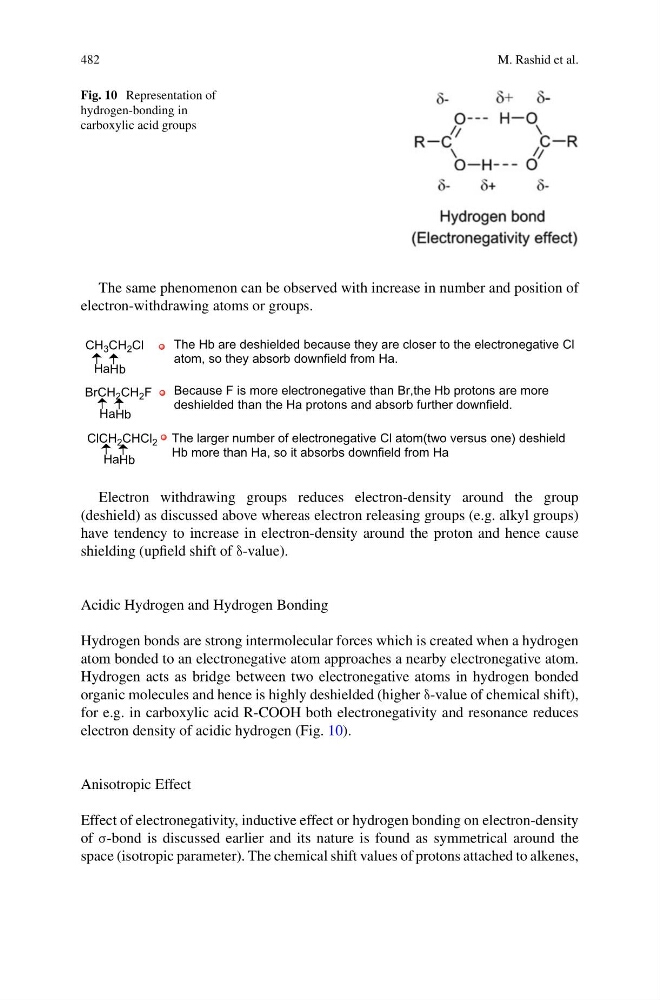
Fig. 10 Representation of
hydrogen-bonding in
carboxylic acid groups
The same phenomenon can be observed with increase in number and position of
electron-withdrawing atoms or groups.
CH 3 CH 2 Cl
BrCH 2 CH 2 F
ClCH 2 CHCl 2
HaHb
HaHb
HaHb
The Hb are deshielded because they are closer to the electronegative Cl
atom, so they absorb downfield from Ha.
Because F is more electronegative than Br,the Hb protons are more
deshielded than the Ha protons and absorb further downfield.
The larger number of electronegative Cl atom(two versus one) deshield
Hb more than Ha, so it absorbs downfield from Ha
Electron withdrawing groups reduces electron-density around the group
(deshield) as discussed above whereas electron releasing groups (e.g. alkyl groups)
have tendency to increase in electron-density around the proton and hence cause
shielding (upfield shift of δ-value).
Acidic Hydrogen and Hydrogen Bonding
Hydrogen bonds are strong intermolecular forces which is created when a hydrogen
atom bonded to an electronegative atom approaches a nearby electronegative atom.
Hydrogen acts as bridge between two electronegative atoms in hydrogen bonded
organic molecules and hence is highly deshielded (higher δ-value of chemical shift),
for e.g. in carboxylic acid R-COOH both electronegativity and resonance reduces
electron density of acidic hydrogen (Fig. 10).
Anisotropic Effect
Effect of electronegativity, inductive effect or hydrogen bonding on electron-density
of σ-bond is discussed earlier and its nature is found as symmetrical around the
space (isotropic parameter). The chemical shift values of protons attached to alkenes,
M. Rashid et al.
Fig. 10 Representation of
hydrogen-bonding in
carboxylic acid groups
The same phenomenon can be observed with increase in number and position of
electron-withdrawing atoms or groups.
CH 3 CH 2 Cl
BrCH 2 CH 2 F
ClCH 2 CHCl 2
HaHb
HaHb
HaHb
The Hb are deshielded because they are closer to the electronegative Cl
atom, so they absorb downfield from Ha.
Because F is more electronegative than Br,the Hb protons are more
deshielded than the Ha protons and absorb further downfield.
The larger number of electronegative Cl atom(two versus one) deshield
Hb more than Ha, so it absorbs downfield from Ha
Electron withdrawing groups reduces electron-density around the group
(deshield) as discussed above whereas electron releasing groups (e.g. alkyl groups)
have tendency to increase in electron-density around the proton and hence cause
shielding (upfield shift of δ-value).
Acidic Hydrogen and Hydrogen Bonding
Hydrogen bonds are strong intermolecular forces which is created when a hydrogen
atom bonded to an electronegative atom approaches a nearby electronegative atom.
Hydrogen acts as bridge between two electronegative atoms in hydrogen bonded
organic molecules and hence is highly deshielded (higher δ-value of chemical shift),
for e.g. in carboxylic acid R-COOH both electronegativity and resonance reduces
electron density of acidic hydrogen (Fig. 10).
Anisotropic Effect
Effect of electronegativity, inductive effect or hydrogen bonding on electron-density
of σ-bond is discussed earlier and its nature is found as symmetrical around the
space (isotropic parameter). The chemical shift values of protons attached to alkenes,