

Nuclear Magnetic Resonance Spectroscopy: Theory and Applications
481
If the secondary field of revolving electrons reinforces the applied field the position
of resonance (peak position) directed downfield in peak position of NMR spectrum
called as deshielding causing higher value of chemical shift.
Chemical shift depends upon many parameters which affect electron density
around nucleus and hence cause shielding and deshielding effect on nucleus [10].
These are discussed as below.
Electronegativity and Inductive Effect
Electronegativity is measure of the tendency of an atom to attract bonding pair
towards itself. Inductive effect is an electronic effect due to polarisation of sigmabonds within a molecule or ion. Inductive effect is typically due to an electronegativity
difference between the atoms at the either end of the bond.
To analyze the effect of electronegativity and inductive effect on chemical shift,
Table 3 shows chemical shift of methyl group when attached to atom or group with
increasing electron attracting tendency [11]. We can observe that as the tendency of
atom or group to polarize covalent sigma-bond increases, the chemical shift position
of methyl proton swift to higher δ value.
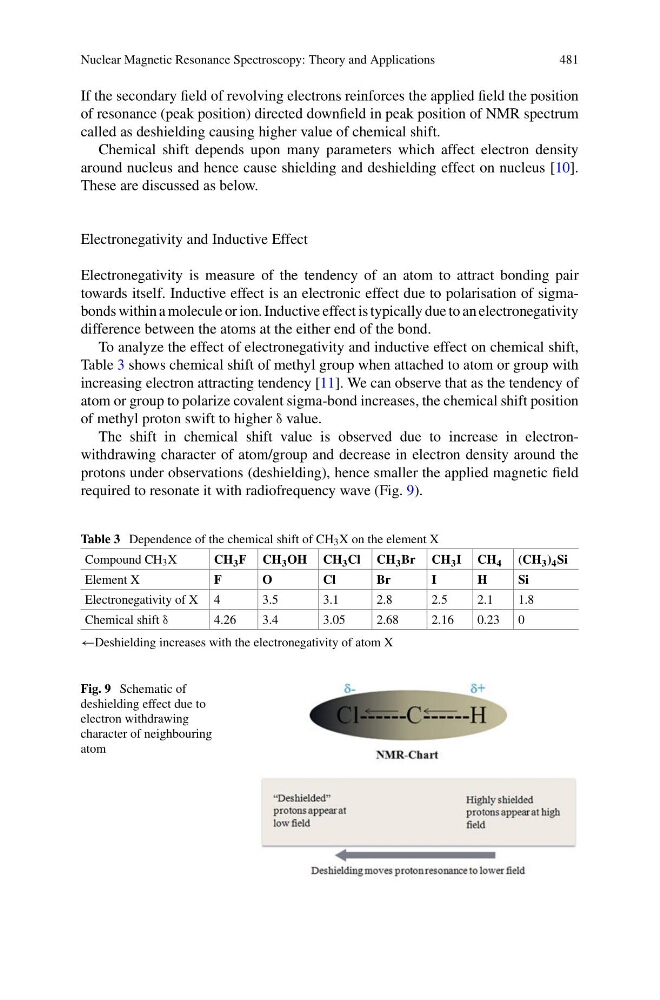
The shift in chemical shift value is observed due to increase in electronwithdrawing character of atom/group and decrease in electron density around the
protons under observations (deshielding), hence smaller the applied magnetic field
required to resonate it with radiofrequency wave (Fig. 9).
Table 3 Dependence of the chemical shift of CH 3 X on the element X
Compound CH 3 X
CH 3 F CH 3 OH CH 3 Cl CH 3 Br CH 3 I CH 4 (CH 3 ) 4 Si
Element X
F
O
Cl
Br
I
H
Si
Electronegativity of X 4
3.5
3.1
2.8
2.5
2.1
1.8
Chemical shift δ
4.26
3.4
3.05
2.68
2.16
0.23 0
←Deshielding increases with the electronegativity of atom X
Fig. 9 Schematic of
deshielding effect due to
electron withdrawing
character of neighbouring
atom
481
If the secondary field of revolving electrons reinforces the applied field the position
of resonance (peak position) directed downfield in peak position of NMR spectrum
called as deshielding causing higher value of chemical shift.
Chemical shift depends upon many parameters which affect electron density
around nucleus and hence cause shielding and deshielding effect on nucleus [10].
These are discussed as below.
Electronegativity and Inductive Effect
Electronegativity is measure of the tendency of an atom to attract bonding pair
towards itself. Inductive effect is an electronic effect due to polarisation of sigmabonds within a molecule or ion. Inductive effect is typically due to an electronegativity
difference between the atoms at the either end of the bond.
To analyze the effect of electronegativity and inductive effect on chemical shift,
Table 3 shows chemical shift of methyl group when attached to atom or group with
increasing electron attracting tendency [11]. We can observe that as the tendency of
atom or group to polarize covalent sigma-bond increases, the chemical shift position
of methyl proton swift to higher δ value.
The shift in chemical shift value is observed due to increase in electronwithdrawing character of atom/group and decrease in electron density around the
protons under observations (deshielding), hence smaller the applied magnetic field
required to resonate it with radiofrequency wave (Fig. 9).
Table 3 Dependence of the chemical shift of CH 3 X on the element X
Compound CH 3 X
CH 3 F CH 3 OH CH 3 Cl CH 3 Br CH 3 I CH 4 (CH 3 ) 4 Si
Element X
F
O
Cl
Br
I
H
Si
Electronegativity of X 4
3.5
3.1
2.8
2.5
2.1
1.8
Chemical shift δ
4.26
3.4
3.05
2.68
2.16
0.23 0
←Deshielding increases with the electronegativity of atom X
Fig. 9 Schematic of
deshielding effect due to
electron withdrawing
character of neighbouring
atom