

480
M. Rashid et al.
Contrary to the δ-scale of chemical shift, small numerical value of chemical shift
in τ indicates a small low field absorption and hence small downfield shift while
large value indicates high field absorption or a large downfield shift.
4.1.3 Shielding and Deshielding Effects
Hydrogen nuclei in a molecule are surrounded by rotating electronic charge that
generate magnetic field which can shield or reinforce the applied external magnetic
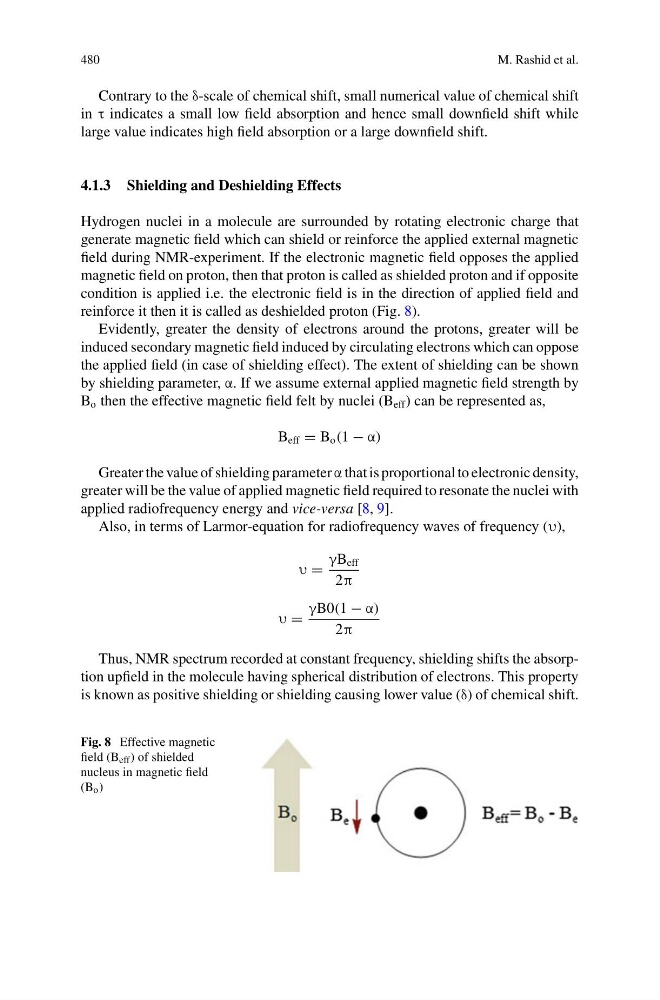
field during NMR-experiment. If the electronic magnetic field opposes the applied
magnetic field on proton, then that proton is called as shielded proton and if opposite
condition is applied i.e. the electronic field is in the direction of applied field and
reinforce it then it is called as deshielded proton (Fig. 8).
Evidently, greater the density of electrons around the protons, greater will be
induced secondary magnetic field induced by circulating electrons which can oppose
the applied field (in case of shielding effect). The extent of shielding can be shown
by shielding parameter, α. If we assume external applied magnetic field strength by
B o then the effective magnetic field felt by nuclei (B eff ) can be represented as,
B eff = B o (1 − α)
Greater the value of shielding parameter α that is proportional to electronic density,
greater will be the value of applied magnetic field required to resonate the nuclei with
applied radiofrequency energy and vice-versa [8, 9].
Also, in terms of Larmor-equation for radiofrequency waves of frequency (υ),
υ =
γB eff
2π
υ =
γB0(1 − α)
2π
Thus, NMR spectrum recorded at constant frequency, shielding shifts the absorption upfield in the molecule having spherical distribution of electrons. This property
is known as positive shielding or shielding causing lower value (δ) of chemical shift.
Fig. 8 Effective magnetic
field (B eff ) of shielded
nucleus in magnetic field
(B o )
M. Rashid et al.
Contrary to the δ-scale of chemical shift, small numerical value of chemical shift
in τ indicates a small low field absorption and hence small downfield shift while
large value indicates high field absorption or a large downfield shift.
4.1.3 Shielding and Deshielding Effects
Hydrogen nuclei in a molecule are surrounded by rotating electronic charge that
generate magnetic field which can shield or reinforce the applied external magnetic
field during NMR-experiment. If the electronic magnetic field opposes the applied
magnetic field on proton, then that proton is called as shielded proton and if opposite
condition is applied i.e. the electronic field is in the direction of applied field and
reinforce it then it is called as deshielded proton (Fig. 8).
Evidently, greater the density of electrons around the protons, greater will be
induced secondary magnetic field induced by circulating electrons which can oppose
the applied field (in case of shielding effect). The extent of shielding can be shown
by shielding parameter, α. If we assume external applied magnetic field strength by
B o then the effective magnetic field felt by nuclei (B eff ) can be represented as,
B eff = B o (1 − α)
Greater the value of shielding parameter α that is proportional to electronic density,
greater will be the value of applied magnetic field required to resonate the nuclei with
applied radiofrequency energy and vice-versa [8, 9].
Also, in terms of Larmor-equation for radiofrequency waves of frequency (υ),
υ =
γB eff
2π
υ =
γB0(1 − α)
2π
Thus, NMR spectrum recorded at constant frequency, shielding shifts the absorption upfield in the molecule having spherical distribution of electrons. This property
is known as positive shielding or shielding causing lower value (δ) of chemical shift.
Fig. 8 Effective magnetic
field (B eff ) of shielded
nucleus in magnetic field
(B o )