

Nuclear Magnetic Resonance Spectroscopy: Theory and Applications
477
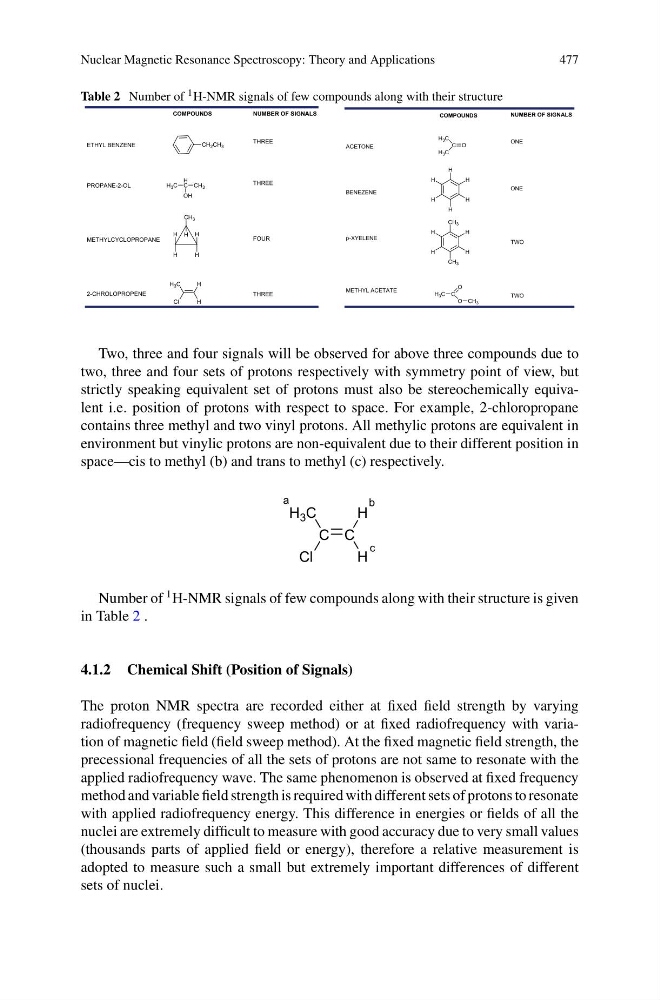
Table 2 Number of 1 H-NMR signals of few compounds along with their structure
CH2CH3
H3C
H
C CH3
OH
CH3
H
H
H
H
H
H3C
Cl
H
H
COMPOUNDS
NUMBER OF SIGNALS
THREE
THREE
FOUR
THREE
ETHYL BENZENE
PROPANE-2-OL
METHYLCYCLOPROPANE
2-CHROLOPROPENE
C
H3C
H3C
O
H
H
H
H
H
H
CH3
H
H
CH3
H
H
C
H3C
O
O CH3
COMPOUNDS
NUMBER OF SIGNALS
ONE
ONE
TWO
TWO
ACETONE
BENEZENE
p-XYELENE
METHYL ACETATE
Two, three and four signals will be observed for above three compounds due to
two, three and four sets of protons respectively with symmetry point of view, but
strictly speaking equivalent set of protons must also be stereochemically equivalent i.e. position of protons with respect to space. For example, 2-chloropropane
contains three methyl and two vinyl protons. All methylic protons are equivalent in
environment but vinylic protons are non-equivalent due to their different position in
space—cis to methyl (b) and trans to methyl (c) respectively.
C C
H 3 C
Cl
H
H
a
b
c
Number of
1 H-NMR signals of few compounds along with their structure is given
in Table 2 .
4.1.2 Chemical Shift (Position of Signals)
The proton NMR spectra are recorded either at fixed field strength by varying
radiofrequency (frequency sweep method) or at fixed radiofrequency with variation of magnetic field (field sweep method). At the fixed magnetic field strength, the
precessional frequencies of all the sets of protons are not same to resonate with the
applied radiofrequency wave. The same phenomenon is observed at fixed frequency
method and variable field strength is required with different sets of protons to resonate
with applied radiofrequency energy. This difference in energies or fields of all the
nuclei are extremely difficult to measure with good accuracy due to very small values
(thousands parts of applied field or energy), therefore a relative measurement is
adopted to measure such a small but extremely important differences of different
sets of nuclei.
477
Table 2 Number of 1 H-NMR signals of few compounds along with their structure
CH2CH3
H3C
H
C CH3
OH
CH3
H
H
H
H
H
H3C
Cl
H
H
COMPOUNDS
NUMBER OF SIGNALS
THREE
THREE
FOUR
THREE
ETHYL BENZENE
PROPANE-2-OL
METHYLCYCLOPROPANE
2-CHROLOPROPENE
C
H3C
H3C
O
H
H
H
H
H
H
CH3
H
H
CH3
H
H
C
H3C
O
O CH3
COMPOUNDS
NUMBER OF SIGNALS
ONE
ONE
TWO
TWO
ACETONE
BENEZENE
p-XYELENE
METHYL ACETATE
Two, three and four signals will be observed for above three compounds due to
two, three and four sets of protons respectively with symmetry point of view, but
strictly speaking equivalent set of protons must also be stereochemically equivalent i.e. position of protons with respect to space. For example, 2-chloropropane
contains three methyl and two vinyl protons. All methylic protons are equivalent in
environment but vinylic protons are non-equivalent due to their different position in
space—cis to methyl (b) and trans to methyl (c) respectively.
C C
H 3 C
Cl
H
H
a
b
c
Number of
1 H-NMR signals of few compounds along with their structure is given
in Table 2 .
4.1.2 Chemical Shift (Position of Signals)
The proton NMR spectra are recorded either at fixed field strength by varying
radiofrequency (frequency sweep method) or at fixed radiofrequency with variation of magnetic field (field sweep method). At the fixed magnetic field strength, the
precessional frequencies of all the sets of protons are not same to resonate with the
applied radiofrequency wave. The same phenomenon is observed at fixed frequency
method and variable field strength is required with different sets of protons to resonate
with applied radiofrequency energy. This difference in energies or fields of all the
nuclei are extremely difficult to measure with good accuracy due to very small values
(thousands parts of applied field or energy), therefore a relative measurement is
adopted to measure such a small but extremely important differences of different
sets of nuclei.