

476
M. Rashid et al.
4 Interpretation of Proton-NMR Spectra
NMR is considered as essential tool for structural elucidation of compounds. One can
draw following information from proton-NMR spectrum of an organic compound
[1, 4–7]:
(a) Number of signals and chemical shift: The number of peaks in NMR spectrum
provides information about type of hydrogen present in organic compounds
whereas position of peaks along x-axis (chemical shift) gives clue as to the
electronic environment of particular hydrogen.
(b) Signal intensity: Integration of peaks provides information about relative
number of each type of hydrogen.
(c) Spin–spin coupling: Spin–spin splitting pattern provides information about
number of hydrogens on neighbouring atoms. The coupling constant of
multiplets of peaks provides information about the arrangement of atoms
involved.
4.1 Number of Signals
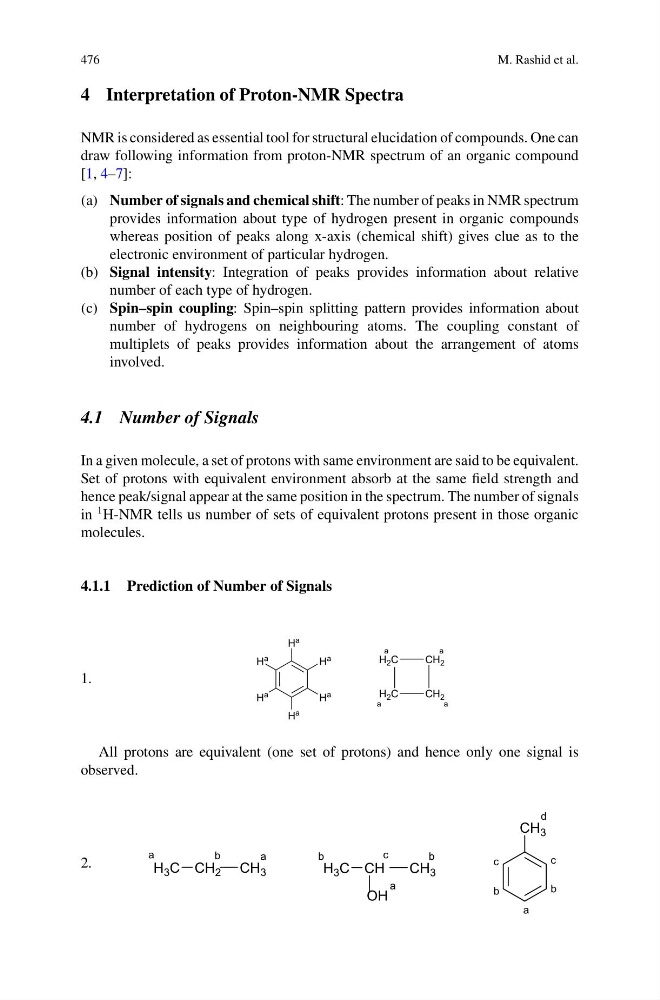
In a given molecule, a set of protons with same environment are said to be equivalent.
Set of protons with equivalent environment absorb at the same field strength and
hence peak/signal appear at the same position in the spectrum. The number of signals
in
1 H-NMR tells us number of sets of equivalent protons present in those organic
molecules.
4.1.1 Prediction of Number of Signals
1.
H
a
H
a
H
a
H
a
H
a
H
a
H 2 C
H 2 C
C H 2
CH 2
a
a
a
a
All protons are equivalent (one set of protons) and hence only one signal is
observed.
2.
H 3 C CH 2 CH 3
H 3 C CH
CH 3
a
b
a
b
c
b
OH
a
CH 3
a
b
b
c
c
d
M. Rashid et al.
4 Interpretation of Proton-NMR Spectra
NMR is considered as essential tool for structural elucidation of compounds. One can
draw following information from proton-NMR spectrum of an organic compound
[1, 4–7]:
(a) Number of signals and chemical shift: The number of peaks in NMR spectrum
provides information about type of hydrogen present in organic compounds
whereas position of peaks along x-axis (chemical shift) gives clue as to the
electronic environment of particular hydrogen.
(b) Signal intensity: Integration of peaks provides information about relative
number of each type of hydrogen.
(c) Spin–spin coupling: Spin–spin splitting pattern provides information about
number of hydrogens on neighbouring atoms. The coupling constant of
multiplets of peaks provides information about the arrangement of atoms
involved.
4.1 Number of Signals
In a given molecule, a set of protons with same environment are said to be equivalent.
Set of protons with equivalent environment absorb at the same field strength and
hence peak/signal appear at the same position in the spectrum. The number of signals
in
1 H-NMR tells us number of sets of equivalent protons present in those organic
molecules.
4.1.1 Prediction of Number of Signals
1.
H
a
H
a
H
a
H
a
H
a
H
a
H 2 C
H 2 C
C H 2
CH 2
a
a
a
a
All protons are equivalent (one set of protons) and hence only one signal is
observed.
2.
H 3 C CH 2 CH 3
H 3 C CH
CH 3
a
b
a
b
c
b
OH
a
CH 3
a
b
b
c
c
d