

446
D. P. Singh et al.
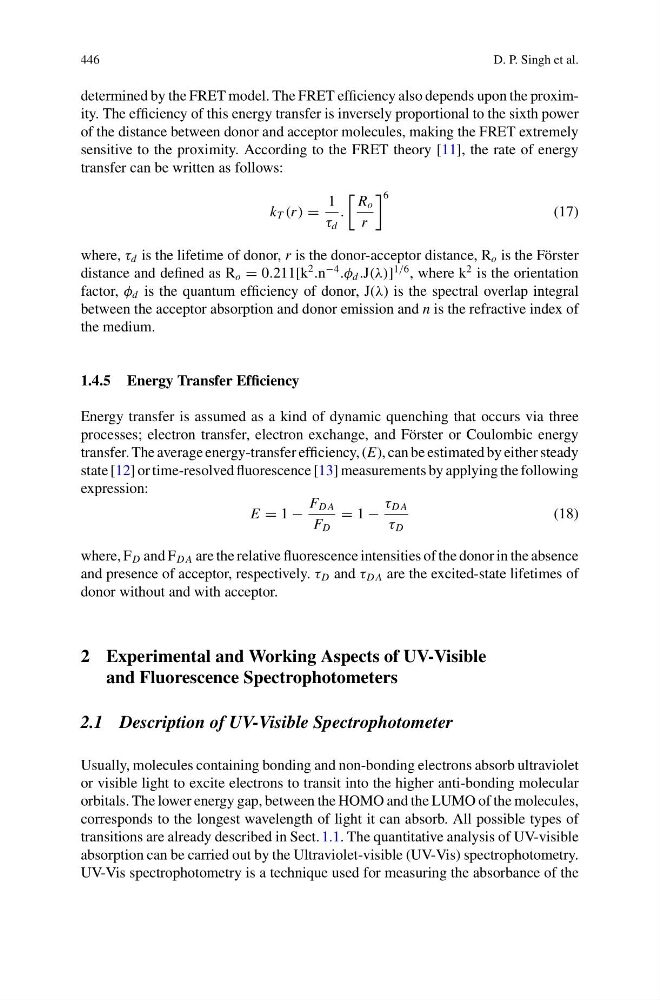
determined by the FRET model. The FRET efficiency also depends upon the proximity. The efficiency of this energy transfer is inversely proportional to the sixth power
of the distance between donor and acceptor molecules, making the FRET extremely
sensitive to the proximity. According to the FRET theory [11], the rate of energy
transfer can be written as follows:
k T (r ) =
1
τ d
.
R o
r
6
(17)
where, τ d is the lifetime of donor, r is the donor-acceptor distance, R o is the Förster
distance and defined as R o = 0.211[k
2
.n
−4
.φ d .J(λ)]
1/6 , where k
2 is the orientation
factor, φ d is the quantum efficiency of donor, J(λ) is the spectral overlap integral
between the acceptor absorption and donor emission and n is the refractive index of
the medium.
1.4.5 Energy Transfer Efficiency
Energy transfer is assumed as a kind of dynamic quenching that occurs via three
processes; electron transfer, electron exchange, and Förster or Coulombic energy
transfer. The average energy-transfer efficiency, (E), can be estimated by either steady
state [12] or time-resolved fluorescence [13] measurements by applying the following
expression:
E = 1 −
F D A
F D
= 1 −
τ D A
τ D
(18)
where, F D and F D A are the relative fluorescence intensities of the donor in the absence
and presence of acceptor, respectively. τ D and τ D A are the excited-state lifetimes of
donor without and with acceptor.
2 Experimental and Working Aspects of UV-Visible
and Fluorescence Spectrophotometers
2.1 Description of UV-Visible Spectrophotometer
Usually, molecules containing bonding and non-bonding electrons absorb ultraviolet
or visible light to excite electrons to transit into the higher anti-bonding molecular
orbitals. The lower energy gap, between the HOMO and the LUMO of the molecules,
corresponds to the longest wavelength of light it can absorb. All possible types of
transitions are already described in Sect. 1.1. The quantitative analysis of UV-visible
absorption can be carried out by the Ultraviolet-visible (UV-Vis) spectrophotometry.
UV-Vis spectrophotometry is a technique used for measuring the absorbance of the
D. P. Singh et al.
determined by the FRET model. The FRET efficiency also depends upon the proximity. The efficiency of this energy transfer is inversely proportional to the sixth power
of the distance between donor and acceptor molecules, making the FRET extremely
sensitive to the proximity. According to the FRET theory [11], the rate of energy
transfer can be written as follows:
k T (r ) =
1
τ d
.
R o
r
6
(17)
where, τ d is the lifetime of donor, r is the donor-acceptor distance, R o is the Förster
distance and defined as R o = 0.211[k
2
.n
−4
.φ d .J(λ)]
1/6 , where k
2 is the orientation
factor, φ d is the quantum efficiency of donor, J(λ) is the spectral overlap integral
between the acceptor absorption and donor emission and n is the refractive index of
the medium.
1.4.5 Energy Transfer Efficiency
Energy transfer is assumed as a kind of dynamic quenching that occurs via three
processes; electron transfer, electron exchange, and Förster or Coulombic energy
transfer. The average energy-transfer efficiency, (E), can be estimated by either steady
state [12] or time-resolved fluorescence [13] measurements by applying the following
expression:
E = 1 −
F D A
F D
= 1 −
τ D A
τ D
(18)
where, F D and F D A are the relative fluorescence intensities of the donor in the absence
and presence of acceptor, respectively. τ D and τ D A are the excited-state lifetimes of
donor without and with acceptor.
2 Experimental and Working Aspects of UV-Visible
and Fluorescence Spectrophotometers
2.1 Description of UV-Visible Spectrophotometer
Usually, molecules containing bonding and non-bonding electrons absorb ultraviolet
or visible light to excite electrons to transit into the higher anti-bonding molecular
orbitals. The lower energy gap, between the HOMO and the LUMO of the molecules,
corresponds to the longest wavelength of light it can absorb. All possible types of
transitions are already described in Sect. 1.1. The quantitative analysis of UV-visible
absorption can be carried out by the Ultraviolet-visible (UV-Vis) spectrophotometry.
UV-Vis spectrophotometry is a technique used for measuring the absorbance of the