

Fluorescence Spectrometry
445
intensity. In the solution state, the increase in temperature accelerates the Brownian
motion resulting in the energy loss via dynamic quenching by the solvent. This
quenching process reduces the overall fluorescence quantum yield along with the
fluorescence intensity. One should keep in mind that fluorescence lifetime is less
sensitive to the change in temperature; therefore, the observed change in fluorescence
lifetime is not analogous to that of the observed fluorescence quantum yield or
fluorescence intensity.
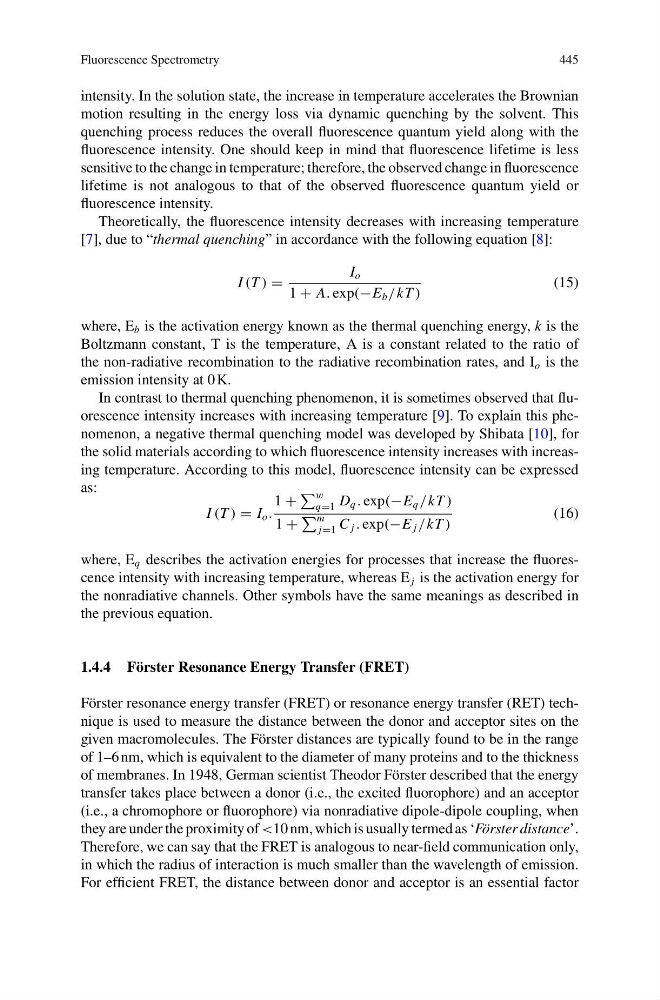
Theoretically, the fluorescence intensity decreases with increasing temperature
[7], due to “thermal quenching” in accordance with the following equation [8]:
I (T ) =
I o
1 + A. exp(−E b /kT )
(15)
where, E b is the activation energy known as the thermal quenching energy, k is the
Boltzmann constant, T is the temperature, A is a constant related to the ratio of
the non-radiative recombination to the radiative recombination rates, and I o is the
emission intensity at 0 K.
In contrast to thermal quenching phenomenon, it is sometimes observed that fluorescence intensity increases with increasing temperature [9]. To explain this phenomenon, a negative thermal quenching model was developed by Shibata [10], for
the solid materials according to which fluorescence intensity increases with increasing temperature. According to this model, fluorescence intensity can be expressed
as:
I (T ) = I o .
1 +
w
q=1 D q . exp(−E q /kT )
1 +
m
j=1 C j . exp(−E j /kT )
(16)
where, E q describes the activation energies for processes that increase the fluorescence intensity with increasing temperature, whereas E j is the activation energy for
the nonradiative channels. Other symbols have the same meanings as described in
the previous equation.
1.4.4 Förster Resonance Energy Transfer (FRET)
Förster resonance energy transfer (FRET) or resonance energy transfer (RET) technique is used to measure the distance between the donor and acceptor sites on the
given macromolecules. The Förster distances are typically found to be in the range
of 1–6 nm, which is equivalent to the diameter of many proteins and to the thickness
of membranes. In 1948, German scientist Theodor Förster described that the energy
transfer takes place between a donor (i.e., the excited fluorophore) and an acceptor
(i.e., a chromophore or fluorophore) via nonradiative dipole-dipole coupling, when
they are under the proximity of <10 nm, which is usually termed as ‘Förster distance’.
Therefore, we can say that the FRET is analogous to near-field communication only,
in which the radius of interaction is much smaller than the wavelength of emission.
For efficient FRET, the distance between donor and acceptor is an essential factor
445
intensity. In the solution state, the increase in temperature accelerates the Brownian
motion resulting in the energy loss via dynamic quenching by the solvent. This
quenching process reduces the overall fluorescence quantum yield along with the
fluorescence intensity. One should keep in mind that fluorescence lifetime is less
sensitive to the change in temperature; therefore, the observed change in fluorescence
lifetime is not analogous to that of the observed fluorescence quantum yield or
fluorescence intensity.
Theoretically, the fluorescence intensity decreases with increasing temperature
[7], due to “thermal quenching” in accordance with the following equation [8]:
I (T ) =
I o
1 + A. exp(−E b /kT )
(15)
where, E b is the activation energy known as the thermal quenching energy, k is the
Boltzmann constant, T is the temperature, A is a constant related to the ratio of
the non-radiative recombination to the radiative recombination rates, and I o is the
emission intensity at 0 K.
In contrast to thermal quenching phenomenon, it is sometimes observed that fluorescence intensity increases with increasing temperature [9]. To explain this phenomenon, a negative thermal quenching model was developed by Shibata [10], for
the solid materials according to which fluorescence intensity increases with increasing temperature. According to this model, fluorescence intensity can be expressed
as:
I (T ) = I o .
1 +
w
q=1 D q . exp(−E q /kT )
1 +
m
j=1 C j . exp(−E j /kT )
(16)
where, E q describes the activation energies for processes that increase the fluorescence intensity with increasing temperature, whereas E j is the activation energy for
the nonradiative channels. Other symbols have the same meanings as described in
the previous equation.
1.4.4 Förster Resonance Energy Transfer (FRET)
Förster resonance energy transfer (FRET) or resonance energy transfer (RET) technique is used to measure the distance between the donor and acceptor sites on the
given macromolecules. The Förster distances are typically found to be in the range
of 1–6 nm, which is equivalent to the diameter of many proteins and to the thickness
of membranes. In 1948, German scientist Theodor Förster described that the energy
transfer takes place between a donor (i.e., the excited fluorophore) and an acceptor
(i.e., a chromophore or fluorophore) via nonradiative dipole-dipole coupling, when
they are under the proximity of <10 nm, which is usually termed as ‘Förster distance’.
Therefore, we can say that the FRET is analogous to near-field communication only,
in which the radius of interaction is much smaller than the wavelength of emission.
For efficient FRET, the distance between donor and acceptor is an essential factor