

444
D. P. Singh et al.
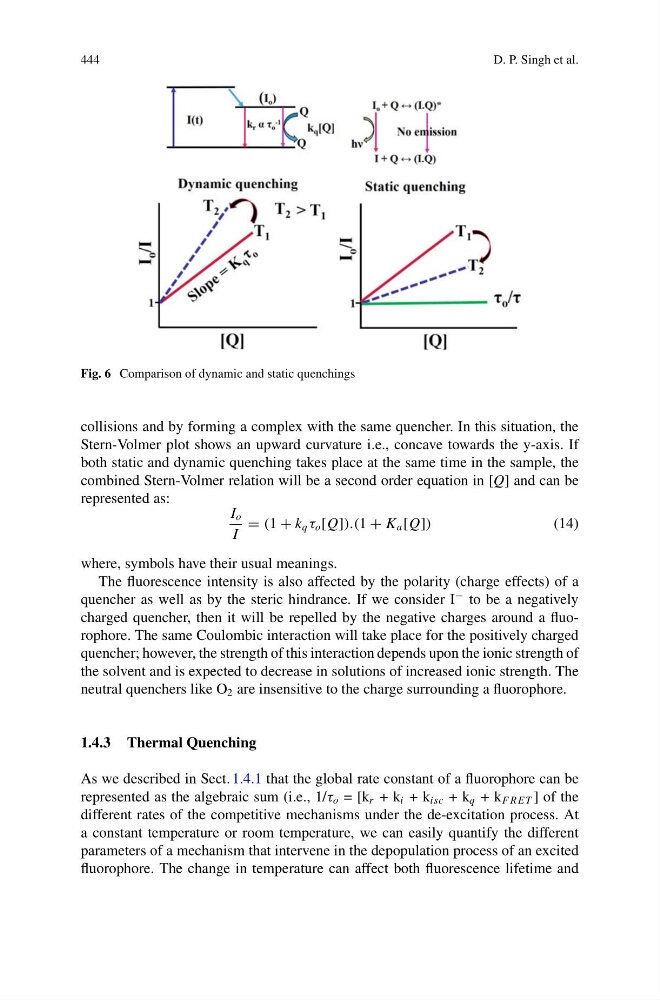
Fig. 6 Comparison of dynamic and static quenchings
collisions and by forming a complex with the same quencher. In this situation, the
Stern-Volmer plot shows an upward curvature i.e., concave towards the y-axis. If
both static and dynamic quenching takes place at the same time in the sample, the
combined Stern-Volmer relation will be a second order equation in [Q] and can be
represented as:
I o
I
= (1 + k q τ o [Q]).(1 + K a [Q])
(14)
where, symbols have their usual meanings.
The fluorescence intensity is also affected by the polarity (charge effects) of a
quencher as well as by the steric hindrance. If we consider I
− to be a negatively
charged quencher, then it will be repelled by the negative charges around a fluorophore. The same Coulombic interaction will take place for the positively charged
quencher; however, the strength of this interaction depends upon the ionic strength of
the solvent and is expected to decrease in solutions of increased ionic strength. The
neutral quenchers like O 2 are insensitive to the charge surrounding a fluorophore.
1.4.3 Thermal Quenching
As we described in Sect. 1.4.1 that the global rate constant of a fluorophore can be
represented as the algebraic sum (i.e., 1/τ o = [k r + k i + k isc + k q + k F RET ] of the
different rates of the competitive mechanisms under the de-excitation process. At
a constant temperature or room temperature, we can easily quantify the different
parameters of a mechanism that intervene in the depopulation process of an excited
fluorophore. The change in temperature can affect both fluorescence lifetime and
D. P. Singh et al.
Fig. 6 Comparison of dynamic and static quenchings
collisions and by forming a complex with the same quencher. In this situation, the
Stern-Volmer plot shows an upward curvature i.e., concave towards the y-axis. If
both static and dynamic quenching takes place at the same time in the sample, the
combined Stern-Volmer relation will be a second order equation in [Q] and can be
represented as:
I o
I
= (1 + k q τ o [Q]).(1 + K a [Q])
(14)
where, symbols have their usual meanings.
The fluorescence intensity is also affected by the polarity (charge effects) of a
quencher as well as by the steric hindrance. If we consider I
− to be a negatively
charged quencher, then it will be repelled by the negative charges around a fluorophore. The same Coulombic interaction will take place for the positively charged
quencher; however, the strength of this interaction depends upon the ionic strength of
the solvent and is expected to decrease in solutions of increased ionic strength. The
neutral quenchers like O 2 are insensitive to the charge surrounding a fluorophore.
1.4.3 Thermal Quenching
As we described in Sect. 1.4.1 that the global rate constant of a fluorophore can be
represented as the algebraic sum (i.e., 1/τ o = [k r + k i + k isc + k q + k F RET ] of the
different rates of the competitive mechanisms under the de-excitation process. At
a constant temperature or room temperature, we can easily quantify the different
parameters of a mechanism that intervene in the depopulation process of an excited
fluorophore. The change in temperature can affect both fluorescence lifetime and