

Fluorescence Spectrometry
441
The efficiency of fluorescence is always less than 1 because of the Stokes losses
and it is close to 1 if the radiationless decay rate is much smaller than that of the
radiative decay i.e., k i k r .
1.3 Up and Down-Conversions
The up-conversion process of photon evinces the absorption of two or more photons and subsequently emission of light of a shorter wavelength in comparison to
the excitation wavelength. The emission to red or green light upon the exposure of
infrared radiation is an example of the up-conversion process. Both, inorganic and
organic materials exhibit up-conversion processes. Usually, polycyclic organic materials show photon up-conversion due to triplet-triplet annihilation; whereas inorganic
materials show this property due to the presence of d or f -block ions like Ti
2+ , Yb
3+ ,
etc. The photon upconversion in inorganic materials takes place due to the following
mechanisms:
• Energy transfer upconversion
• Excited-state absorption
• Photon avalanche.
However, the photon upconversion in organic materials occurs via following
mechanisms:
• Sensitized triplet-triplet annihilation
• Energy pooling.
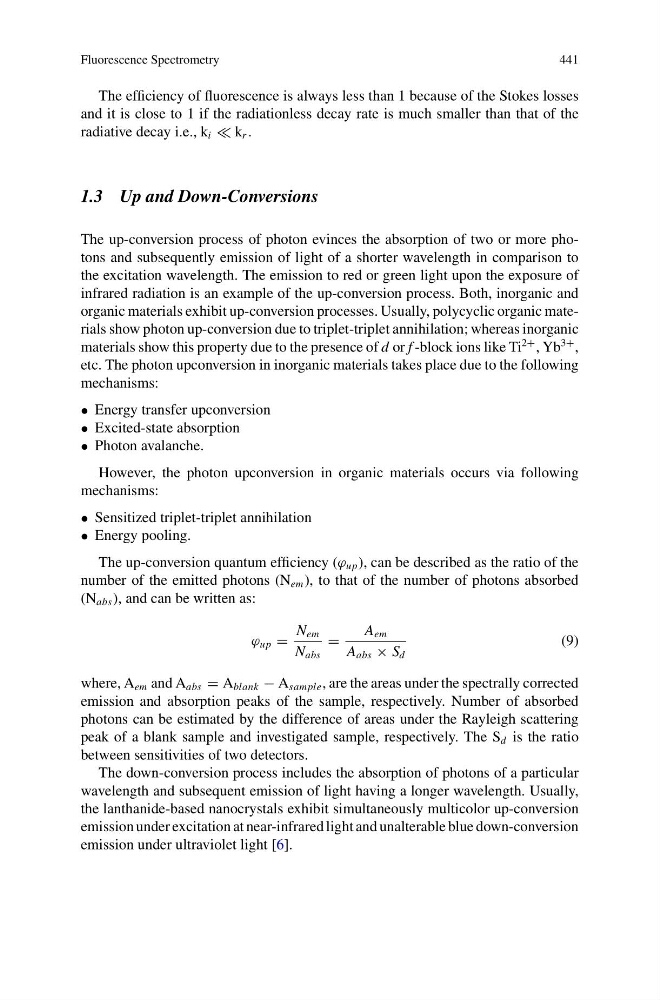
The up-conversion quantum efficiency (ϕ up ), can be described as the ratio of the
number of the emitted photons (N em ), to that of the number of photons absorbed
(N abs ), and can be written as:
ϕ up =
N em
N abs
=
A em
A abs × S d
(9)
where, A em and A abs = A blank − A sample , are the areas under the spectrally corrected
emission and absorption peaks of the sample, respectively. Number of absorbed
photons can be estimated by the difference of areas under the Rayleigh scattering
peak of a blank sample and investigated sample, respectively. The S d is the ratio
between sensitivities of two detectors.
The down-conversion process includes the absorption of photons of a particular
wavelength and subsequent emission of light having a longer wavelength. Usually,
the lanthanide-based nanocrystals exhibit simultaneously multicolor up-conversion
emission under excitation at near-infrared light and unalterable blue down-conversion
emission under ultraviolet light [6].
441
The efficiency of fluorescence is always less than 1 because of the Stokes losses
and it is close to 1 if the radiationless decay rate is much smaller than that of the
radiative decay i.e., k i k r .
1.3 Up and Down-Conversions
The up-conversion process of photon evinces the absorption of two or more photons and subsequently emission of light of a shorter wavelength in comparison to
the excitation wavelength. The emission to red or green light upon the exposure of
infrared radiation is an example of the up-conversion process. Both, inorganic and
organic materials exhibit up-conversion processes. Usually, polycyclic organic materials show photon up-conversion due to triplet-triplet annihilation; whereas inorganic
materials show this property due to the presence of d or f -block ions like Ti
2+ , Yb
3+ ,
etc. The photon upconversion in inorganic materials takes place due to the following
mechanisms:
• Energy transfer upconversion
• Excited-state absorption
• Photon avalanche.
However, the photon upconversion in organic materials occurs via following
mechanisms:
• Sensitized triplet-triplet annihilation
• Energy pooling.
The up-conversion quantum efficiency (ϕ up ), can be described as the ratio of the
number of the emitted photons (N em ), to that of the number of photons absorbed
(N abs ), and can be written as:
ϕ up =
N em
N abs
=
A em
A abs × S d
(9)
where, A em and A abs = A blank − A sample , are the areas under the spectrally corrected
emission and absorption peaks of the sample, respectively. Number of absorbed
photons can be estimated by the difference of areas under the Rayleigh scattering
peak of a blank sample and investigated sample, respectively. The S d is the ratio
between sensitivities of two detectors.
The down-conversion process includes the absorption of photons of a particular
wavelength and subsequent emission of light having a longer wavelength. Usually,
the lanthanide-based nanocrystals exhibit simultaneously multicolor up-conversion
emission under excitation at near-infrared light and unalterable blue down-conversion
emission under ultraviolet light [6].