

442
D. P. Singh et al.
1.4 Quenching Phenomenon
When any external molecules or ions are added to fluorophores, its fluorescence intensity can be quenched, and thus quantum yield is also reduced. It is due to the fact that
the fluorescence quantum yield is directly proportional to the intensity of fluorescence emission (i.e., ϕ ∝ I F L ). These external additives are termed as ‘Quenchers’
and their presence suppresses the fluorescence property while interacting with the
fluorophores via collision or during the formation of nonfluorescent complex with
a fluorophore (i.e., ligand binding). The above-said quenching processes are said
to be dynamic and static quenchings, respectively. Dynamic quenching and static
quenching are not mechanisms of fluorescence quenching, but rather two classes
of quenching mechanism. In the presence of a quenching agent, the fluorescence
lifetime is decreased according to:
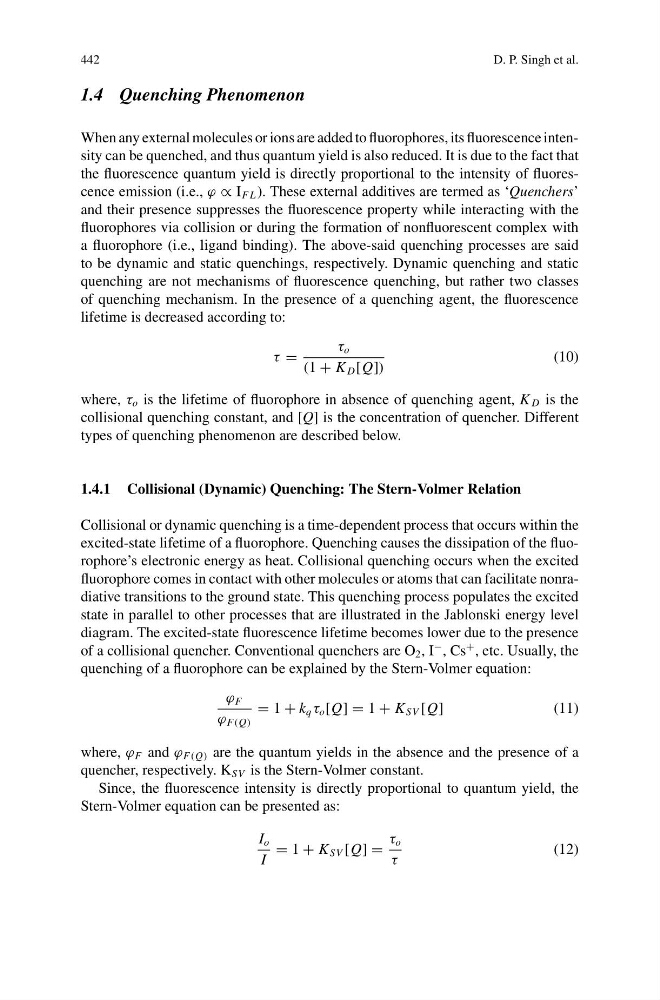
τ =
τ o
(1 + K D [Q])
(10)
where, τ o is the lifetime of fluorophore in absence of quenching agent, K D is the
collisional quenching constant, and [Q] is the concentration of quencher. Different
types of quenching phenomenon are described below.
1.4.1 Collisional (Dynamic) Quenching: The Stern-Volmer Relation
Collisional or dynamic quenching is a time-dependent process that occurs within the
excited-state lifetime of a fluorophore. Quenching causes the dissipation of the fluorophore’s electronic energy as heat. Collisional quenching occurs when the excited
fluorophore comes in contact with other molecules or atoms that can facilitate nonradiative transitions to the ground state. This quenching process populates the excited
state in parallel to other processes that are illustrated in the Jablonski energy level
diagram. The excited-state fluorescence lifetime becomes lower due to the presence
of a collisional quencher. Conventional quenchers are O 2 , I
− , Cs
+ , etc. Usually, the
quenching of a fluorophore can be explained by the Stern-Volmer equation:
ϕ F
ϕ F(Q)
= 1 + k q τ o [Q] = 1 + K SV [Q]
(11)
where, ϕ F and ϕ F(Q) are the quantum yields in the absence and the presence of a
quencher, respectively. K SV is the Stern-Volmer constant.
Since, the fluorescence intensity is directly proportional to quantum yield, the
Stern-Volmer equation can be presented as:
I o
I
= 1 + K SV [Q] =
τ o
τ
(12)
D. P. Singh et al.
1.4 Quenching Phenomenon
When any external molecules or ions are added to fluorophores, its fluorescence intensity can be quenched, and thus quantum yield is also reduced. It is due to the fact that
the fluorescence quantum yield is directly proportional to the intensity of fluorescence emission (i.e., ϕ ∝ I F L ). These external additives are termed as ‘Quenchers’
and their presence suppresses the fluorescence property while interacting with the
fluorophores via collision or during the formation of nonfluorescent complex with
a fluorophore (i.e., ligand binding). The above-said quenching processes are said
to be dynamic and static quenchings, respectively. Dynamic quenching and static
quenching are not mechanisms of fluorescence quenching, but rather two classes
of quenching mechanism. In the presence of a quenching agent, the fluorescence
lifetime is decreased according to:
τ =
τ o
(1 + K D [Q])
(10)
where, τ o is the lifetime of fluorophore in absence of quenching agent, K D is the
collisional quenching constant, and [Q] is the concentration of quencher. Different
types of quenching phenomenon are described below.
1.4.1 Collisional (Dynamic) Quenching: The Stern-Volmer Relation
Collisional or dynamic quenching is a time-dependent process that occurs within the
excited-state lifetime of a fluorophore. Quenching causes the dissipation of the fluorophore’s electronic energy as heat. Collisional quenching occurs when the excited
fluorophore comes in contact with other molecules or atoms that can facilitate nonradiative transitions to the ground state. This quenching process populates the excited
state in parallel to other processes that are illustrated in the Jablonski energy level
diagram. The excited-state fluorescence lifetime becomes lower due to the presence
of a collisional quencher. Conventional quenchers are O 2 , I
− , Cs
+ , etc. Usually, the
quenching of a fluorophore can be explained by the Stern-Volmer equation:
ϕ F
ϕ F(Q)
= 1 + k q τ o [Q] = 1 + K SV [Q]
(11)
where, ϕ F and ϕ F(Q) are the quantum yields in the absence and the presence of a
quencher, respectively. K SV is the Stern-Volmer constant.
Since, the fluorescence intensity is directly proportional to quantum yield, the
Stern-Volmer equation can be presented as:
I o
I
= 1 + K SV [Q] =
τ o
τ
(12)