

440
D. P. Singh et al.
1.2 Radiative and Nonradiative Transitions
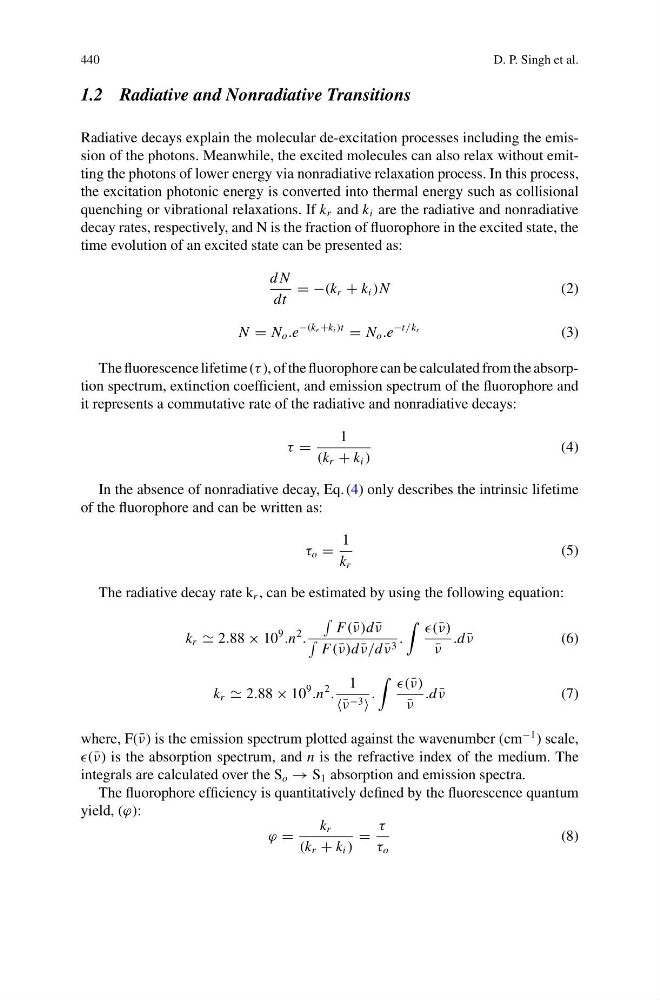
Radiative decays explain the molecular de-excitation processes including the emission of the photons. Meanwhile, the excited molecules can also relax without emitting the photons of lower energy via nonradiative relaxation process. In this process,
the excitation photonic energy is converted into thermal energy such as collisional
quenching or vibrational relaxations. If k r and k i are the radiative and nonradiative
decay rates, respectively, and N is the fraction of fluorophore in the excited state, the
time evolution of an excited state can be presented as:
d N
dt
= −(k r + k i )N
(2)
N = N o .e
−(k r +k i )t
= N o .e
−t/k r
(3)
The fluorescence lifetime (τ ), of the fluorophore can be calculated from the absorption spectrum, extinction coefficient, and emission spectrum of the fluorophore and
it represents a commutative rate of the radiative and nonradiative decays:
τ =
1
(k r + k i )
(4)
In the absence of nonradiative decay, Eq. (4) only describes the intrinsic lifetime
of the fluorophore and can be written as:
τ o =
1
k r
(5)
The radiative decay rate k r , can be estimated by using the following equation:
k r 2.88 × 10
9
.n
2
.
F(¯ ν)d ¯
ν
F(¯ ν)d ¯
ν/d ¯
ν 3 .
(¯ ν)
¯
ν
.d ¯
ν
(6)
k r 2.88 × 10
9
.n
2
.
1
¯ ν −3
.
(¯ ν)
¯
ν
.d ¯
ν
(7)
where, F(¯ ν) is the emission spectrum plotted against the wavenumber (cm
−1 ) scale,
(¯ ν) is the absorption spectrum, and n is the refractive index of the medium. The
integrals are calculated over the S o → S 1 absorption and emission spectra.
The fluorophore efficiency is quantitatively defined by the fluorescence quantum
yield, (ϕ):
ϕ =
k r
(k r + k i )
=
τ
τ o
(8)
D. P. Singh et al.
1.2 Radiative and Nonradiative Transitions
Radiative decays explain the molecular de-excitation processes including the emission of the photons. Meanwhile, the excited molecules can also relax without emitting the photons of lower energy via nonradiative relaxation process. In this process,
the excitation photonic energy is converted into thermal energy such as collisional
quenching or vibrational relaxations. If k r and k i are the radiative and nonradiative
decay rates, respectively, and N is the fraction of fluorophore in the excited state, the
time evolution of an excited state can be presented as:
d N
dt
= −(k r + k i )N
(2)
N = N o .e
−(k r +k i )t
= N o .e
−t/k r
(3)
The fluorescence lifetime (τ ), of the fluorophore can be calculated from the absorption spectrum, extinction coefficient, and emission spectrum of the fluorophore and
it represents a commutative rate of the radiative and nonradiative decays:
τ =
1
(k r + k i )
(4)
In the absence of nonradiative decay, Eq. (4) only describes the intrinsic lifetime
of the fluorophore and can be written as:
τ o =
1
k r
(5)
The radiative decay rate k r , can be estimated by using the following equation:
k r 2.88 × 10
9
.n
2
.
F(¯ ν)d ¯
ν
F(¯ ν)d ¯
ν/d ¯
ν 3 .
(¯ ν)
¯
ν
.d ¯
ν
(6)
k r 2.88 × 10
9
.n
2
.
1
¯ ν −3
.
(¯ ν)
¯
ν
.d ¯
ν
(7)
where, F(¯ ν) is the emission spectrum plotted against the wavenumber (cm
−1 ) scale,
(¯ ν) is the absorption spectrum, and n is the refractive index of the medium. The
integrals are calculated over the S o → S 1 absorption and emission spectra.
The fluorophore efficiency is quantitatively defined by the fluorescence quantum
yield, (ϕ):
ϕ =
k r
(k r + k i )
=
τ
τ o
(8)