

438
D. P. Singh et al.
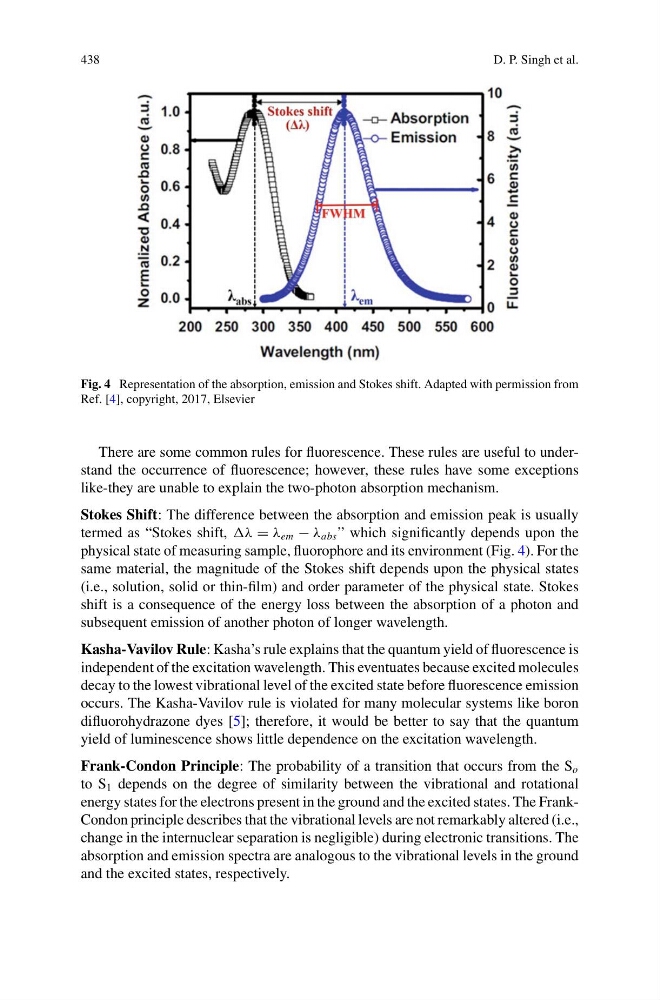
Fig. 4 Representation of the absorption, emission and Stokes shift. Adapted with permission from
Ref. [4], copyright, 2017, Elsevier
There are some common rules for fluorescence. These rules are useful to understand the occurrence of fluorescence; however, these rules have some exceptions
like-they are unable to explain the two-photon absorption mechanism.
Stokes Shift: The difference between the absorption and emission peak is usually
termed as “Stokes shift, λ = λ em − λ abs ” which significantly depends upon the
physical state of measuring sample, fluorophore and its environment (Fig. 4). For the
same material, the magnitude of the Stokes shift depends upon the physical states
(i.e., solution, solid or thin-film) and order parameter of the physical state. Stokes
shift is a consequence of the energy loss between the absorption of a photon and
subsequent emission of another photon of longer wavelength.
Kasha-Vavilov Rule: Kasha’s rule explains that the quantum yield of fluorescence is
independent of the excitation wavelength. This eventuates because excited molecules
decay to the lowest vibrational level of the excited state before fluorescence emission
occurs. The Kasha-Vavilov rule is violated for many molecular systems like boron
difluorohydrazone dyes [5]; therefore, it would be better to say that the quantum
yield of luminescence shows little dependence on the excitation wavelength.
Frank-Condon Principle: The probability of a transition that occurs from the S o
to S 1 depends on the degree of similarity between the vibrational and rotational
energy states for the electrons present in the ground and the excited states. The FrankCondon principle describes that the vibrational levels are not remarkably altered (i.e.,
change in the internuclear separation is negligible) during electronic transitions. The
absorption and emission spectra are analogous to the vibrational levels in the ground
and the excited states, respectively.
D. P. Singh et al.
Fig. 4 Representation of the absorption, emission and Stokes shift. Adapted with permission from
Ref. [4], copyright, 2017, Elsevier
There are some common rules for fluorescence. These rules are useful to understand the occurrence of fluorescence; however, these rules have some exceptions
like-they are unable to explain the two-photon absorption mechanism.
Stokes Shift: The difference between the absorption and emission peak is usually
termed as “Stokes shift, λ = λ em − λ abs ” which significantly depends upon the
physical state of measuring sample, fluorophore and its environment (Fig. 4). For the
same material, the magnitude of the Stokes shift depends upon the physical states
(i.e., solution, solid or thin-film) and order parameter of the physical state. Stokes
shift is a consequence of the energy loss between the absorption of a photon and
subsequent emission of another photon of longer wavelength.
Kasha-Vavilov Rule: Kasha’s rule explains that the quantum yield of fluorescence is
independent of the excitation wavelength. This eventuates because excited molecules
decay to the lowest vibrational level of the excited state before fluorescence emission
occurs. The Kasha-Vavilov rule is violated for many molecular systems like boron
difluorohydrazone dyes [5]; therefore, it would be better to say that the quantum
yield of luminescence shows little dependence on the excitation wavelength.
Frank-Condon Principle: The probability of a transition that occurs from the S o
to S 1 depends on the degree of similarity between the vibrational and rotational
energy states for the electrons present in the ground and the excited states. The FrankCondon principle describes that the vibrational levels are not remarkably altered (i.e.,
change in the internuclear separation is negligible) during electronic transitions. The
absorption and emission spectra are analogous to the vibrational levels in the ground
and the excited states, respectively.