

Fluorescence Spectrometry
437
is approximately 10
4 times longer than that of the singlet state. Electromagnetic
radiation that induces a transition from the ground state to an excited triplet
state shows a low possibility of occurrence; therefore, their absorption bands
are less intense as compared to the singlet-singlet state absorption band. The
excited triplet state can be populated from the excited singlet state that results
in the occurrence of phosphorescence. These spin multiplicities in the ground
and excited states are used to explain the mechanism of photoluminescence.
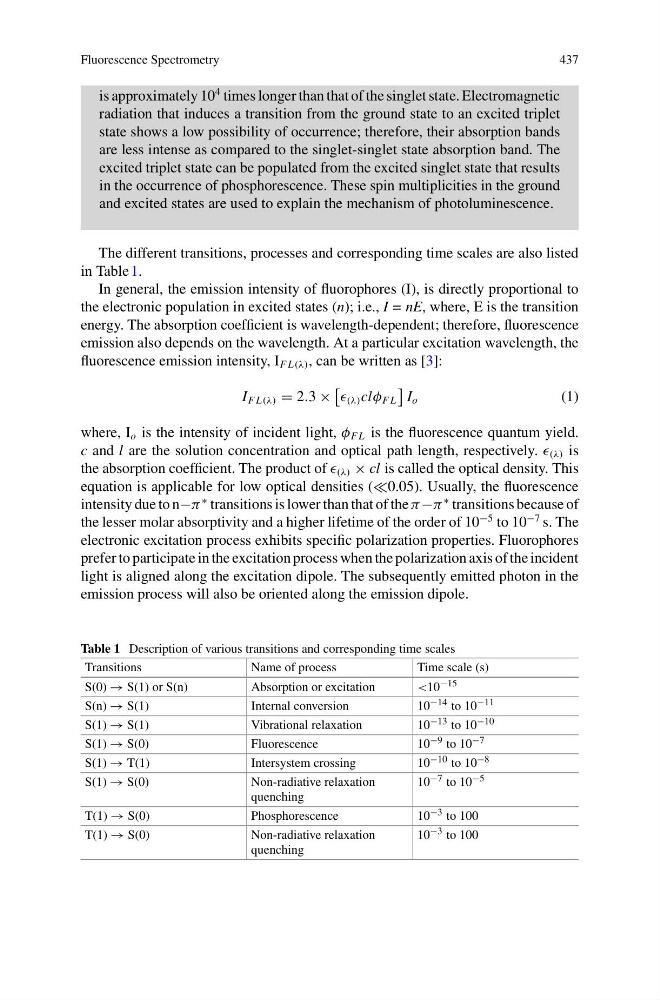
The different transitions, processes and corresponding time scales are also listed
in Table 1.
In general, the emission intensity of fluorophores (I), is directly proportional to
the electronic population in excited states (n); i.e., I = nE, where, E is the transition
energy. The absorption coefficient is wavelength-dependent; therefore, fluorescence
emission also depends on the wavelength. At a particular excitation wavelength, the
fluorescence emission intensity, I F L(λ) , can be written as [3]:
I F L(λ) = 2.3 ×
(λ) clφ F L
I o
(1)
where, I o is the intensity of incident light, φ F L is the fluorescence quantum yield.
c and l are the solution concentration and optical path length, respectively. (λ) is
the absorption coefficient. The product of (λ) × cl is called the optical density. This
equation is applicable for low optical densities (0.05). Usually, the fluorescence
intensity due to n−π
∗ transitions is lower than that of the π −π
∗ transitions because of
the lesser molar absorptivity and a higher lifetime of the order of 10
−5 to 10
−7 s. The
electronic excitation process exhibits specific polarization properties. Fluorophores
prefer to participate in the excitation process when the polarization axis of the incident
light is aligned along the excitation dipole. The subsequently emitted photon in the
emission process will also be oriented along the emission dipole.
Table 1 Description of various transitions and corresponding time scales
Transitions
Name of process
Time scale (s)
S(0) → S(1) or S(n)
Absorption or excitation
<10 −15
S(n) → S(1)
Internal conversion
10 −14 to 10 −11
S(1) → S(1)
Vibrational relaxation
10 −13 to 10 −10
S(1) → S(0)
Fluorescence
10 −9 to 10 −7
S(1) → T(1)
Intersystem crossing
10 −10 to 10 −8
S(1) → S(0)
Non-radiative relaxation
quenching
10 −7 to 10 −5
T(1) → S(0)
Phosphorescence
10 −3 to 100
T(1) → S(0)
Non-radiative relaxation
quenching
10 −3 to 100
437
is approximately 10
4 times longer than that of the singlet state. Electromagnetic
radiation that induces a transition from the ground state to an excited triplet
state shows a low possibility of occurrence; therefore, their absorption bands
are less intense as compared to the singlet-singlet state absorption band. The
excited triplet state can be populated from the excited singlet state that results
in the occurrence of phosphorescence. These spin multiplicities in the ground
and excited states are used to explain the mechanism of photoluminescence.
The different transitions, processes and corresponding time scales are also listed
in Table 1.
In general, the emission intensity of fluorophores (I), is directly proportional to
the electronic population in excited states (n); i.e., I = nE, where, E is the transition
energy. The absorption coefficient is wavelength-dependent; therefore, fluorescence
emission also depends on the wavelength. At a particular excitation wavelength, the
fluorescence emission intensity, I F L(λ) , can be written as [3]:
I F L(λ) = 2.3 ×
(λ) clφ F L
I o
(1)
where, I o is the intensity of incident light, φ F L is the fluorescence quantum yield.
c and l are the solution concentration and optical path length, respectively. (λ) is
the absorption coefficient. The product of (λ) × cl is called the optical density. This
equation is applicable for low optical densities (0.05). Usually, the fluorescence
intensity due to n−π
∗ transitions is lower than that of the π −π
∗ transitions because of
the lesser molar absorptivity and a higher lifetime of the order of 10
−5 to 10
−7 s. The
electronic excitation process exhibits specific polarization properties. Fluorophores
prefer to participate in the excitation process when the polarization axis of the incident
light is aligned along the excitation dipole. The subsequently emitted photon in the
emission process will also be oriented along the emission dipole.
Table 1 Description of various transitions and corresponding time scales
Transitions
Name of process
Time scale (s)
S(0) → S(1) or S(n)
Absorption or excitation
<10 −15
S(n) → S(1)
Internal conversion
10 −14 to 10 −11
S(1) → S(1)
Vibrational relaxation
10 −13 to 10 −10
S(1) → S(0)
Fluorescence
10 −9 to 10 −7
S(1) → T(1)
Intersystem crossing
10 −10 to 10 −8
S(1) → S(0)
Non-radiative relaxation
quenching
10 −7 to 10 −5
T(1) → S(0)
Phosphorescence
10 −3 to 100
T(1) → S(0)
Non-radiative relaxation
quenching
10 −3 to 100