

Quantum Cascade Laser Spectroscopy
371
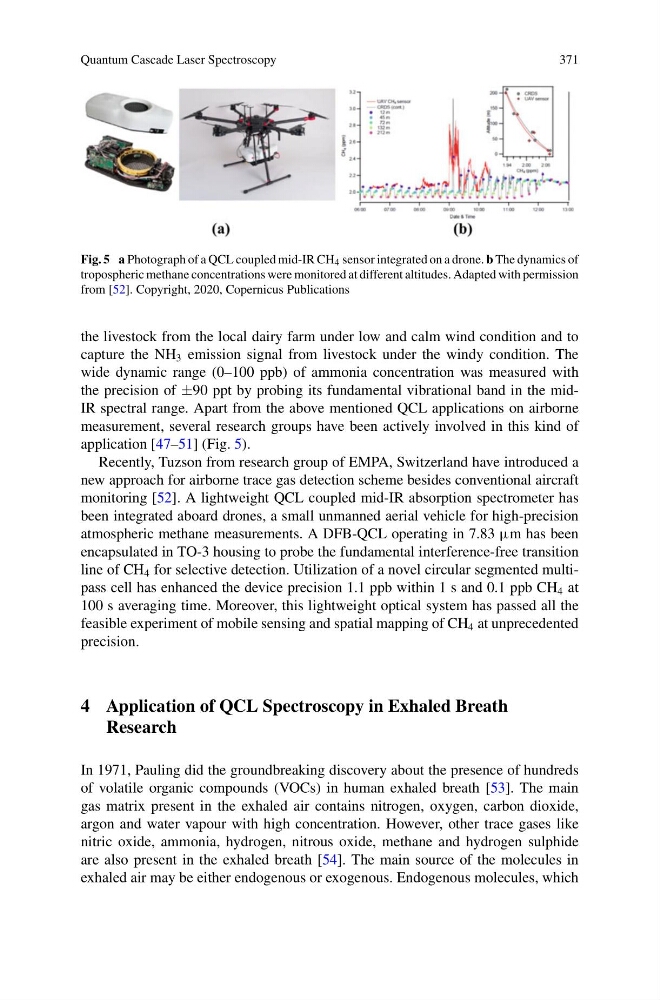
Fig. 5 a Photograph of a QCL coupled mid-IR CH 4 sensor integrated on a drone. b The dynamics of
tropospheric methane concentrations were monitored at different altitudes. Adapted with permission
from [52]. Copyright, 2020, Copernicus Publications
the livestock from the local dairy farm under low and calm wind condition and to
capture the NH 3 emission signal from livestock under the windy condition. The
wide dynamic range (0–100 ppb) of ammonia concentration was measured with
the precision of ±90 ppt by probing its fundamental vibrational band in the midIR spectral range. Apart from the above mentioned QCL applications on airborne
measurement, several research groups have been actively involved in this kind of
application [47–51] (Fig. 5).
Recently, Tuzson from research group of EMPA, Switzerland have introduced a
new approach for airborne trace gas detection scheme besides conventional aircraft
monitoring [52]. A lightweight QCL coupled mid-IR absorption spectrometer has
been integrated aboard drones, a small unmanned aerial vehicle for high-precision
atmospheric methane measurements. A DFB-QCL operating in 7.83 μm has been
encapsulated in TO-3 housing to probe the fundamental interference-free transition
line of CH 4 for selective detection. Utilization of a novel circular segmented multipass cell has enhanced the device precision 1.1 ppb within 1 s and 0.1 ppb CH 4 at
100 s averaging time. Moreover, this lightweight optical system has passed all the
feasible experiment of mobile sensing and spatial mapping of CH 4 at unprecedented
precision.
4 Application of QCL Spectroscopy in Exhaled Breath
Research
In 1971, Pauling did the groundbreaking discovery about the presence of hundreds
of volatile organic compounds (VOCs) in human exhaled breath [53]. The main
gas matrix present in the exhaled air contains nitrogen, oxygen, carbon dioxide,
argon and water vapour with high concentration. However, other trace gases like
nitric oxide, ammonia, hydrogen, nitrous oxide, methane and hydrogen sulphide
are also present in the exhaled breath [54]. The main source of the molecules in
exhaled air may be either endogenous or exogenous. Endogenous molecules, which
371
Fig. 5 a Photograph of a QCL coupled mid-IR CH 4 sensor integrated on a drone. b The dynamics of
tropospheric methane concentrations were monitored at different altitudes. Adapted with permission
from [52]. Copyright, 2020, Copernicus Publications
the livestock from the local dairy farm under low and calm wind condition and to
capture the NH 3 emission signal from livestock under the windy condition. The
wide dynamic range (0–100 ppb) of ammonia concentration was measured with
the precision of ±90 ppt by probing its fundamental vibrational band in the midIR spectral range. Apart from the above mentioned QCL applications on airborne
measurement, several research groups have been actively involved in this kind of
application [47–51] (Fig. 5).
Recently, Tuzson from research group of EMPA, Switzerland have introduced a
new approach for airborne trace gas detection scheme besides conventional aircraft
monitoring [52]. A lightweight QCL coupled mid-IR absorption spectrometer has
been integrated aboard drones, a small unmanned aerial vehicle for high-precision
atmospheric methane measurements. A DFB-QCL operating in 7.83 μm has been
encapsulated in TO-3 housing to probe the fundamental interference-free transition
line of CH 4 for selective detection. Utilization of a novel circular segmented multipass cell has enhanced the device precision 1.1 ppb within 1 s and 0.1 ppb CH 4 at
100 s averaging time. Moreover, this lightweight optical system has passed all the
feasible experiment of mobile sensing and spatial mapping of CH 4 at unprecedented
precision.
4 Application of QCL Spectroscopy in Exhaled Breath
Research
In 1971, Pauling did the groundbreaking discovery about the presence of hundreds
of volatile organic compounds (VOCs) in human exhaled breath [53]. The main
gas matrix present in the exhaled air contains nitrogen, oxygen, carbon dioxide,
argon and water vapour with high concentration. However, other trace gases like
nitric oxide, ammonia, hydrogen, nitrous oxide, methane and hydrogen sulphide
are also present in the exhaled breath [54]. The main source of the molecules in
exhaled air may be either endogenous or exogenous. Endogenous molecules, which