

370
M. Pal and M. Pradhan
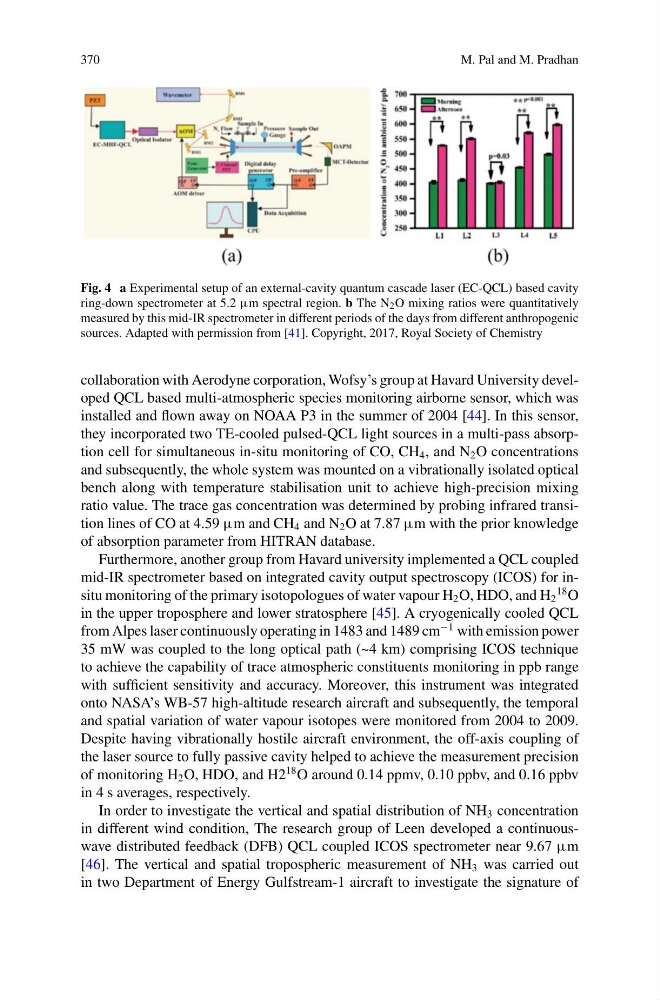
Fig. 4 a Experimental setup of an external-cavity quantum cascade laser (EC-QCL) based cavity
ring-down spectrometer at 5.2 μm spectral region. b The N 2 O mixing ratios were quantitatively
measured by this mid-IR spectrometer in different periods of the days from different anthropogenic
sources. Adapted with permission from [41]. Copyright, 2017, Royal Society of Chemistry
collaboration with Aerodyne corporation, Wofsy’s group at Havard University developed QCL based multi-atmospheric species monitoring airborne sensor, which was
installed and flown away on NOAA P3 in the summer of 2004 [44]. In this sensor,
they incorporated two TE-cooled pulsed-QCL light sources in a multi-pass absorption cell for simultaneous in-situ monitoring of CO, CH 4 , and N 2 O concentrations
and subsequently, the whole system was mounted on a vibrationally isolated optical
bench along with temperature stabilisation unit to achieve high-precision mixing
ratio value. The trace gas concentration was determined by probing infrared transition lines of CO at 4.59 μm and CH 4 and N 2 O at 7.87 μm with the prior knowledge
of absorption parameter from HITRAN database.
Furthermore, another group from Havard university implemented a QCL coupled
mid-IR spectrometer based on integrated cavity output spectroscopy (ICOS) for insitu monitoring of the primary isotopologues of water vapour H 2 O, HDO, and H 2
18 O
in the upper troposphere and lower stratosphere [45]. A cryogenically cooled QCL
from Alpes laser continuously operating in 1483 and 1489 cm
−1 with emission power
35 mW was coupled to the long optical path (~4 km) comprising ICOS technique
to achieve the capability of trace atmospheric constituents monitoring in ppb range
with sufficient sensitivity and accuracy. Moreover, this instrument was integrated
onto NASA’s WB-57 high-altitude research aircraft and subsequently, the temporal
and spatial variation of water vapour isotopes were monitored from 2004 to 2009.
Despite having vibrationally hostile aircraft environment, the off-axis coupling of
the laser source to fully passive cavity helped to achieve the measurement precision
of monitoring H 2 O, HDO, and H2
18 O around 0.14 ppmv, 0.10 ppbv, and 0.16 ppbv
in 4 s averages, respectively.
In order to investigate the vertical and spatial distribution of NH 3 concentration
in different wind condition, The research group of Leen developed a continuouswave distributed feedback (DFB) QCL coupled ICOS spectrometer near 9.67 μm
[46]. The vertical and spatial tropospheric measurement of NH 3 was carried out
in two Department of Energy Gulfstream-1 aircraft to investigate the signature of
M. Pal and M. Pradhan
Fig. 4 a Experimental setup of an external-cavity quantum cascade laser (EC-QCL) based cavity
ring-down spectrometer at 5.2 μm spectral region. b The N 2 O mixing ratios were quantitatively
measured by this mid-IR spectrometer in different periods of the days from different anthropogenic
sources. Adapted with permission from [41]. Copyright, 2017, Royal Society of Chemistry
collaboration with Aerodyne corporation, Wofsy’s group at Havard University developed QCL based multi-atmospheric species monitoring airborne sensor, which was
installed and flown away on NOAA P3 in the summer of 2004 [44]. In this sensor,
they incorporated two TE-cooled pulsed-QCL light sources in a multi-pass absorption cell for simultaneous in-situ monitoring of CO, CH 4 , and N 2 O concentrations
and subsequently, the whole system was mounted on a vibrationally isolated optical
bench along with temperature stabilisation unit to achieve high-precision mixing
ratio value. The trace gas concentration was determined by probing infrared transition lines of CO at 4.59 μm and CH 4 and N 2 O at 7.87 μm with the prior knowledge
of absorption parameter from HITRAN database.
Furthermore, another group from Havard university implemented a QCL coupled
mid-IR spectrometer based on integrated cavity output spectroscopy (ICOS) for insitu monitoring of the primary isotopologues of water vapour H 2 O, HDO, and H 2
18 O
in the upper troposphere and lower stratosphere [45]. A cryogenically cooled QCL
from Alpes laser continuously operating in 1483 and 1489 cm
−1 with emission power
35 mW was coupled to the long optical path (~4 km) comprising ICOS technique
to achieve the capability of trace atmospheric constituents monitoring in ppb range
with sufficient sensitivity and accuracy. Moreover, this instrument was integrated
onto NASA’s WB-57 high-altitude research aircraft and subsequently, the temporal
and spatial variation of water vapour isotopes were monitored from 2004 to 2009.
Despite having vibrationally hostile aircraft environment, the off-axis coupling of
the laser source to fully passive cavity helped to achieve the measurement precision
of monitoring H 2 O, HDO, and H2
18 O around 0.14 ppmv, 0.10 ppbv, and 0.16 ppbv
in 4 s averages, respectively.
In order to investigate the vertical and spatial distribution of NH 3 concentration
in different wind condition, The research group of Leen developed a continuouswave distributed feedback (DFB) QCL coupled ICOS spectrometer near 9.67 μm
[46]. The vertical and spatial tropospheric measurement of NH 3 was carried out
in two Department of Energy Gulfstream-1 aircraft to investigate the signature of