

372
M. Pal and M. Pradhan
are produced in response to the metabolic process in the human body, are transported through the bloodstream and subsequently, they are exhaled via an alveolar
pulmonary membrane. The concentration of exhaled air trace molecules generally
varies with patient’s diet, state of health and stress level. Therefore, exhaling excessive
amount of some compounds might be the cause of some diseases.
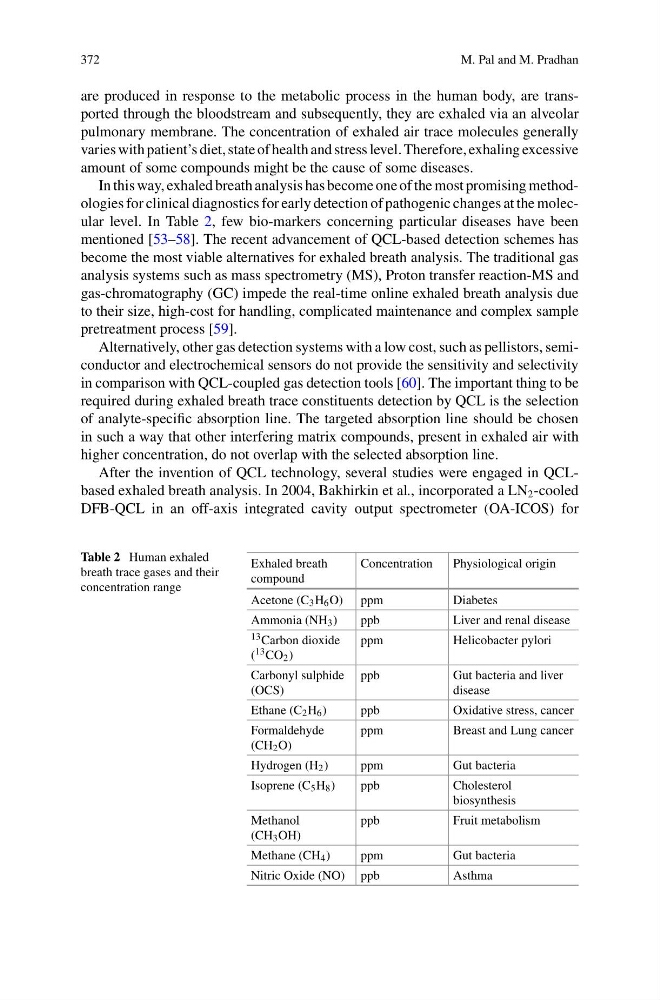
In this way, exhaled breath analysis has become one of the most promising methodologies for clinical diagnostics for early detection of pathogenic changes at the molecular level. In Table 2, few bio-markers concerning particular diseases have been
mentioned [53–58]. The recent advancement of QCL-based detection schemes has
become the most viable alternatives for exhaled breath analysis. The traditional gas
analysis systems such as mass spectrometry (MS), Proton transfer reaction-MS and
gas-chromatography (GC) impede the real-time online exhaled breath analysis due
to their size, high-cost for handling, complicated maintenance and complex sample
pretreatment process [59].
Alternatively, other gas detection systems with a low cost, such as pellistors, semiconductor and electrochemical sensors do not provide the sensitivity and selectivity
in comparison with QCL-coupled gas detection tools [60]. The important thing to be
required during exhaled breath trace constituents detection by QCL is the selection
of analyte-specific absorption line. The targeted absorption line should be chosen
in such a way that other interfering matrix compounds, present in exhaled air with
higher concentration, do not overlap with the selected absorption line.
After the invention of QCL technology, several studies were engaged in QCLbased exhaled breath analysis. In 2004, Bakhirkin et al., incorporated a LN 2 -cooled
DFB-QCL in an off-axis integrated cavity output spectrometer (OA-ICOS) for
Table 2 Human exhaled
breath trace gases and their
concentration range
Exhaled breath
compound
Concentration
Physiological origin
Acetone (C 3 H 6 O) ppm
Diabetes
Ammonia (NH 3 )
ppb
Liver and renal disease
13 Carbon dioxide
( 13 CO 2 )
ppm
Helicobacter pylori
Carbonyl sulphide
(OCS)
ppb
Gut bacteria and liver
disease
Ethane (C 2 H 6 )
ppb
Oxidative stress, cancer
Formaldehyde
(CH 2 O)
ppm
Breast and Lung cancer
Hydrogen (H 2 )
ppm
Gut bacteria
Isoprene (C 5 H 8 )
ppb
Cholesterol
biosynthesis
Methanol
(CH 3 OH)
ppb
Fruit metabolism
Methane (CH 4 )
ppm
Gut bacteria
Nitric Oxide (NO) ppb
Asthma
M. Pal and M. Pradhan
are produced in response to the metabolic process in the human body, are transported through the bloodstream and subsequently, they are exhaled via an alveolar
pulmonary membrane. The concentration of exhaled air trace molecules generally
varies with patient’s diet, state of health and stress level. Therefore, exhaling excessive
amount of some compounds might be the cause of some diseases.
In this way, exhaled breath analysis has become one of the most promising methodologies for clinical diagnostics for early detection of pathogenic changes at the molecular level. In Table 2, few bio-markers concerning particular diseases have been
mentioned [53–58]. The recent advancement of QCL-based detection schemes has
become the most viable alternatives for exhaled breath analysis. The traditional gas
analysis systems such as mass spectrometry (MS), Proton transfer reaction-MS and
gas-chromatography (GC) impede the real-time online exhaled breath analysis due
to their size, high-cost for handling, complicated maintenance and complex sample
pretreatment process [59].
Alternatively, other gas detection systems with a low cost, such as pellistors, semiconductor and electrochemical sensors do not provide the sensitivity and selectivity
in comparison with QCL-coupled gas detection tools [60]. The important thing to be
required during exhaled breath trace constituents detection by QCL is the selection
of analyte-specific absorption line. The targeted absorption line should be chosen
in such a way that other interfering matrix compounds, present in exhaled air with
higher concentration, do not overlap with the selected absorption line.
After the invention of QCL technology, several studies were engaged in QCLbased exhaled breath analysis. In 2004, Bakhirkin et al., incorporated a LN 2 -cooled
DFB-QCL in an off-axis integrated cavity output spectrometer (OA-ICOS) for
Table 2 Human exhaled
breath trace gases and their
concentration range
Exhaled breath
compound
Concentration
Physiological origin
Acetone (C 3 H 6 O) ppm
Diabetes
Ammonia (NH 3 )
ppb
Liver and renal disease
13 Carbon dioxide
( 13 CO 2 )
ppm
Helicobacter pylori
Carbonyl sulphide
(OCS)
ppb
Gut bacteria and liver
disease
Ethane (C 2 H 6 )
ppb
Oxidative stress, cancer
Formaldehyde
(CH 2 O)
ppm
Breast and Lung cancer
Hydrogen (H 2 )
ppm
Gut bacteria
Isoprene (C 5 H 8 )
ppb
Cholesterol
biosynthesis
Methanol
(CH 3 OH)
ppb
Fruit metabolism
Methane (CH 4 )
ppm
Gut bacteria
Nitric Oxide (NO) ppb
Asthma