

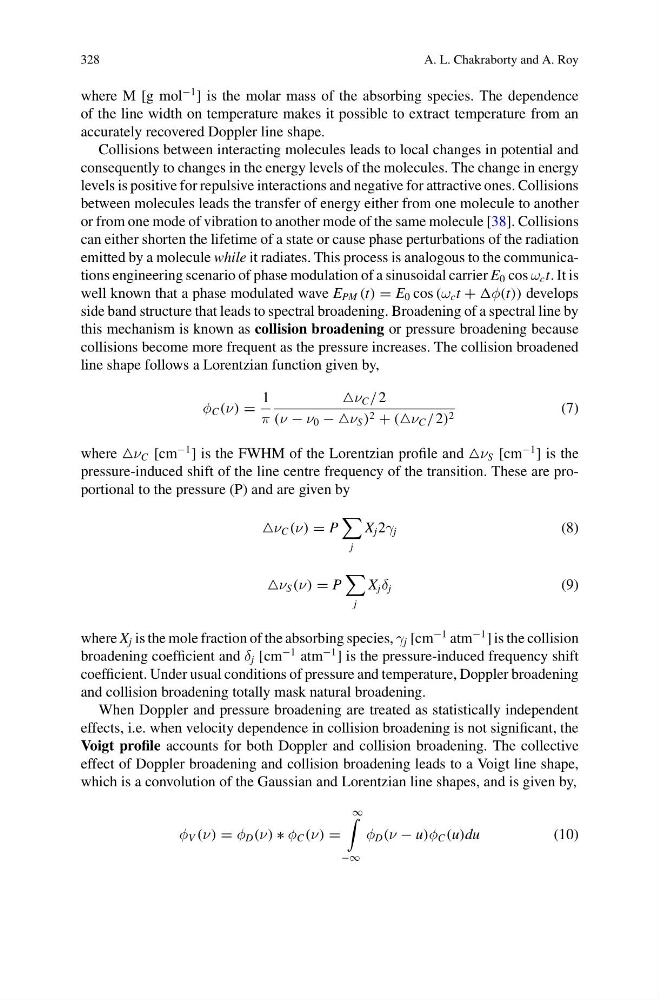
328
A. L. Chakraborty and A. Roy
where M [g mol
−1 ] is the molar mass of the absorbing species. The dependence
of the line width on temperature makes it possible to extract temperature from an
accurately recovered Doppler line shape.
Collisions between interacting molecules leads to local changes in potential and
consequently to changes in the energy levels of the molecules. The change in energy
levels is positive for repulsive interactions and negative for attractive ones. Collisions
between molecules leads the transfer of energy either from one molecule to another
or from one mode of vibration to another mode of the same molecule [38]. Collisions
can either shorten the lifetime of a state or cause phase perturbations of the radiation
emitted by a molecule while it radiates. This process is analogous to the communications engineering scenario of phase modulation of a sinusoidal carrier E 0 cos ω c t. It is
well known that a phase modulated wave E PM (t) = E 0 cos (ω c t + φ(t)) develops
side band structure that leads to spectral broadening. Broadening of a spectral line by
this mechanism is known as collision broadening or pressure broadening because
collisions become more frequent as the pressure increases. The collision broadened
line shape follows a Lorentzian function given by,
φ C (ν) =
1
π
ν C / 2
(ν − ν 0 − −ν S ) 2 + (ν C / 2) 2
(7)
where ν C [cm
−1 ] is the FWHM of the Lorentzian profile and ν S [cm
−1 ] is the
pressure-induced shift of the line centre frequency of the transition. These are proportional to the pressure (P) and are given by
ν C (ν) = P
j
X j 2γ j
(8)
ν S (ν) = P
j
X j δ j
(9)
where X j is the mole fraction of the absorbing species, γ j [cm
−1 atm
−1 ] is the collision
broadening coefficient and δ j [cm
−1 atm
−1 ] is the pressure-induced frequency shift
coefficient. Under usual conditions of pressure and temperature, Doppler broadening
and collision broadening totally mask natural broadening.
When Doppler and pressure broadening are treated as statistically independent
effects, i.e. when velocity dependence in collision broadening is not significant, the
Voigt profile accounts for both Doppler and collision broadening. The collective
effect of Doppler broadening and collision broadening leads to a Voigt line shape,
which is a convolution of the Gaussian and Lorentzian line shapes, and is given by,
φ V (ν) = φ D (ν) ∗ φ C (ν) =
∞
−∞
φ D (ν − u)φ C (u)du
(10)
A. L. Chakraborty and A. Roy
where M [g mol
−1 ] is the molar mass of the absorbing species. The dependence
of the line width on temperature makes it possible to extract temperature from an
accurately recovered Doppler line shape.
Collisions between interacting molecules leads to local changes in potential and
consequently to changes in the energy levels of the molecules. The change in energy
levels is positive for repulsive interactions and negative for attractive ones. Collisions
between molecules leads the transfer of energy either from one molecule to another
or from one mode of vibration to another mode of the same molecule [38]. Collisions
can either shorten the lifetime of a state or cause phase perturbations of the radiation
emitted by a molecule while it radiates. This process is analogous to the communications engineering scenario of phase modulation of a sinusoidal carrier E 0 cos ω c t. It is
well known that a phase modulated wave E PM (t) = E 0 cos (ω c t + φ(t)) develops
side band structure that leads to spectral broadening. Broadening of a spectral line by
this mechanism is known as collision broadening or pressure broadening because
collisions become more frequent as the pressure increases. The collision broadened
line shape follows a Lorentzian function given by,
φ C (ν) =
1
π
ν C / 2
(ν − ν 0 − −ν S ) 2 + (ν C / 2) 2
(7)
where ν C [cm
−1 ] is the FWHM of the Lorentzian profile and ν S [cm
−1 ] is the
pressure-induced shift of the line centre frequency of the transition. These are proportional to the pressure (P) and are given by
ν C (ν) = P
j
X j 2γ j
(8)
ν S (ν) = P
j
X j δ j
(9)
where X j is the mole fraction of the absorbing species, γ j [cm
−1 atm
−1 ] is the collision
broadening coefficient and δ j [cm
−1 atm
−1 ] is the pressure-induced frequency shift
coefficient. Under usual conditions of pressure and temperature, Doppler broadening
and collision broadening totally mask natural broadening.
When Doppler and pressure broadening are treated as statistically independent
effects, i.e. when velocity dependence in collision broadening is not significant, the
Voigt profile accounts for both Doppler and collision broadening. The collective
effect of Doppler broadening and collision broadening leads to a Voigt line shape,
which is a convolution of the Gaussian and Lorentzian line shapes, and is given by,
φ V (ν) = φ D (ν) ∗ φ C (ν) =
∞
−∞
φ D (ν − u)φ C (u)du
(10)