

Wavelength Modulation Spectroscopy
327
2.3 Line Shape Functions
A spectral line corresponding to a transition between two allowed energy levels
is never infinitesimally narrow. There are fundamental quantum mechanical limits
to the minimum linewidth as well as macroscopic effects due to temperature and
collisions between molecules that cause the lines to have a finite width [38]. The
three main mechanisms that lead to broadening of an absorption line are natural
broadening, Doppler broadening and collision broadening. The relative contributions
from the different broadening mechanisms depend on the temperature, pressure and
concentration of the gas.
All spectral lines have a minimum width known as the natural linewidth, which is
essentially due to spontaneous emission that results from a finite upper state lifetime
(t u ) of the excited species. Fourier analysis of the damped oscillations executed
by a spring-mass system (the classical model of a molecule) leads to a Lorentzian
frequency distribution about the central frequency (ν 0 ). This leads to the conclusion
that the radiation from a oscillator that is turned on or off at a specific time instant
must have a spectral distribution with non-zero width [38] known as the natural line
width. This can also be explained based on the Uncertainty Principle, t u E≥ , to
say that there is an inherent uncertainty in the energy of a state and therefore in the
emission wavelength. The contribution of natural broadening to the final line shape
is negligible compared to other broadening mechanisms that are far more dominant
under usual conditions of pressure and temperature encountered in TDLS.
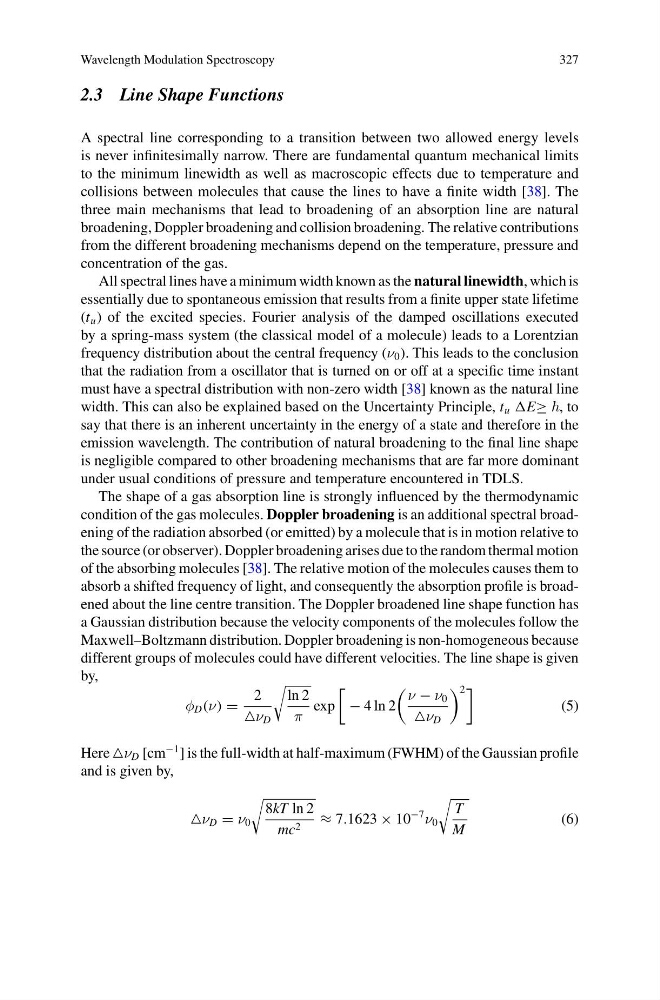
The shape of a gas absorption line is strongly influenced by the thermodynamic
condition of the gas molecules. Doppler broadening is an additional spectral broadening of the radiation absorbed (or emitted) by a molecule that is in motion relative to
the source (or observer). Doppler broadening arises due to the random thermal motion
of the absorbing molecules [38]. The relative motion of the molecules causes them to
absorb a shifted frequency of light, and consequently the absorption profile is broadened about the line centre transition. The Doppler broadened line shape function has
a Gaussian distribution because the velocity components of the molecules follow the
Maxwell–Boltzmann distribution. Doppler broadening is non-homogeneous because
different groups of molecules could have different velocities. The line shape is given
by,
φ D (ν) =
2
ν D
ln 2
π
exp
− 4 ln 2
ν − ν 0
ν D
2
(5)
Here ν D [cm
−1 ] is the full-width at half-maximum (FWHM) of the Gaussian profile
and is given by,
ν D = ν 0
8kT ln 2
mc 2 ≈ 7.1623 × 10
−7
ν 0
T
M
(6)
327
2.3 Line Shape Functions
A spectral line corresponding to a transition between two allowed energy levels
is never infinitesimally narrow. There are fundamental quantum mechanical limits
to the minimum linewidth as well as macroscopic effects due to temperature and
collisions between molecules that cause the lines to have a finite width [38]. The
three main mechanisms that lead to broadening of an absorption line are natural
broadening, Doppler broadening and collision broadening. The relative contributions
from the different broadening mechanisms depend on the temperature, pressure and
concentration of the gas.
All spectral lines have a minimum width known as the natural linewidth, which is
essentially due to spontaneous emission that results from a finite upper state lifetime
(t u ) of the excited species. Fourier analysis of the damped oscillations executed
by a spring-mass system (the classical model of a molecule) leads to a Lorentzian
frequency distribution about the central frequency (ν 0 ). This leads to the conclusion
that the radiation from a oscillator that is turned on or off at a specific time instant
must have a spectral distribution with non-zero width [38] known as the natural line
width. This can also be explained based on the Uncertainty Principle, t u E≥ , to
say that there is an inherent uncertainty in the energy of a state and therefore in the
emission wavelength. The contribution of natural broadening to the final line shape
is negligible compared to other broadening mechanisms that are far more dominant
under usual conditions of pressure and temperature encountered in TDLS.
The shape of a gas absorption line is strongly influenced by the thermodynamic
condition of the gas molecules. Doppler broadening is an additional spectral broadening of the radiation absorbed (or emitted) by a molecule that is in motion relative to
the source (or observer). Doppler broadening arises due to the random thermal motion
of the absorbing molecules [38]. The relative motion of the molecules causes them to
absorb a shifted frequency of light, and consequently the absorption profile is broadened about the line centre transition. The Doppler broadened line shape function has
a Gaussian distribution because the velocity components of the molecules follow the
Maxwell–Boltzmann distribution. Doppler broadening is non-homogeneous because
different groups of molecules could have different velocities. The line shape is given
by,
φ D (ν) =
2
ν D
ln 2
π
exp
− 4 ln 2
ν − ν 0
ν D
2
(5)
Here ν D [cm
−1 ] is the full-width at half-maximum (FWHM) of the Gaussian profile
and is given by,
ν D = ν 0
8kT ln 2
mc 2 ≈ 7.1623 × 10
−7
ν 0
T
M
(6)