

Wavelength Modulation Spectroscopy
329
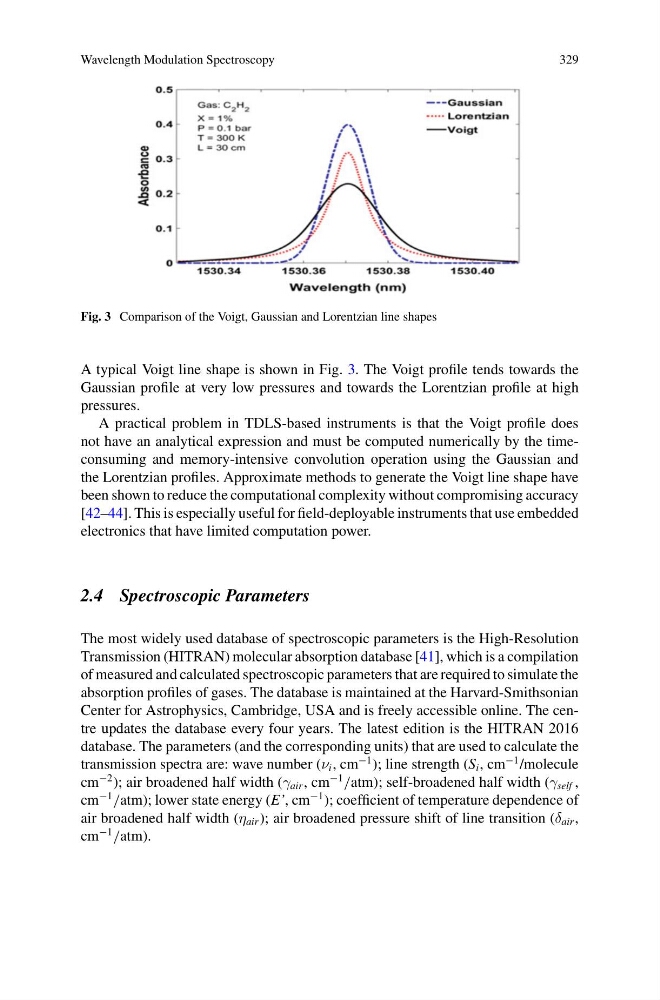
Fig. 3 Comparison of the Voigt, Gaussian and Lorentzian line shapes
A typical Voigt line shape is shown in Fig. 3. The Voigt profile tends towards the
Gaussian profile at very low pressures and towards the Lorentzian profile at high
pressures.
A practical problem in TDLS-based instruments is that the Voigt profile does
not have an analytical expression and must be computed numerically by the timeconsuming and memory-intensive convolution operation using the Gaussian and
the Lorentzian profiles. Approximate methods to generate the Voigt line shape have
been shown to reduce the computational complexity without compromising accuracy
[42–44]. This is especially useful for field-deployable instruments that use embedded
electronics that have limited computation power.
2.4 Spectroscopic Parameters
The most widely used database of spectroscopic parameters is the High-Resolution
Transmission (HITRAN) molecular absorption database [41], which is a compilation
of measured and calculated spectroscopic parameters that are required to simulate the
absorption profiles of gases. The database is maintained at the Harvard-Smithsonian
Center for Astrophysics, Cambridge, USA and is freely accessible online. The centre updates the database every four years. The latest edition is the HITRAN 2016
database. The parameters (and the corresponding units) that are used to calculate the
transmission spectra are: wave number (ν i , cm
−1 ); line strength (S i , cm
−1 /molecule
cm
−2 ); air broadened half width (γ air , cm
−1
/atm); self-broadened half width (γ self ,
cm
−1
/atm); lower state energy (E’, cm
−1 ); coefficient of temperature dependence of
air broadened half width (η air ); air broadened pressure shift of line transition (δ air ,
cm
−1
/atm).
329
Fig. 3 Comparison of the Voigt, Gaussian and Lorentzian line shapes
A typical Voigt line shape is shown in Fig. 3. The Voigt profile tends towards the
Gaussian profile at very low pressures and towards the Lorentzian profile at high
pressures.
A practical problem in TDLS-based instruments is that the Voigt profile does
not have an analytical expression and must be computed numerically by the timeconsuming and memory-intensive convolution operation using the Gaussian and
the Lorentzian profiles. Approximate methods to generate the Voigt line shape have
been shown to reduce the computational complexity without compromising accuracy
[42–44]. This is especially useful for field-deployable instruments that use embedded
electronics that have limited computation power.
2.4 Spectroscopic Parameters
The most widely used database of spectroscopic parameters is the High-Resolution
Transmission (HITRAN) molecular absorption database [41], which is a compilation
of measured and calculated spectroscopic parameters that are required to simulate the
absorption profiles of gases. The database is maintained at the Harvard-Smithsonian
Center for Astrophysics, Cambridge, USA and is freely accessible online. The centre updates the database every four years. The latest edition is the HITRAN 2016
database. The parameters (and the corresponding units) that are used to calculate the
transmission spectra are: wave number (ν i , cm
−1 ); line strength (S i , cm
−1 /molecule
cm
−2 ); air broadened half width (γ air , cm
−1
/atm); self-broadened half width (γ self ,
cm
−1
/atm); lower state energy (E’, cm
−1 ); coefficient of temperature dependence of
air broadened half width (η air ); air broadened pressure shift of line transition (δ air ,
cm
−1
/atm).