

292
A. Maity et al.
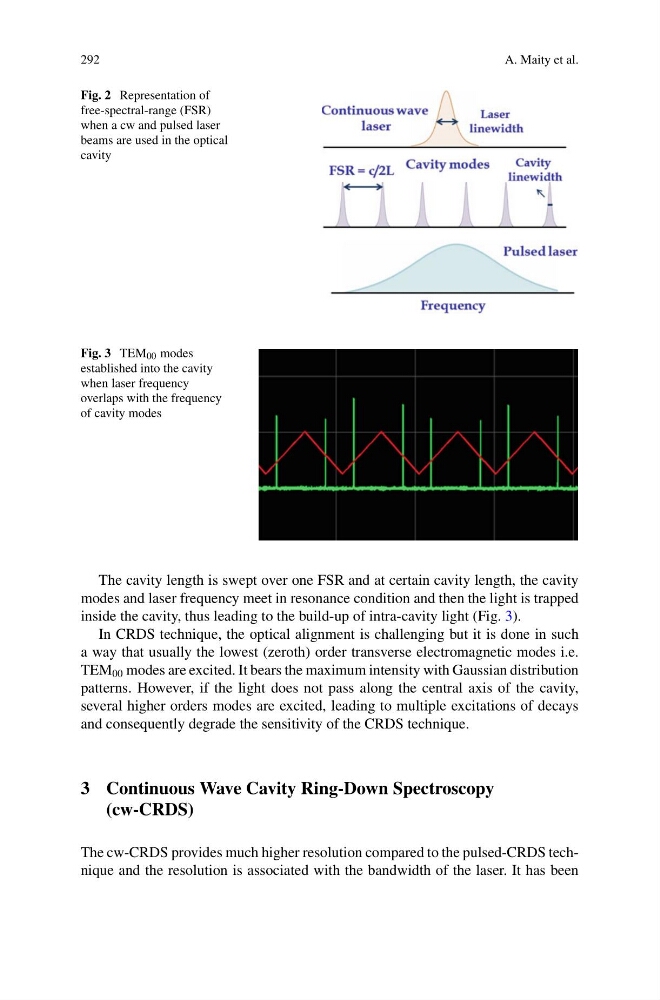
Fig. 2 Representation of
free-spectral-range (FSR)
when a cw and pulsed laser
beams are used in the optical
cavity
Fig. 3 TEM 00 modes
established into the cavity
when laser frequency
overlaps with the frequency
of cavity modes
The cavity length is swept over one FSR and at certain cavity length, the cavity
modes and laser frequency meet in resonance condition and then the light is trapped
inside the cavity, thus leading to the build-up of intra-cavity light (Fig. 3).
In CRDS technique, the optical alignment is challenging but it is done in such
a way that usually the lowest (zeroth) order transverse electromagnetic modes i.e.
TEM 00 modes are excited. It bears the maximum intensity with Gaussian distribution
patterns. However, if the light does not pass along the central axis of the cavity,
several higher orders modes are excited, leading to multiple excitations of decays
and consequently degrade the sensitivity of the CRDS technique.
3 Continuous Wave Cavity Ring-Down Spectroscopy
(cw-CRDS)
The cw-CRDS provides much higher resolution compared to the pulsed-CRDS technique and the resolution is associated with the bandwidth of the laser. It has been
A. Maity et al.
Fig. 2 Representation of
free-spectral-range (FSR)
when a cw and pulsed laser
beams are used in the optical
cavity
Fig. 3 TEM 00 modes
established into the cavity
when laser frequency
overlaps with the frequency
of cavity modes
The cavity length is swept over one FSR and at certain cavity length, the cavity
modes and laser frequency meet in resonance condition and then the light is trapped
inside the cavity, thus leading to the build-up of intra-cavity light (Fig. 3).
In CRDS technique, the optical alignment is challenging but it is done in such
a way that usually the lowest (zeroth) order transverse electromagnetic modes i.e.
TEM 00 modes are excited. It bears the maximum intensity with Gaussian distribution
patterns. However, if the light does not pass along the central axis of the cavity,
several higher orders modes are excited, leading to multiple excitations of decays
and consequently degrade the sensitivity of the CRDS technique.
3 Continuous Wave Cavity Ring-Down Spectroscopy
(cw-CRDS)
The cw-CRDS provides much higher resolution compared to the pulsed-CRDS technique and the resolution is associated with the bandwidth of the laser. It has been