

12
H. Kaur et al.
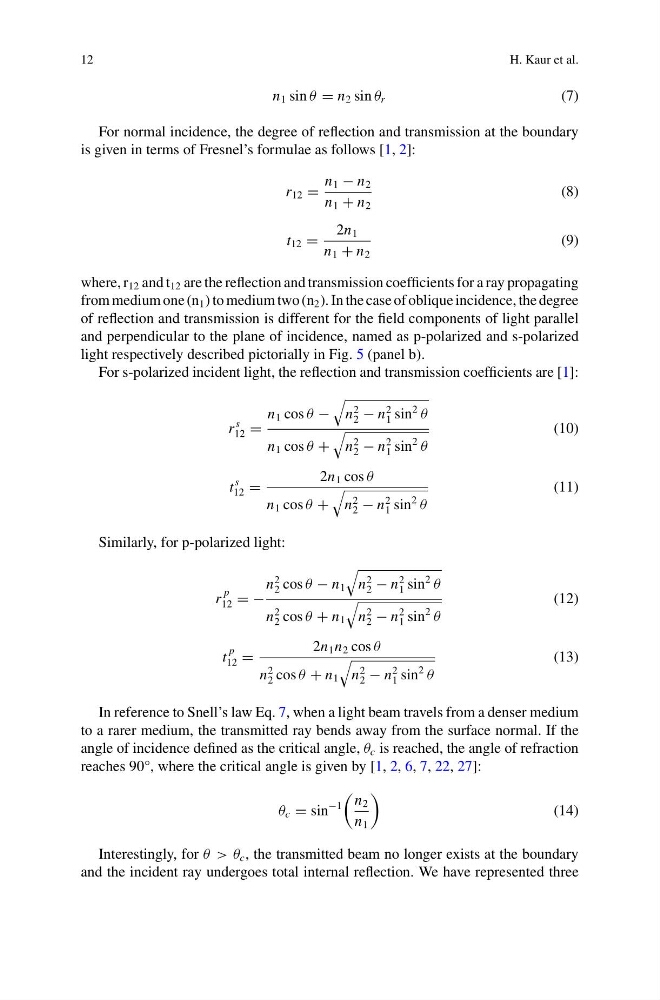
n 1 sin θ = n 2 sin θ r
(7)
For normal incidence, the degree of reflection and transmission at the boundary
is given in terms of Fresnel’s formulae as follows [1, 2]:
r 12 =
n 1 − n 2
n 1 + n 2
(8)
t 12 =
2n 1
n 1 + n 2
(9)
where, r 12 and t 12 are the reflection and transmission coefficients for a ray propagating
from medium one (n 1 ) to medium two (n 2 ). In the case of oblique incidence, the degree
of reflection and transmission is different for the field components of light parallel
and perpendicular to the plane of incidence, named as p-polarized and s-polarized
light respectively described pictorially in Fig. 5 (panel b).
For s-polarized incident light, the reflection and transmission coefficients are [1]:
r
s
12 =
n 1 cos θ −
n
2
2 − n
2
1 sin
2
θ
n 1 cos θ +
n
2
2 − n
2
1 sin
2
θ
(10)
t
s
12 =
2n 1 cos θ
n 1 cos θ +
n
2
2 − n
2
1 sin
2
θ
(11)
Similarly, for p-polarized light:
r
p
12 = −
n
2
2 cos θ − n 1
n
2
2 − n
2
1 sin
2
θ
n
2
2 cos θ + n 1
n
2
2 − n
2
1 sin
2
θ
(12)
t
p
12 =
2n 1 n 2 cos θ
n
2
2 cos θ + n 1
n
2
2 − n
2
1 sin
2
θ
(13)
In reference to Snell’s law Eq. 7, when a light beam travels from a denser medium
to a rarer medium, the transmitted ray bends away from the surface normal. If the
angle of incidence defined as the critical angle, θ c is reached, the angle of refraction
reaches 90°, where the critical angle is given by [1, 2, 6, 7, 22, 27]:
θ c = sin
−1
n 2
n 1
(14)
Interestingly, for θ > θ c , the transmitted beam no longer exists at the boundary
and the incident ray undergoes total internal reflection. We have represented three
H. Kaur et al.
n 1 sin θ = n 2 sin θ r
(7)
For normal incidence, the degree of reflection and transmission at the boundary
is given in terms of Fresnel’s formulae as follows [1, 2]:
r 12 =
n 1 − n 2
n 1 + n 2
(8)
t 12 =
2n 1
n 1 + n 2
(9)
where, r 12 and t 12 are the reflection and transmission coefficients for a ray propagating
from medium one (n 1 ) to medium two (n 2 ). In the case of oblique incidence, the degree
of reflection and transmission is different for the field components of light parallel
and perpendicular to the plane of incidence, named as p-polarized and s-polarized
light respectively described pictorially in Fig. 5 (panel b).
For s-polarized incident light, the reflection and transmission coefficients are [1]:
r
s
12 =
n 1 cos θ −
n
2
2 − n
2
1 sin
2
θ
n 1 cos θ +
n
2
2 − n
2
1 sin
2
θ
(10)
t
s
12 =
2n 1 cos θ
n 1 cos θ +
n
2
2 − n
2
1 sin
2
θ
(11)
Similarly, for p-polarized light:
r
p
12 = −
n
2
2 cos θ − n 1
n
2
2 − n
2
1 sin
2
θ
n
2
2 cos θ + n 1
n
2
2 − n
2
1 sin
2
θ
(12)
t
p
12 =
2n 1 n 2 cos θ
n
2
2 cos θ + n 1
n
2
2 − n
2
1 sin
2
θ
(13)
In reference to Snell’s law Eq. 7, when a light beam travels from a denser medium
to a rarer medium, the transmitted ray bends away from the surface normal. If the
angle of incidence defined as the critical angle, θ c is reached, the angle of refraction
reaches 90°, where the critical angle is given by [1, 2, 6, 7, 22, 27]:
θ c = sin
−1
n 2
n 1
(14)
Interestingly, for θ > θ c , the transmitted beam no longer exists at the boundary
and the incident ray undergoes total internal reflection. We have represented three