

Fundamentals of ATR-FTIR Spectroscopy and Its Role …
11
Eq. 6 [1, 2, 22].
ω I R =
1
λ I R
=
ν I R
c
=
1
2π c
k
m
(6)
Here, c is the velocity of light, λ I R is the IR wavelength, m is the reduced mass,
and k is the force constant.
The wavenumber of IR radiation and the force constant of molecules varies
according to the change in the chemical environment of the sample. So, the strength
of intermolecular interactions varies within the sample that originates a particular
width of the peak in the IR spectrum. Also, more is the mass of the atoms involved
in the functional group of a molecule, lower would be the resonance IR frequency.
IR spectroscopy usually can be operated in reflection, transmission, and absorption modes by using different types of accessories with the FTIR spectrometer. The
increasing interest of reflection spectroscopy within the research community lead the
development of a new IR spectroscopic technique based on total internal reflection
phenomenon named as attenuated total reflectance IR (ATR-IR) spectroscopy [1, 2,
5, 22, 32]. Here, we will briefly review the fundamental aspects of the reflection
phenomenon occurring at the boundary between the two media of different refractive index. When an electromagnetic wave travels from one medium to another, the
extent of reflection and transmission of light intensity at the boundary between the
two optically transparent media is associated with their respective refractive indices.
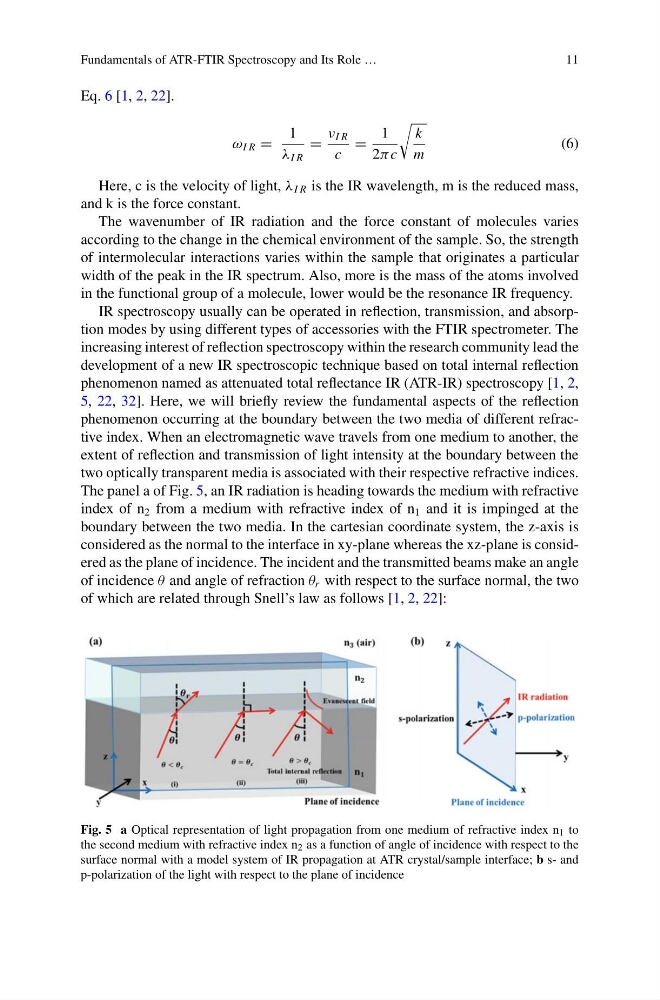
The panel a of Fig. 5, an IR radiation is heading towards the medium with refractive
index of n 2 from a medium with refractive index of n 1 and it is impinged at the
boundary between the two media. In the cartesian coordinate system, the z-axis is
considered as the normal to the interface in xy-plane whereas the xz-plane is considered as the plane of incidence. The incident and the transmitted beams make an angle
of incidence θ and angle of refraction θ r with respect to the surface normal, the two
of which are related through Snell’s law as follows [1, 2, 22]:
Fig. 5 a Optical representation of light propagation from one medium of refractive index n 1 to
the second medium with refractive index n 2 as a function of angle of incidence with respect to the
surface normal with a model system of IR propagation at ATR crystal/sample interface; b s- and
p-polarization of the light with respect to the plane of incidence
11
Eq. 6 [1, 2, 22].
ω I R =
1
λ I R
=
ν I R
c
=
1
2π c
k
m
(6)
Here, c is the velocity of light, λ I R is the IR wavelength, m is the reduced mass,
and k is the force constant.
The wavenumber of IR radiation and the force constant of molecules varies
according to the change in the chemical environment of the sample. So, the strength
of intermolecular interactions varies within the sample that originates a particular
width of the peak in the IR spectrum. Also, more is the mass of the atoms involved
in the functional group of a molecule, lower would be the resonance IR frequency.
IR spectroscopy usually can be operated in reflection, transmission, and absorption modes by using different types of accessories with the FTIR spectrometer. The
increasing interest of reflection spectroscopy within the research community lead the
development of a new IR spectroscopic technique based on total internal reflection
phenomenon named as attenuated total reflectance IR (ATR-IR) spectroscopy [1, 2,
5, 22, 32]. Here, we will briefly review the fundamental aspects of the reflection
phenomenon occurring at the boundary between the two media of different refractive index. When an electromagnetic wave travels from one medium to another, the
extent of reflection and transmission of light intensity at the boundary between the
two optically transparent media is associated with their respective refractive indices.
The panel a of Fig. 5, an IR radiation is heading towards the medium with refractive
index of n 2 from a medium with refractive index of n 1 and it is impinged at the
boundary between the two media. In the cartesian coordinate system, the z-axis is
considered as the normal to the interface in xy-plane whereas the xz-plane is considered as the plane of incidence. The incident and the transmitted beams make an angle
of incidence θ and angle of refraction θ r with respect to the surface normal, the two
of which are related through Snell’s law as follows [1, 2, 22]:
Fig. 5 a Optical representation of light propagation from one medium of refractive index n 1 to
the second medium with refractive index n 2 as a function of angle of incidence with respect to the
surface normal with a model system of IR propagation at ATR crystal/sample interface; b s- and
p-polarization of the light with respect to the plane of incidence