

10
H. Kaur et al.
The peak intensity in the IR absorbance spectrum depends on the concentration of
particular molecules in the sample.
In consideration of Maxwell equations, the field associated with light propagating
in a medium is given by [1]:
E(r, t) = E 0 e
2πinkr−iωt
(3)
Here, E(r, t) is the amplitude of electric field at position ‘r’ in the medium of
refractive index ‘n’ at time ‘t’ and ‘E 0 ’ is the field amplitude of the incident light
beam. If there is an absorbing medium, then the light gets weaker as it penetrates
through the medium. It can be explained after replacing ‘n’ by ‘n c ’, the complex
refractive index of the medium, where the imaginary part of the refractive index κ
(Eq. 4), accounts for the decay of the field during propagation through the absorbing
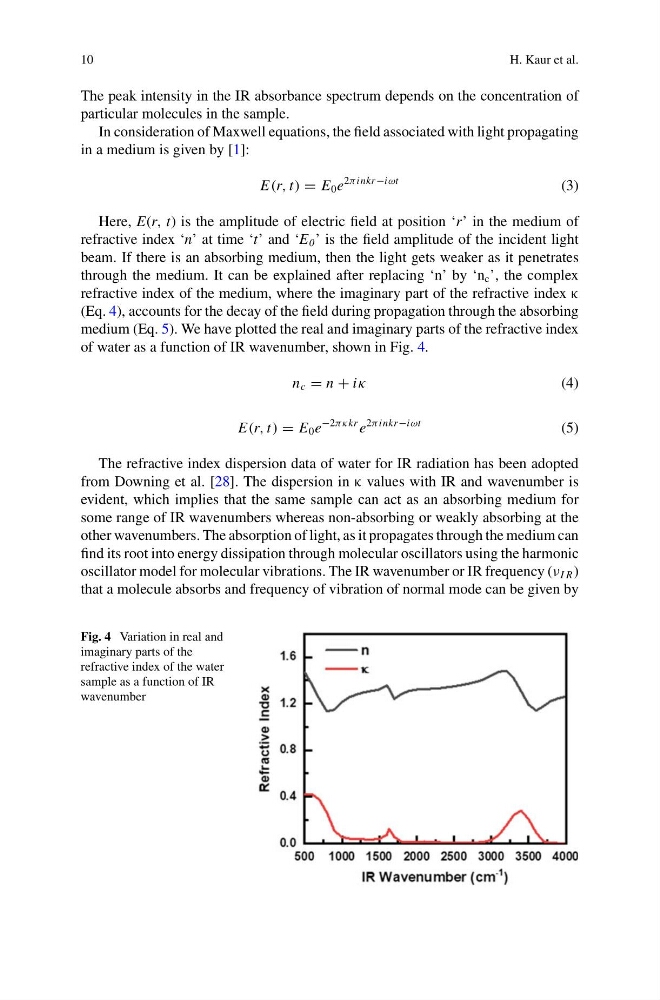
medium (Eq. 5). We have plotted the real and imaginary parts of the refractive index
of water as a function of IR wavenumber, shown in Fig. 4.
n c = n + iκ
(4)
E(r, t) = E 0 e
−2πκkr e
2πinkr−iωt
(5)
The refractive index dispersion data of water for IR radiation has been adopted
from Downing et al. [28]. The dispersion in κ values with IR and wavenumber is
evident, which implies that the same sample can act as an absorbing medium for
some range of IR wavenumbers whereas non-absorbing or weakly absorbing at the
other wavenumbers. The absorption of light, as it propagates through the medium can
find its root into energy dissipation through molecular oscillators using the harmonic
oscillator model for molecular vibrations. The IR wavenumber or IR frequency (ν I R )
that a molecule absorbs and frequency of vibration of normal mode can be given by
Fig. 4 Variation in real and
imaginary parts of the
refractive index of the water
sample as a function of IR
wavenumber
H. Kaur et al.
The peak intensity in the IR absorbance spectrum depends on the concentration of
particular molecules in the sample.
In consideration of Maxwell equations, the field associated with light propagating
in a medium is given by [1]:
E(r, t) = E 0 e
2πinkr−iωt
(3)
Here, E(r, t) is the amplitude of electric field at position ‘r’ in the medium of
refractive index ‘n’ at time ‘t’ and ‘E 0 ’ is the field amplitude of the incident light
beam. If there is an absorbing medium, then the light gets weaker as it penetrates
through the medium. It can be explained after replacing ‘n’ by ‘n c ’, the complex
refractive index of the medium, where the imaginary part of the refractive index κ
(Eq. 4), accounts for the decay of the field during propagation through the absorbing
medium (Eq. 5). We have plotted the real and imaginary parts of the refractive index
of water as a function of IR wavenumber, shown in Fig. 4.
n c = n + iκ
(4)
E(r, t) = E 0 e
−2πκkr e
2πinkr−iωt
(5)
The refractive index dispersion data of water for IR radiation has been adopted
from Downing et al. [28]. The dispersion in κ values with IR and wavenumber is
evident, which implies that the same sample can act as an absorbing medium for
some range of IR wavenumbers whereas non-absorbing or weakly absorbing at the
other wavenumbers. The absorption of light, as it propagates through the medium can
find its root into energy dissipation through molecular oscillators using the harmonic
oscillator model for molecular vibrations. The IR wavenumber or IR frequency (ν I R )
that a molecule absorbs and frequency of vibration of normal mode can be given by
Fig. 4 Variation in real and
imaginary parts of the
refractive index of the water
sample as a function of IR
wavenumber