

266
P. Madhusudhan et al.
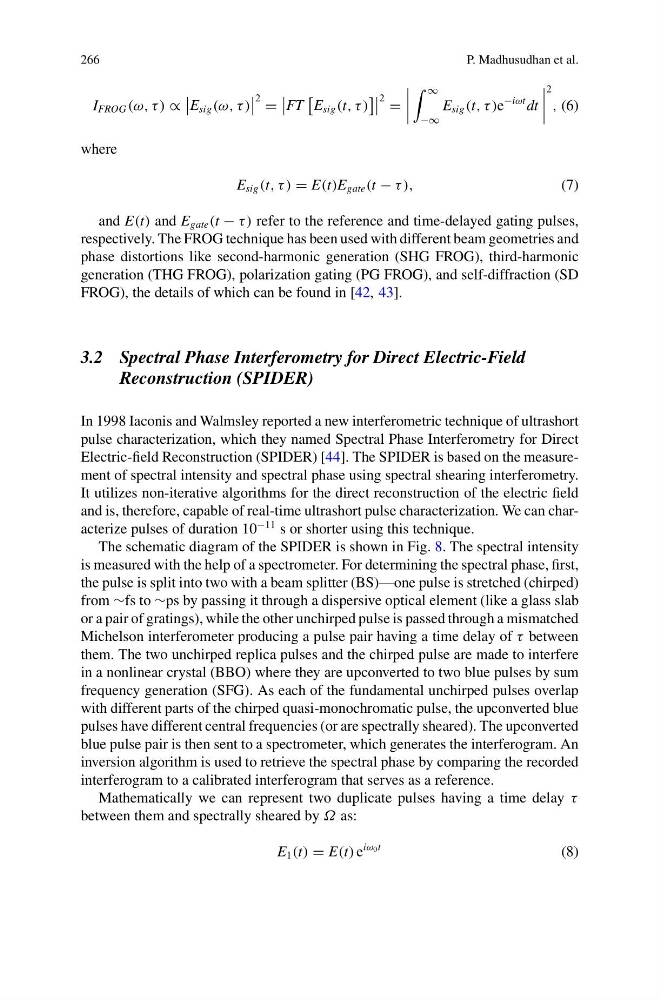
I FROG (ω, τ ) ∝
E sig (ω, τ )
2 =
FT
E sig (t, τ )
2 =
∞
−∞
E sig (t, τ )e
−iωt dt
2
, (6)
where
E sig (t, τ ) = E(t)E gate (t − τ ),
(7)
and E(t) and E gate (t − τ ) refer to the reference and time-delayed gating pulses,
respectively. The FROG technique has been used with different beam geometries and
phase distortions like second-harmonic generation (SHG FROG), third-harmonic
generation (THG FROG), polarization gating (PG FROG), and self-diffraction (SD
FROG), the details of which can be found in [42, 43].
3.2 Spectral Phase Interferometry for Direct Electric-Field
Reconstruction (SPIDER)
In 1998 Iaconis and Walmsley reported a new interferometric technique of ultrashort
pulse characterization, which they named Spectral Phase Interferometry for Direct
Electric-field Reconstruction (SPIDER) [44]. The SPIDER is based on the measurement of spectral intensity and spectral phase using spectral shearing interferometry.
It utilizes non-iterative algorithms for the direct reconstruction of the electric field
and is, therefore, capable of real-time ultrashort pulse characterization. We can characterize pulses of duration 10
−11 s or shorter using this technique.
The schematic diagram of the SPIDER is shown in Fig. 8. The spectral intensity
is measured with the help of a spectrometer. For determining the spectral phase, first,
the pulse is split into two with a beam splitter (BS)—one pulse is stretched (chirped)
from ∼fs to ∼ps by passing it through a dispersive optical element (like a glass slab
or a pair of gratings), while the other unchirped pulse is passed through a mismatched
Michelson interferometer producing a pulse pair having a time delay of τ between
them. The two unchirped replica pulses and the chirped pulse are made to interfere
in a nonlinear crystal (BBO) where they are upconverted to two blue pulses by sum
frequency generation (SFG). As each of the fundamental unchirped pulses overlap
with different parts of the chirped quasi-monochromatic pulse, the upconverted blue
pulses have different central frequencies (or are spectrally sheared). The upconverted
blue pulse pair is then sent to a spectrometer, which generates the interferogram. An
inversion algorithm is used to retrieve the spectral phase by comparing the recorded
interferogram to a calibrated interferogram that serves as a reference.
Mathematically we can represent two duplicate pulses having a time delay τ
between them and spectrally sheared by Ω as:
E 1 (t) = E(t) e
iω 0 t
(8)
P. Madhusudhan et al.
I FROG (ω, τ ) ∝
E sig (ω, τ )
2 =
FT
E sig (t, τ )
2 =
∞
−∞
E sig (t, τ )e
−iωt dt
2
, (6)
where
E sig (t, τ ) = E(t)E gate (t − τ ),
(7)
and E(t) and E gate (t − τ ) refer to the reference and time-delayed gating pulses,
respectively. The FROG technique has been used with different beam geometries and
phase distortions like second-harmonic generation (SHG FROG), third-harmonic
generation (THG FROG), polarization gating (PG FROG), and self-diffraction (SD
FROG), the details of which can be found in [42, 43].
3.2 Spectral Phase Interferometry for Direct Electric-Field
Reconstruction (SPIDER)
In 1998 Iaconis and Walmsley reported a new interferometric technique of ultrashort
pulse characterization, which they named Spectral Phase Interferometry for Direct
Electric-field Reconstruction (SPIDER) [44]. The SPIDER is based on the measurement of spectral intensity and spectral phase using spectral shearing interferometry.
It utilizes non-iterative algorithms for the direct reconstruction of the electric field
and is, therefore, capable of real-time ultrashort pulse characterization. We can characterize pulses of duration 10
−11 s or shorter using this technique.
The schematic diagram of the SPIDER is shown in Fig. 8. The spectral intensity
is measured with the help of a spectrometer. For determining the spectral phase, first,
the pulse is split into two with a beam splitter (BS)—one pulse is stretched (chirped)
from ∼fs to ∼ps by passing it through a dispersive optical element (like a glass slab
or a pair of gratings), while the other unchirped pulse is passed through a mismatched
Michelson interferometer producing a pulse pair having a time delay of τ between
them. The two unchirped replica pulses and the chirped pulse are made to interfere
in a nonlinear crystal (BBO) where they are upconverted to two blue pulses by sum
frequency generation (SFG). As each of the fundamental unchirped pulses overlap
with different parts of the chirped quasi-monochromatic pulse, the upconverted blue
pulses have different central frequencies (or are spectrally sheared). The upconverted
blue pulse pair is then sent to a spectrometer, which generates the interferogram. An
inversion algorithm is used to retrieve the spectral phase by comparing the recorded
interferogram to a calibrated interferogram that serves as a reference.
Mathematically we can represent two duplicate pulses having a time delay τ
between them and spectrally sheared by Ω as:
E 1 (t) = E(t) e
iω 0 t
(8)