

Modern Experimental Techniques in Ultrafast Atomic …
265
The major disadvantage of all the above techniques is that the temporal or spectral
phase of the ultrashort pulse cannot be measured, without which complete information of a pulse is not available. For the complete ultrashort pulse characterization,
the following techniques were eventually developed.
3.1 Frequency Resolved Optical Gating (FROG)
FROG was the first technique to measure the spectral phase of ultrashort pulses completely and was developed by Kane and Trebino in 1993 [41]. Using this technique,
we can determine the intensity I (t) and phase φ(t) of a pulse in real-time. The FROG
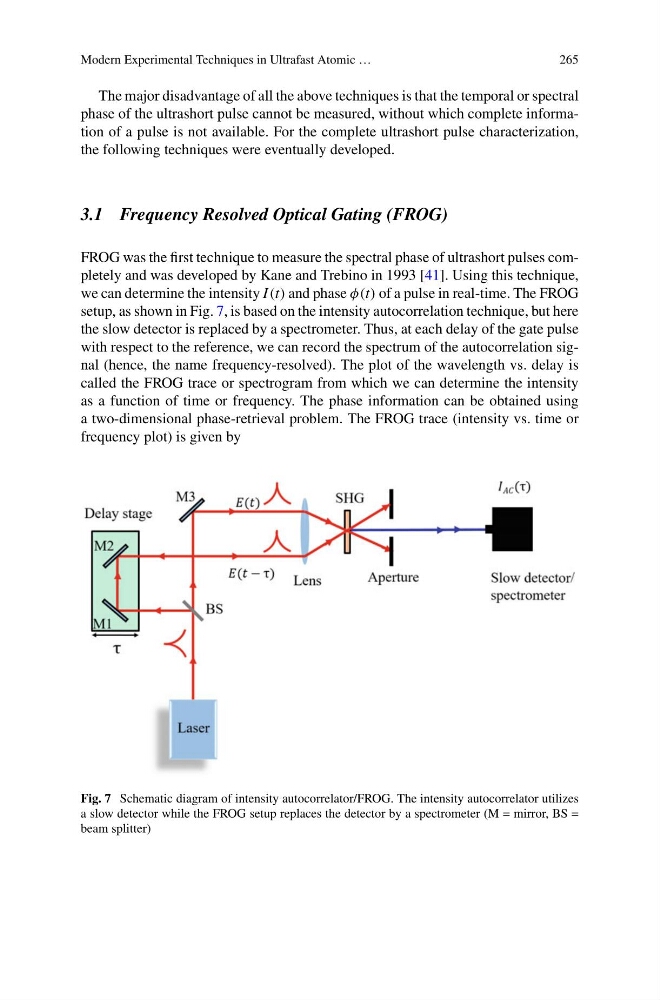
setup, as shown in Fig. 7, is based on the intensity autocorrelation technique, but here
the slow detector is replaced by a spectrometer. Thus, at each delay of the gate pulse
with respect to the reference, we can record the spectrum of the autocorrelation signal (hence, the name frequency-resolved). The plot of the wavelength vs. delay is
called the FROG trace or spectrogram from which we can determine the intensity
as a function of time or frequency. The phase information can be obtained using
a two-dimensional phase-retrieval problem. The FROG trace (intensity vs. time or
frequency plot) is given by
Fig. 7 Schematic diagram of intensity autocorrelator/FROG. The intensity autocorrelator utilizes
a slow detector while the FROG setup replaces the detector by a spectrometer (M = mirror, BS =
beam splitter)
265
The major disadvantage of all the above techniques is that the temporal or spectral
phase of the ultrashort pulse cannot be measured, without which complete information of a pulse is not available. For the complete ultrashort pulse characterization,
the following techniques were eventually developed.
3.1 Frequency Resolved Optical Gating (FROG)
FROG was the first technique to measure the spectral phase of ultrashort pulses completely and was developed by Kane and Trebino in 1993 [41]. Using this technique,
we can determine the intensity I (t) and phase φ(t) of a pulse in real-time. The FROG
setup, as shown in Fig. 7, is based on the intensity autocorrelation technique, but here
the slow detector is replaced by a spectrometer. Thus, at each delay of the gate pulse
with respect to the reference, we can record the spectrum of the autocorrelation signal (hence, the name frequency-resolved). The plot of the wavelength vs. delay is
called the FROG trace or spectrogram from which we can determine the intensity
as a function of time or frequency. The phase information can be obtained using
a two-dimensional phase-retrieval problem. The FROG trace (intensity vs. time or
frequency plot) is given by
Fig. 7 Schematic diagram of intensity autocorrelator/FROG. The intensity autocorrelator utilizes
a slow detector while the FROG setup replaces the detector by a spectrometer (M = mirror, BS =
beam splitter)