

262
P. Madhusudhan et al.
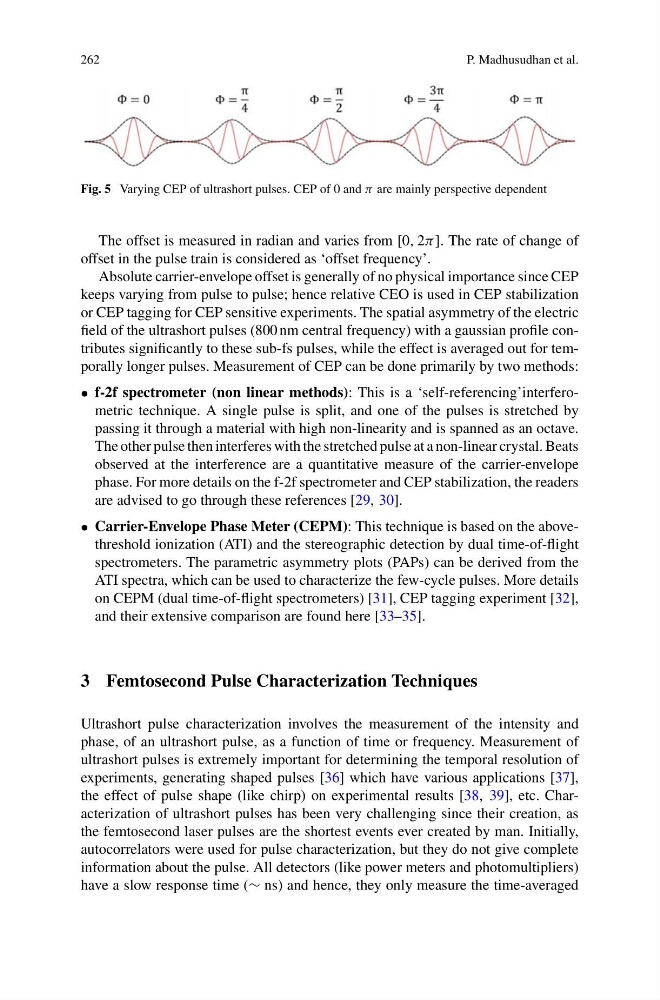
Fig. 5 Varying CEP of ultrashort pulses. CEP of 0 and π are mainly perspective dependent
The offset is measured in radian and varies from [0, 2π ]. The rate of change of
offset in the pulse train is considered as ‘offset frequency’.
Absolute carrier-envelope offset is generally of no physical importance since CEP
keeps varying from pulse to pulse; hence relative CEO is used in CEP stabilization
or CEP tagging for CEP sensitive experiments. The spatial asymmetry of the electric
field of the ultrashort pulses (800 nm central frequency) with a gaussian profile contributes significantly to these sub-fs pulses, while the effect is averaged out for temporally longer pulses. Measurement of CEP can be done primarily by two methods:
• f-2f spectrometer (non linear methods): This is a ‘self-referencing’interferometric technique. A single pulse is split, and one of the pulses is stretched by
passing it through a material with high non-linearity and is spanned as an octave.
The other pulse then interferes with the stretched pulse at a non-linear crystal. Beats
observed at the interference are a quantitative measure of the carrier-envelope
phase. For more details on the f-2f spectrometer and CEP stabilization, the readers
are advised to go through these references [29, 30].
• Carrier-Envelope Phase Meter (CEPM): This technique is based on the abovethreshold ionization (ATI) and the stereographic detection by dual time-of-flight
spectrometers. The parametric asymmetry plots (PAPs) can be derived from the
ATI spectra, which can be used to characterize the few-cycle pulses. More details
on CEPM (dual time-of-flight spectrometers) [31], CEP tagging experiment [32],
and their extensive comparison are found here [33–35].
3 Femtosecond Pulse Characterization Techniques
Ultrashort pulse characterization involves the measurement of the intensity and
phase, of an ultrashort pulse, as a function of time or frequency. Measurement of
ultrashort pulses is extremely important for determining the temporal resolution of
experiments, generating shaped pulses [36] which have various applications [37],
the effect of pulse shape (like chirp) on experimental results [38, 39], etc. Characterization of ultrashort pulses has been very challenging since their creation, as
the femtosecond laser pulses are the shortest events ever created by man. Initially,
autocorrelators were used for pulse characterization, but they do not give complete
information about the pulse. All detectors (like power meters and photomultipliers)
have a slow response time (∼ ns) and hence, they only measure the time-averaged
P. Madhusudhan et al.
Fig. 5 Varying CEP of ultrashort pulses. CEP of 0 and π are mainly perspective dependent
The offset is measured in radian and varies from [0, 2π ]. The rate of change of
offset in the pulse train is considered as ‘offset frequency’.
Absolute carrier-envelope offset is generally of no physical importance since CEP
keeps varying from pulse to pulse; hence relative CEO is used in CEP stabilization
or CEP tagging for CEP sensitive experiments. The spatial asymmetry of the electric
field of the ultrashort pulses (800 nm central frequency) with a gaussian profile contributes significantly to these sub-fs pulses, while the effect is averaged out for temporally longer pulses. Measurement of CEP can be done primarily by two methods:
• f-2f spectrometer (non linear methods): This is a ‘self-referencing’interferometric technique. A single pulse is split, and one of the pulses is stretched by
passing it through a material with high non-linearity and is spanned as an octave.
The other pulse then interferes with the stretched pulse at a non-linear crystal. Beats
observed at the interference are a quantitative measure of the carrier-envelope
phase. For more details on the f-2f spectrometer and CEP stabilization, the readers
are advised to go through these references [29, 30].
• Carrier-Envelope Phase Meter (CEPM): This technique is based on the abovethreshold ionization (ATI) and the stereographic detection by dual time-of-flight
spectrometers. The parametric asymmetry plots (PAPs) can be derived from the
ATI spectra, which can be used to characterize the few-cycle pulses. More details
on CEPM (dual time-of-flight spectrometers) [31], CEP tagging experiment [32],
and their extensive comparison are found here [33–35].
3 Femtosecond Pulse Characterization Techniques
Ultrashort pulse characterization involves the measurement of the intensity and
phase, of an ultrashort pulse, as a function of time or frequency. Measurement of
ultrashort pulses is extremely important for determining the temporal resolution of
experiments, generating shaped pulses [36] which have various applications [37],
the effect of pulse shape (like chirp) on experimental results [38, 39], etc. Characterization of ultrashort pulses has been very challenging since their creation, as
the femtosecond laser pulses are the shortest events ever created by man. Initially,
autocorrelators were used for pulse characterization, but they do not give complete
information about the pulse. All detectors (like power meters and photomultipliers)
have a slow response time (∼ ns) and hence, they only measure the time-averaged