

260
P. Madhusudhan et al.
amplified which leads to a train of pulses, resulting in the mode-locking of the oscillator. A successful passive mode-locking technique is the Kerr-lens mode-locking
(KLM) which exploits the Kerr lensing effect in the gain medium. The combination
of the Kerr lensing and a slit can be considered as a virtual saturable absorber. In
KLM, the intense modes experience higher gain which favors mode-locking. For
more details on active and passive mode-locking techniques, the readers are advised
to go through these references [26–28].
2.2 Femtosecond Laser Amplifier
A mode-locked femtosecond oscillator emits pulses having energy ∼nanojoules and
repetition rate ∼80 MHz. For many atomic and molecular physics experiments and
applications of femtosecond pulses to other branches of science, high power laser
pulses are essential. Direct amplification of the oscillator pulses may damage the
Ti:sapphire crystal. To tackle this problem, the idea of pulse stretching was introduced which was innovative and successful. However, pulse stretching followed by
amplification by a single pass of the pulse through the amplifier unit may not give
several watts of output power. In order to achieve high power femtosecond laser output, two design schemes of amplifier have been developed viz a multipass amplifier
and a regenerative amplifier.
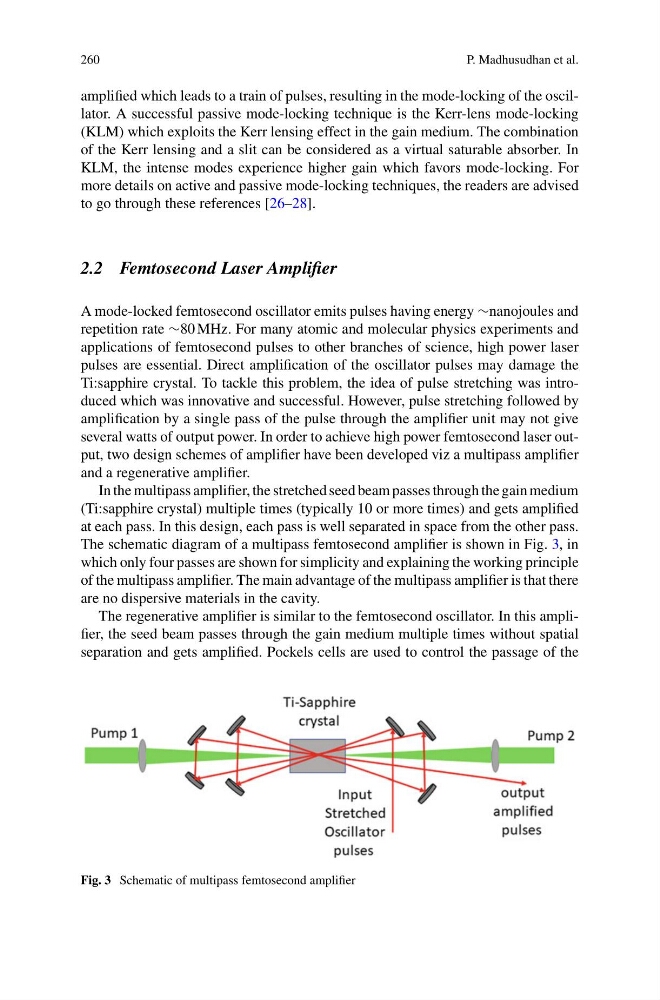
In the multipass amplifier, the stretched seed beam passes through the gain medium
(Ti:sapphire crystal) multiple times (typically 10 or more times) and gets amplified
at each pass. In this design, each pass is well separated in space from the other pass.
The schematic diagram of a multipass femtosecond amplifier is shown in Fig. 3, in
which only four passes are shown for simplicity and explaining the working principle
of the multipass amplifier. The main advantage of the multipass amplifier is that there
are no dispersive materials in the cavity.
The regenerative amplifier is similar to the femtosecond oscillator. In this amplifier, the seed beam passes through the gain medium multiple times without spatial
separation and gets amplified. Pockels cells are used to control the passage of the
Fig. 3 Schematic of multipass femtosecond amplifier
P. Madhusudhan et al.
amplified which leads to a train of pulses, resulting in the mode-locking of the oscillator. A successful passive mode-locking technique is the Kerr-lens mode-locking
(KLM) which exploits the Kerr lensing effect in the gain medium. The combination
of the Kerr lensing and a slit can be considered as a virtual saturable absorber. In
KLM, the intense modes experience higher gain which favors mode-locking. For
more details on active and passive mode-locking techniques, the readers are advised
to go through these references [26–28].
2.2 Femtosecond Laser Amplifier
A mode-locked femtosecond oscillator emits pulses having energy ∼nanojoules and
repetition rate ∼80 MHz. For many atomic and molecular physics experiments and
applications of femtosecond pulses to other branches of science, high power laser
pulses are essential. Direct amplification of the oscillator pulses may damage the
Ti:sapphire crystal. To tackle this problem, the idea of pulse stretching was introduced which was innovative and successful. However, pulse stretching followed by
amplification by a single pass of the pulse through the amplifier unit may not give
several watts of output power. In order to achieve high power femtosecond laser output, two design schemes of amplifier have been developed viz a multipass amplifier
and a regenerative amplifier.
In the multipass amplifier, the stretched seed beam passes through the gain medium
(Ti:sapphire crystal) multiple times (typically 10 or more times) and gets amplified
at each pass. In this design, each pass is well separated in space from the other pass.
The schematic diagram of a multipass femtosecond amplifier is shown in Fig. 3, in
which only four passes are shown for simplicity and explaining the working principle
of the multipass amplifier. The main advantage of the multipass amplifier is that there
are no dispersive materials in the cavity.
The regenerative amplifier is similar to the femtosecond oscillator. In this amplifier, the seed beam passes through the gain medium multiple times without spatial
separation and gets amplified. Pockels cells are used to control the passage of the
Fig. 3 Schematic of multipass femtosecond amplifier