

Modern Experimental Techniques in Ultrafast Atomic …
259
2.1 Femtosecond Oscillator
The femtosecond oscillator produces seed pulses for the chirped pulse amplifier
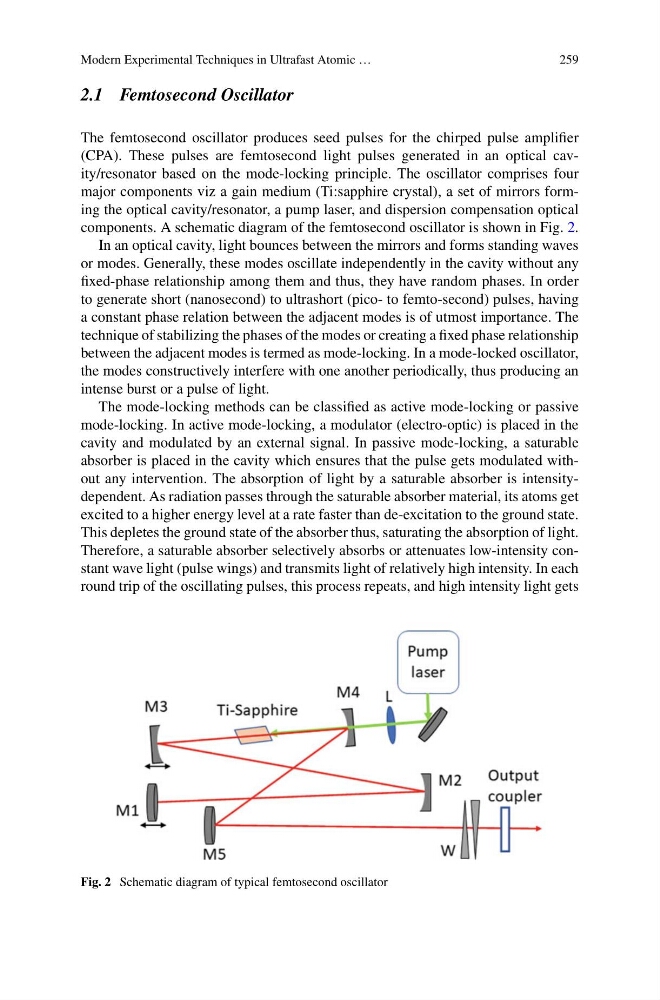
(CPA). These pulses are femtosecond light pulses generated in an optical cavity/resonator based on the mode-locking principle. The oscillator comprises four
major components viz a gain medium (Ti:sapphire crystal), a set of mirrors forming the optical cavity/resonator, a pump laser, and dispersion compensation optical
components. A schematic diagram of the femtosecond oscillator is shown in Fig. 2.
In an optical cavity, light bounces between the mirrors and forms standing waves
or modes. Generally, these modes oscillate independently in the cavity without any
fixed-phase relationship among them and thus, they have random phases. In order
to generate short (nanosecond) to ultrashort (pico- to femto-second) pulses, having
a constant phase relation between the adjacent modes is of utmost importance. The
technique of stabilizing the phases of the modes or creating a fixed phase relationship
between the adjacent modes is termed as mode-locking. In a mode-locked oscillator,
the modes constructively interfere with one another periodically, thus producing an
intense burst or a pulse of light.
The mode-locking methods can be classified as active mode-locking or passive
mode-locking. In active mode-locking, a modulator (electro-optic) is placed in the
cavity and modulated by an external signal. In passive mode-locking, a saturable
absorber is placed in the cavity which ensures that the pulse gets modulated without any intervention. The absorption of light by a saturable absorber is intensitydependent. As radiation passes through the saturable absorber material, its atoms get
excited to a higher energy level at a rate faster than de-excitation to the ground state.
This depletes the ground state of the absorber thus, saturating the absorption of light.
Therefore, a saturable absorber selectively absorbs or attenuates low-intensity constant wave light (pulse wings) and transmits light of relatively high intensity. In each
round trip of the oscillating pulses, this process repeats, and high intensity light gets
Fig. 2 Schematic diagram of typical femtosecond oscillator
259
2.1 Femtosecond Oscillator
The femtosecond oscillator produces seed pulses for the chirped pulse amplifier
(CPA). These pulses are femtosecond light pulses generated in an optical cavity/resonator based on the mode-locking principle. The oscillator comprises four
major components viz a gain medium (Ti:sapphire crystal), a set of mirrors forming the optical cavity/resonator, a pump laser, and dispersion compensation optical
components. A schematic diagram of the femtosecond oscillator is shown in Fig. 2.
In an optical cavity, light bounces between the mirrors and forms standing waves
or modes. Generally, these modes oscillate independently in the cavity without any
fixed-phase relationship among them and thus, they have random phases. In order
to generate short (nanosecond) to ultrashort (pico- to femto-second) pulses, having
a constant phase relation between the adjacent modes is of utmost importance. The
technique of stabilizing the phases of the modes or creating a fixed phase relationship
between the adjacent modes is termed as mode-locking. In a mode-locked oscillator,
the modes constructively interfere with one another periodically, thus producing an
intense burst or a pulse of light.
The mode-locking methods can be classified as active mode-locking or passive
mode-locking. In active mode-locking, a modulator (electro-optic) is placed in the
cavity and modulated by an external signal. In passive mode-locking, a saturable
absorber is placed in the cavity which ensures that the pulse gets modulated without any intervention. The absorption of light by a saturable absorber is intensitydependent. As radiation passes through the saturable absorber material, its atoms get
excited to a higher energy level at a rate faster than de-excitation to the ground state.
This depletes the ground state of the absorber thus, saturating the absorption of light.
Therefore, a saturable absorber selectively absorbs or attenuates low-intensity constant wave light (pulse wings) and transmits light of relatively high intensity. In each
round trip of the oscillating pulses, this process repeats, and high intensity light gets
Fig. 2 Schematic diagram of typical femtosecond oscillator