

258
P. Madhusudhan et al.
matter interaction, in which intense femtosecond-attosecond light pulses interact with
atoms and molecules. During the interaction numerous phenomena like multi-photon
ionization (MPI) or above-threshold ionization (ATI) [7–11], tunnel ionization (TI)
[12–14], high harmonic generation (HHG) [15–17], laser-induced electron diffractions (LIED) [18, 19], frustrated double ionization of atoms and molecules in strong
laser fields [20, 21], and many more take place. The field of attosecond science is
evolving rapidly. Nowadays, many research groups worldwide possess ultrafast lasers
and high harmonic generation setup, which they utilize in the generation of attosecond pulses trains [22, 23] or even isolated attosecond pulses [24]. The femtosecond
and attosecond light pulses have given the opportunity to understand the fundamental mechanism of any photo-induced molecular reaction. In experimental ultrafast
atomic and molecular physics, the knowledge of ultrafast laser, femtosecond light
pulse characterization techniques, electron/ion coincidence technique, time of flight
mass spectrometer, recoil ion momentum spectrometer/COLTRIMS/reaction microscope and Velocity Map Imaging (VMI) spectrometer is essential. In this chapter,
these experimental techniques are discussed which will be indispensable for graduate
students.
2 Femtosecond Laser
The 2018 Nobel Prize in Physics was awarded to Gérard Mourou and Donna Strickland for introducing the chirped pulse amplification technique [25] which has created
the shortest and most intense laser pulses known to mankind. A femtosecond laser
is essentially based on chirped pulse amplification which consists of mode-locked
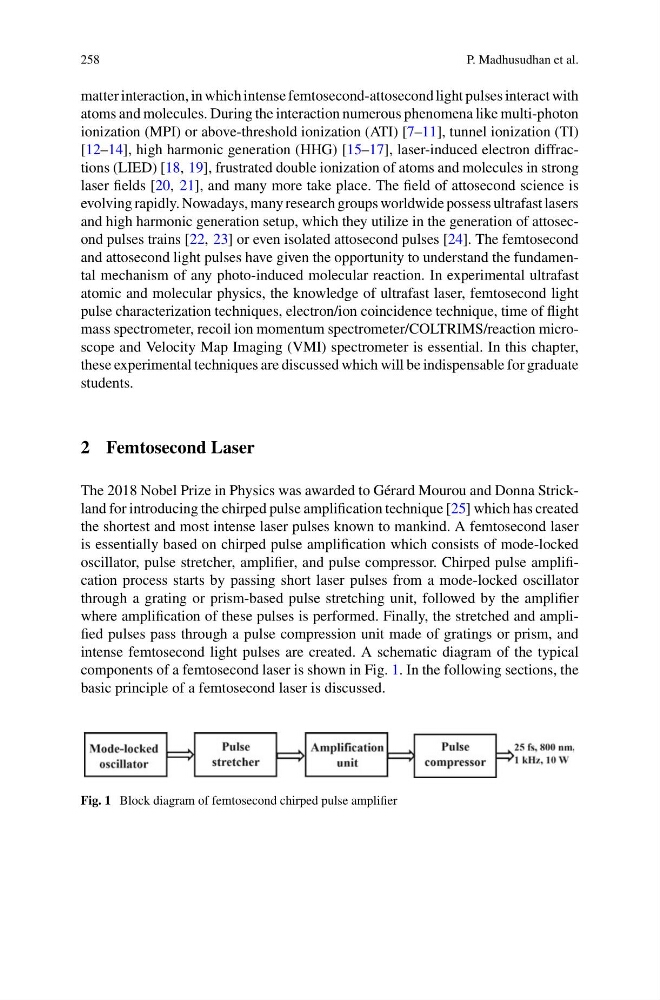
oscillator, pulse stretcher, amplifier, and pulse compressor. Chirped pulse amplification process starts by passing short laser pulses from a mode-locked oscillator
through a grating or prism-based pulse stretching unit, followed by the amplifier
where amplification of these pulses is performed. Finally, the stretched and amplified pulses pass through a pulse compression unit made of gratings or prism, and
intense femtosecond light pulses are created. A schematic diagram of the typical
components of a femtosecond laser is shown in Fig. 1. In the following sections, the
basic principle of a femtosecond laser is discussed.
Fig. 1 Block diagram of femtosecond chirped pulse amplifier
P. Madhusudhan et al.
matter interaction, in which intense femtosecond-attosecond light pulses interact with
atoms and molecules. During the interaction numerous phenomena like multi-photon
ionization (MPI) or above-threshold ionization (ATI) [7–11], tunnel ionization (TI)
[12–14], high harmonic generation (HHG) [15–17], laser-induced electron diffractions (LIED) [18, 19], frustrated double ionization of atoms and molecules in strong
laser fields [20, 21], and many more take place. The field of attosecond science is
evolving rapidly. Nowadays, many research groups worldwide possess ultrafast lasers
and high harmonic generation setup, which they utilize in the generation of attosecond pulses trains [22, 23] or even isolated attosecond pulses [24]. The femtosecond
and attosecond light pulses have given the opportunity to understand the fundamental mechanism of any photo-induced molecular reaction. In experimental ultrafast
atomic and molecular physics, the knowledge of ultrafast laser, femtosecond light
pulse characterization techniques, electron/ion coincidence technique, time of flight
mass spectrometer, recoil ion momentum spectrometer/COLTRIMS/reaction microscope and Velocity Map Imaging (VMI) spectrometer is essential. In this chapter,
these experimental techniques are discussed which will be indispensable for graduate
students.
2 Femtosecond Laser
The 2018 Nobel Prize in Physics was awarded to Gérard Mourou and Donna Strickland for introducing the chirped pulse amplification technique [25] which has created
the shortest and most intense laser pulses known to mankind. A femtosecond laser
is essentially based on chirped pulse amplification which consists of mode-locked
oscillator, pulse stretcher, amplifier, and pulse compressor. Chirped pulse amplification process starts by passing short laser pulses from a mode-locked oscillator
through a grating or prism-based pulse stretching unit, followed by the amplifier
where amplification of these pulses is performed. Finally, the stretched and amplified pulses pass through a pulse compression unit made of gratings or prism, and
intense femtosecond light pulses are created. A schematic diagram of the typical
components of a femtosecond laser is shown in Fig. 1. In the following sections, the
basic principle of a femtosecond laser is discussed.
Fig. 1 Block diagram of femtosecond chirped pulse amplifier